
A private communal gallery: The Bowdoin College Museum of Art Wall of Things
March 27, 2026
 Abigail Hebert
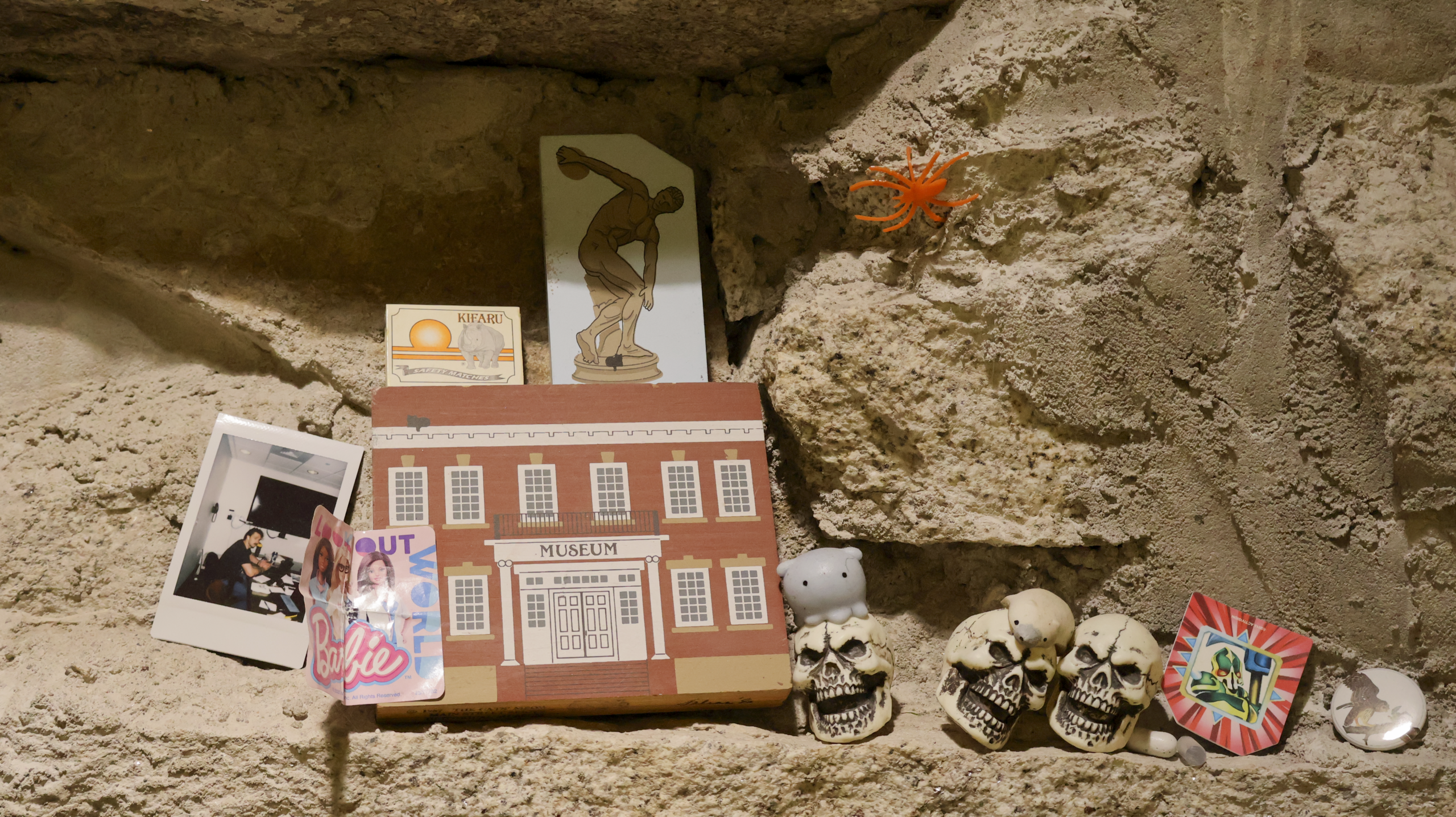
Hidden away in a staff corridor at the Bowdoin College Museum of Art (BCMA), there is a Wall of Things. Crevices of the original outer stone wall of the Museum have become resting spots for everything from Elvis Presley pictures to paper airplanes to a stray OneCard, added by staff and student interns over the years. Staff also pointed out boxwood figurines, a 3D-printed replica of the Assyrian relief on the second floor of the museum, an annotated picture of the Go-Go’s and finally, a framed picture of Dan Dowd, the museum’s cultural properties security officer, that a student brought for a Yankee swap.
Dowd, who has worked at the museum for 18 years, talked about the wall’s inception around 2007.
“I think things started to accumulate relatively early. Things started to show up in this little alcove. I feel like that [garden] gnome has been here a really long time.… There’s a few pictures of interns that have been here, and there’s a lot of things staff have just put on the wall.… Then, of course, there’s little things that are related to the museum,” Dowd said.
The wall is a result of many people’s efforts, but as shared as it is, it is also private, both between staff members and to the public. In fact, many staff members keep their contributions secret.
“I had a cold, so I was using cough drops, and I was twisting them and sticking them in the wall. I noticed that they were being pulled out, so I think it’s collaborative, but not consciously…. I think it’s because people pretty much pass here by themselves…, so as much as it’s public, it’s very private,” Dowd said. “Most people that come into the museum don’t get to see this, so it’s like this weird little private exhibition. I would say it’s really personal to the people that work or intern here.”
Alongside its lighthearted nature, the wall has a sense of poetic beauty. Now a shelf for various eccentricities, the wall is the original foundation of the museum building, which was built in 1894. Following several renovations, including one in 2007—after which the tradition started—a new history started to be written.
“A funny dynamic of shared office spaces is the accumulation of stuff and how it represents that era, whoever was working there. But then it kind of loses its context, and you’re like, ‘Why did this pewter spoon end up [here]?’” Amanda Skinner, director of communications at the BCMA, said.
Andrew Tran ’26, who was an education and shop assistant at the BCMA in 2023, contributed a Polaroid photo of the student interns from that year to the wall.
“That summer, there was a big exhibition on photography, and … kids could take Polaroids and things like that. I think that was a very big piece of the summer, especially among the interns,” Tran said.
The wall represents a sense of community among BCMA staff, something that Tran noted when he interviewed staff members as part of his podcast project, Walker Wisdom.
“There are just so many objects on [the wall] that don’t all relate to one another. They seem like they’re from another place in the world, a different time,” Tran said. “I think the museum itself is a very professional space, but [at the same time] it is a very tight, close-knit community. Everyone knows each other…, and they have so many different interests and hobbies. Like, the [Assistant Director of Cultural Property], Steve [Perkins], takes care of the orchids in the lobby. There are certain quirky things like that.”
As playful as it is, the wall is a special tradition.
“Specifically for the Bowdoin museum, because it’s a small institution, the impacts that individual people have in the museum are much more apparent. Their influence on certain legacies or traditions may still be there for longer than larger places,” Tran said. “It’s a place of camaraderie that you are contributing to. There is this mindfulness that you’re contributing directly to the museum’s foundation literally and metaphorically.”
Comments
Before submitting a comment, please review our comment policy. Some key points from the policy: