
Plutarch’s not so simple lives
March 27, 2026
 Mia Lasic-Ellis
This one’s a little on the nose for me, friends. Just this month, I was at my first Classics conference, presenting on a panel (I’m sure you could never guess) on the topic of my column this week, Plutarch. I was in Mobile, Ala., at the excitingly named 122nd Classical Association of the Middle West and South (Middle West, notably, not Midwest, as a Colonel Sanders lookalike and Classics professor corrected me in near incoherent drawl). It was me, one of my best friends who happened to also be presenting on Plutarch and three graduate students.
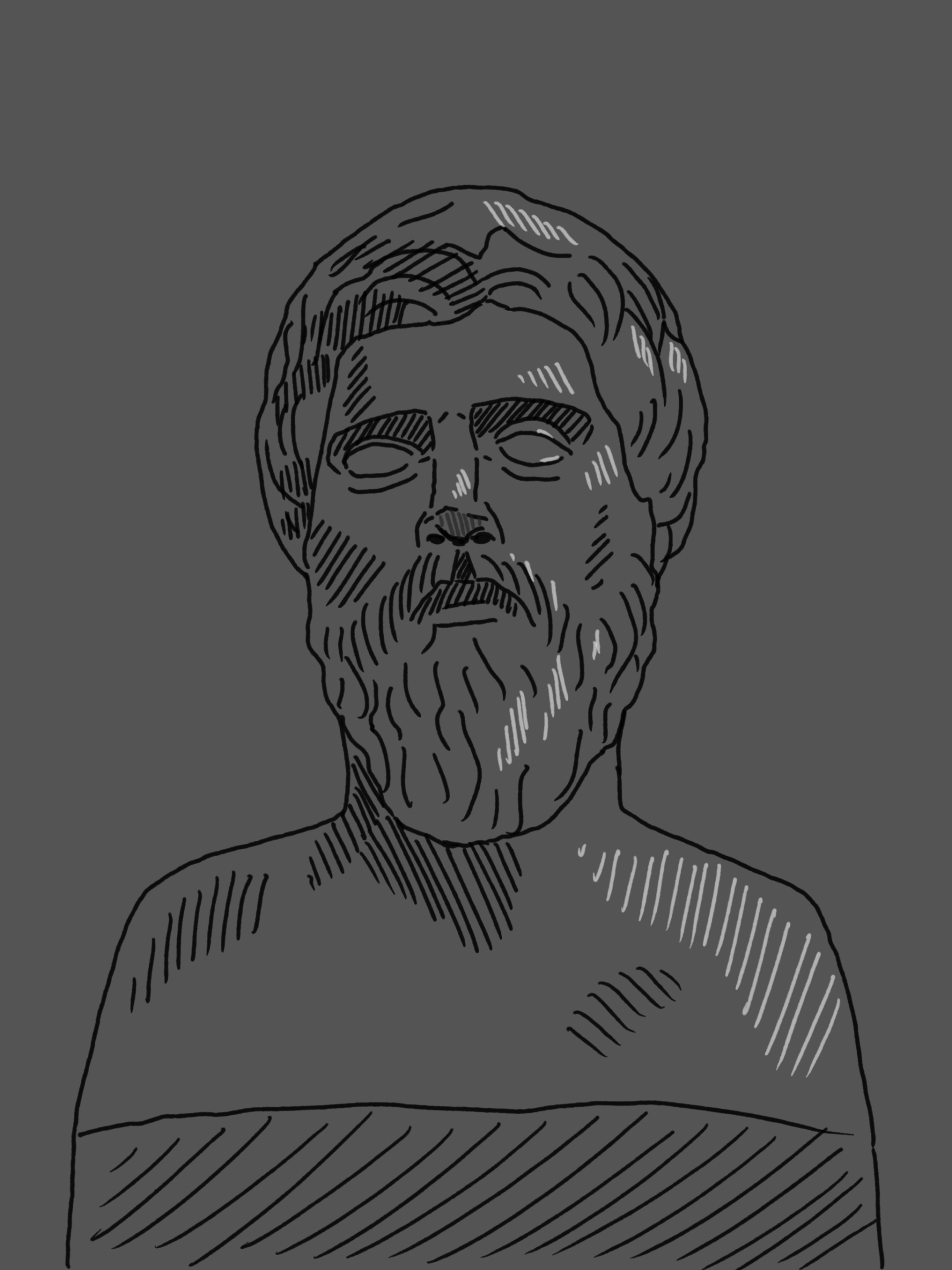
Plutarch is likely the least popular name I will present to you in this column. Philosopher, historian, historiographer, he occupies an odd role both in his own time and in modernity. Though he popularized the biography format, inspiring Shakespeare’s Roman plays along with a whole slew of others like Michel de Montaigne, Benjamin Franklin, Alexander Hamilton and Ralph Waldo Emerson, his popularity has greatly tapered off since his heyday. His corpus is vast, but while there is a case for reading his works of philosophy, it is his biographies, his imperfect, even at times knowingly incorrect, biographies that I find myself deeply drawn to time and time again.
His “Parallel Lives” pairs a Greek and Roman figure together, writing a complete account of their lives while including rumors, inconsistencies and downright lies when he thinks it helps his audience comprehend the character of his subjects. In his own words, he writes “lives, not histories.”
No figure is off limits for him, and this is what makes his lives so rich. You will recognize some of his subjects: Alexander the Great, Julius Caesar, Brutus, Cicero and Theseus. Many, though, are new. The mythical Spartan lawgiver Lycurgus, with his sharp one-liners like “men who speak few words need few laws,” the raunchy and horny Alcibiades who bangs his way to near regional domination and my personal favorite, Cato the Younger, a man in a dying Republic who just seeks justice and the good in a Rome that no longer recognizes either.
None of his figures are perfect, even when he deals with their mythical accomplishments. They all, in some way, falter. The brave can be cowardly, the cowardly brave, the wise stupid and the stupid wise. Plutarch is clear: Your character is not constant. You can become more, be more, when it is demanded of you. This transient nature of who we are in Plutarch’s conception is comforting to me and is why I am pleading to you to give him a shot, because he reminds me that we are known and understood for our choices, and we can always choose a better path if we want it. He doesn’t offer us salvation or redemption, but he does offer us, eponymously, lives. Lives to learn from, lives to beware of and even lives to emulate when we need strength.
As I struggle to find meaning in a world I truly don’t know how I’ll get through, encountering my own loss and death and hardship, I think about the figures Plutarch has revealed to me. I’ll share one in general that my mind wanders to and hope it’s compelling enough.
Phocion, an Athenian general and statesman, spent his life out of step with the city he served. He refused to flatter the people, spoke plainly in the assembly and held to a kind of severity that made him useful in crisis and resented in calmer times. Plutarch presents him as a man whose judgment was steady but whose manner made that steadiness hard to bear.
In the upheaval after Alexander the Great’s death, that distance proved fatal. Phocion was accused of betrayal, brought before the assembly and condemned. The vote came quickly. He was led away to drink the hemlock alongside his friends. Even then, Plutarch lingers on small details. Phocion rebukes one companion for disorderly behavior. Another asks whether he has any message for his son. Phocion answers only that he should bear no resentment toward the Athenians.
It is not a grand ending. There is no reversal, no recognition scene, no late vindication. The city does not understand him, and he does not attempt to correct it. What remains is the decision itself, made at the very end, to meet what comes without anger. Not because it redeems anything, it does not, but because it preserves something of who he has been.
While the opposite is true for some lives, some ending with bitter, horrible endings for men who have fallen quite far, Plutarch never lets us forget that the same capacity that allows someone to meet a moment well can also undo them. The line between principle and pride, between firmness and blindness, is thin. His figures are not instructions so much as tests. They show us that we are always in the process of becoming something, and that what we become depends on what we choose to do when it matters.
Comments
Before submitting a comment, please review our comment policy. Some key points from the policy:
- No hate speech, profanity, disrespectful or threatening comments.
- No personal attacks on reporters.
- Comments must be under 200 words.
- You are strongly encouraged to use a real name or identifier ("Class of '92").
- Any comments made with an email address that does not belong to you will get removed.
I took Professor Nerdahl’s seminar on Plutarch’s “Lives” in 2023 and it was one of the best courses that I took at Bowdoin. I garnered such a profound appreciation for his works through that class (which was masterfully taught!) and am glad to see fellow polar bears continuing to appreciate his impact!