
Dr. Lori Lefkovitz presents on intersection between Jewish studies, gender studies and global studies
March 27, 2026
 Addison Moore
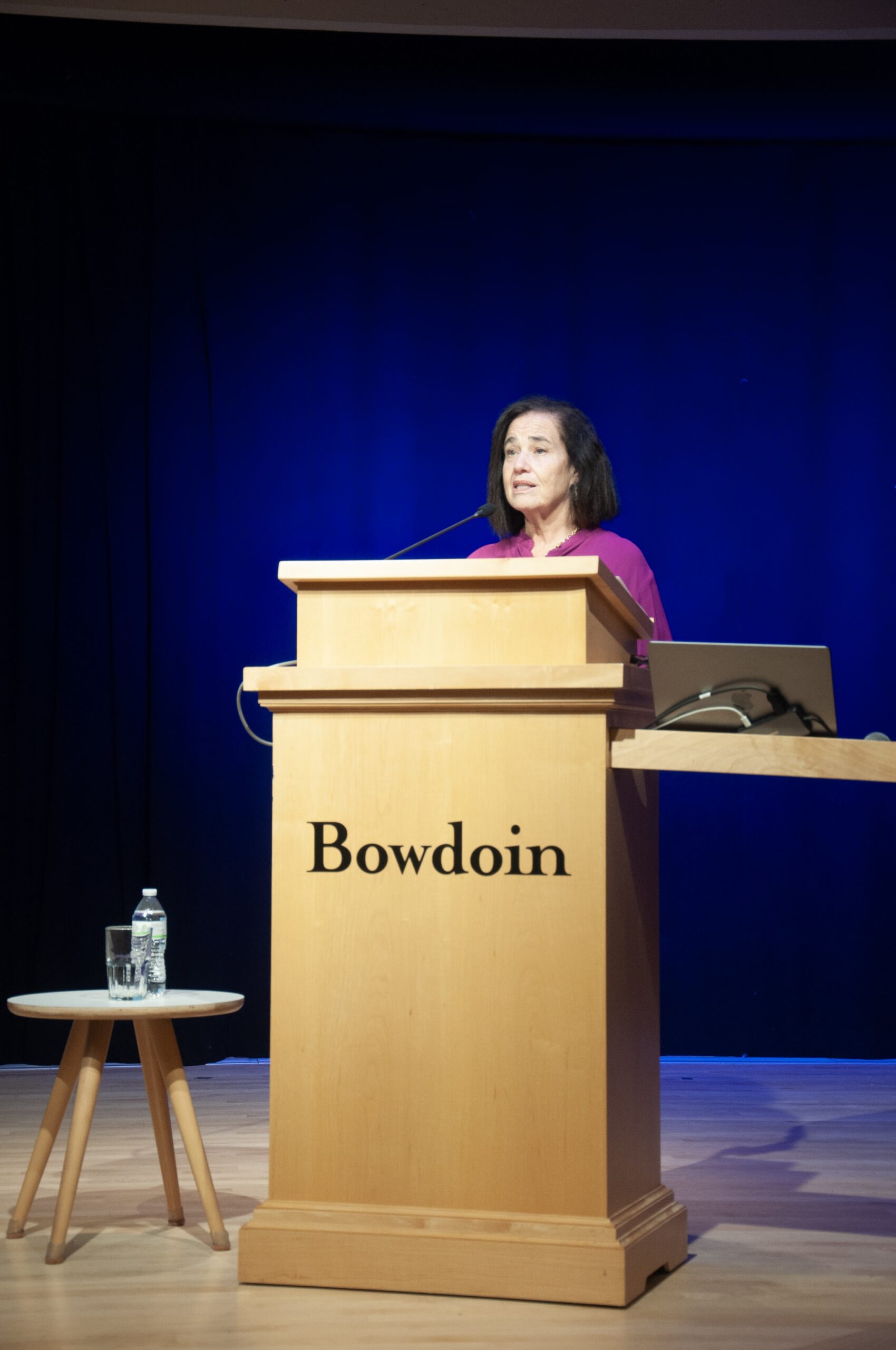
On Wednesday night, students, faculty and community members gathered in Kresge Auditorium to hear Dr. Lori Lefkovitz speak. Lefkovitz, the director of the Jewish studies program at Northeastern University and a professor of English and Jewish studies, delivered a Viewpoint Exchange talk titled “Jewish Studies, Gender Studies, Global Studies: Intersections on the Frontiers.”
After an introduction by Senior Vice President for Inclusion and Diversity Benje Douglas, Lefkovitz began her talk with a brief overview of the field of Jewish studies.
“Jewish studies has changed from the early decades, when we eagerly brought the Jewish textual tradition into the secular academy,” Lefkovitz said. “We have moved into provocative new research, into diaspora studies, the full range of Jewish languages and have dramatically globalized Jewish studies beyond Latin America to Morocco and North Africa, China, the Caribbean and every corner of the planet where Jews have contributed to and been influenced by cultural productions, researching everything from Jewish pirates to Jewish slaves and slave holders.”
Lefkovitz acknowledged the unique position of Jewish studies among other similar disciplines.
“The weaponization of antisemitism has made Jewish studies seemingly less vulnerable. Since strengthening Jewish studies has been one of the demands this administration has made in its negotiations with leading academic institutions, it may seem as if Jewish studies has, for the moment, been exempted from efforts to roll back [Diversity, Equity and Inclusion] (DEI) initiatives,” Lefkovitz said. “This exceptionalism is unwelcome to me and many of my colleagues, some of whom have said so publicly and eloquently in the Chronicle of Higher Education and express resentment at being used to divide us in this way.”
Lefkovitz expressed pride in the progress made towards gender equality in Jewish spaces.
“When I was a kid, I remember that we hoped that someday we would see women in leadership roles in the synagogue,” Lefkovitz said. “We had the modest hope that girls in Jewish spaces would be equal, and I could easily imagine the fullness of egalitarianism in the liberal Jewish denominations, but I could not have imagined how much Jewish women’s scholarship and activism mutually informing one another would transform the practices of living Judaism.”
Transitioning to the intersection between global studies and Jewish studies, Lefkovitz focused on the research of her colleagues at Northeastern.
“Our faculty in Jewish studies have long been interested in minority Jewish communities around the world. Jonathan Kaufman has written about the Sassoons and Kadoories, Iraqi Jewish families who emigrated to and were central to the development of Shanghai. Jim Ross and Bill Miles have studied the Indigenous Jewish presence in multiple African nations,” Lefkovitz said. “I have spent my last two winter breaks in Barbados learning the fascinating history of Jewish emigration to Barbados in 1654 from Brazil.”
Northeastern’s department of Jewish studies offers a summer study away trip to Spain and Morocco. Lefkovitz explained why she chose those two countries, highlighting unique historical parallels.
“We study medieval history and literature.… The reconquest and the expulsion of Jews in 1492 and Muslims soon thereafter, ending what has been characterized, some argue in an over-romanticization, as a golden age in which Jewish, Christian and Muslim communities lived as neighbors in relative, sometimes fraught coexistence,” Lefkovitz said. “We chose this because we hope that this period might be a distant mirror for us as we try to imagine what coexistence looked like. We were interested in how Jewish culture and identity is shaped and has a shaping effect on the cultures with which it interacts.”
Lefkovitz ended her talk by describing the effect of the Jewish diaspora on Judaism.
“Expanding the Jewish studies global horizon emerges out of growing scholarship about life and history in this wider Jewish diaspora,” Lefkovitz said. “A number of recent books by prominent Jewish studies scholars argue that Judaism has thrived as a diaspora religion, explicitly challenging the dominant assumption of modern Jewish historiography that Jewish life has always pointed to sovereignty in the land of Israel.”
Comments
Before submitting a comment, please review our comment policy. Some key points from the policy: