
Portrait of an Artist: Ada Potter ’26
February 19, 2026
 Abigail Hebert
As an environmental studies and visual arts double major, Ada Potter ’26 has learned to blend her interest in biological sciences with her artistic pursuits.
Throughout her childhood, Potter was encouraged by her father, an art teacher, to draw and create art with her brother. Before coming to Bowdoin, however, Potter’s love of nature rarely found its way into her work.
“I grew up in Maine, so I was able to go outside a lot when I was little, and it started with a lot of observational drawings,” Potter said. “I would occasionally go into my yard and sketch the plants, but I wasn’t thinking about the natural world in my art before Bowdoin. Taking these botany and environmental studies classes really changed that.”
Beyond Bowdoin’s commitment to interdisciplinary study, Potter recalls a moment that highlights why she was drawn to Bowdoin.
“On admitted students day, I snuck into the [Edwards Center for Art and Dance]. Someone was coming out of the art building, and so I went in right after them because it was locked. I was sneaking around because I didn’t know if I was supposed to be in there. The stuff that people were producing—because they were doing their final projects—I was floored by everything I saw.”
This past summer, Potter was an artist-in-residence at the Bowdoin Scientific Station on Kent Island. The reduced digital connectivity and remoteness there allowed Potter to make art, while her research on tree swallows was her primary focus.
“[The studio] was renovated with this glass garage door that looks over the water. When the water’s at full tide, it’s almost to the level with the floor of the hut,” Potter said. “You feel like you’re a part of the landscape … doing art when you literally see the rhythms of the environment and you’re within them—I feel like that was very transformative.”
Potter’s work on the island utilized a variety of mediums, but she consistently connected her work to the land.
“I did some printmaking, and then some charcoal, and I made this cardboard seagull and cardboard tree swallows,” she said. “I did some pencil drawing, and it was mainly focused on the landscape and the student researchers too. I really wanted to depict them and the legacy of student research.”
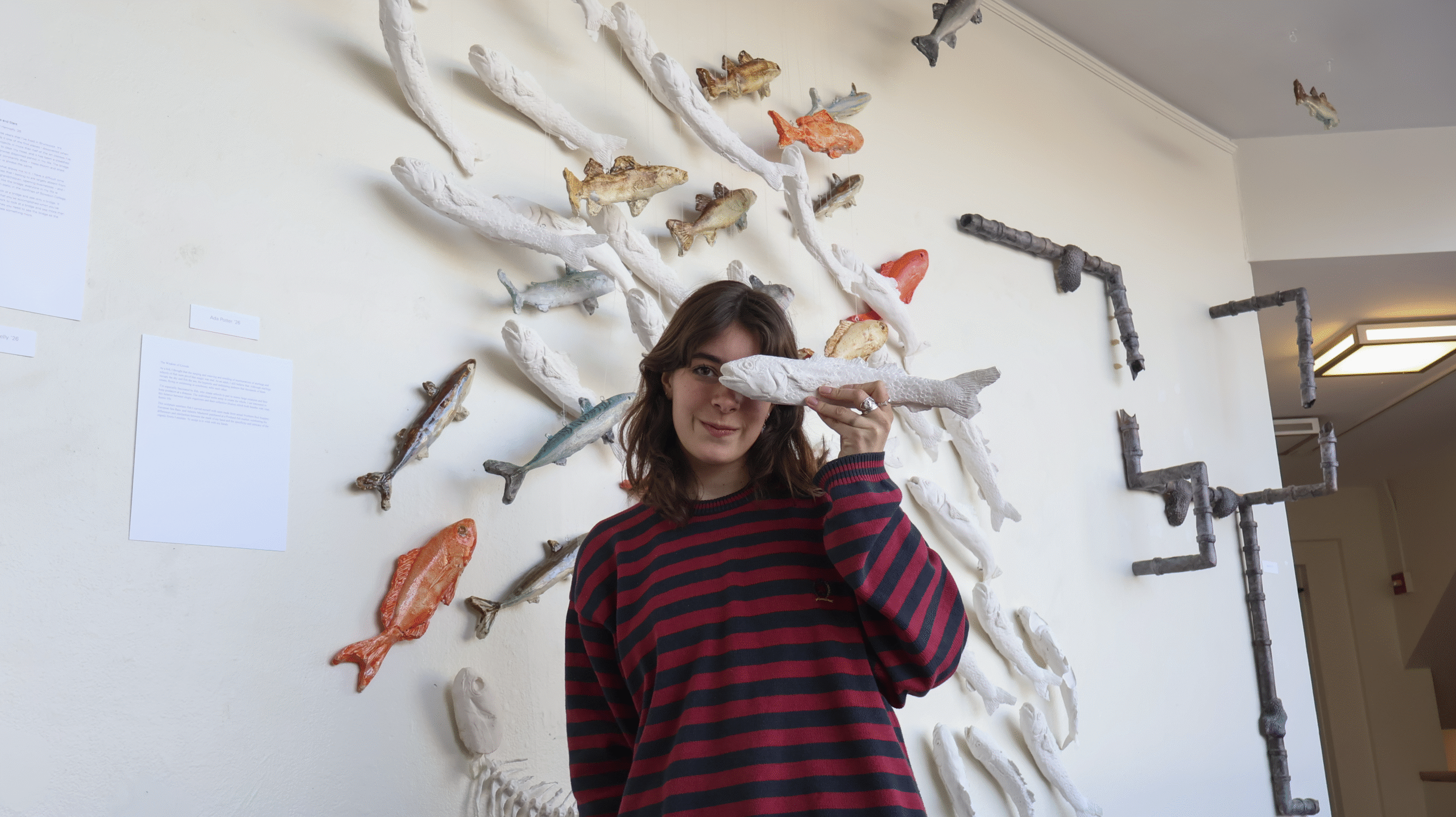
Previously displayed in Edwards and in the first floor of the Visual Arts Center, Potter’s recent work is inspired by movement—this time of a school of fish.
“Something about their movement is so hypnotic and the fact that they form schools … in order to fool predators into thinking that they’re a bigger mass,” Potter said. “I was so interested in the individual fish, but then the movement of the swarm as a whole.”
For this project, Potter made clay molds from fish that she purchased at a Portland fish market. After this installation, Potter continues to be excited by the molding medium. Currently, Potter is working on a molding project inspired by her time at Kent Island.
“Death was really visible there. There were a lot of bird bones everywhere, mostly of herring gulls that didn’t make it…, so I’m making these molds of dead birds that I’ve carved in clay,” Potter said. “What does seeing a dead bird mean? Should it mean anything? Is it to reduce it to a symbol? That also feels cruel.”
Using art to ask questions and connect with others is part of the reason that Potter keeps coming back.
“Art … has brought me closer to a lot of other people,” she said. “This is one way of showing [people] how I see the world and a way to find connection.”
In addition to the outside world, an internal dimension is also at the core of Potter’s artistic process.
“Art has helped me sort through memories and things that have long been unresolved, because I feel like sometimes it’s not enough to hold it all within you. I have to put it outside myself in order to understand it,” Potter said.
As Potter looks forward to producing a final piece for her senior studio course, she is reminded that environmental work can be amplified through an artistic lens.
“Art and environmental studies are driven by curiosity,” Potter said. “They are both ways of understanding the world or understanding my relation to the world.”
Ada Potter ’26 is a member of the Bowdoin Orient.
Comments
Before submitting a comment, please review our comment policy. Some key points from the policy: