
O for a muse of fire: Professor Aaron Kitch on the musicality of Shakespeare
February 13, 2026
 Addison Moore
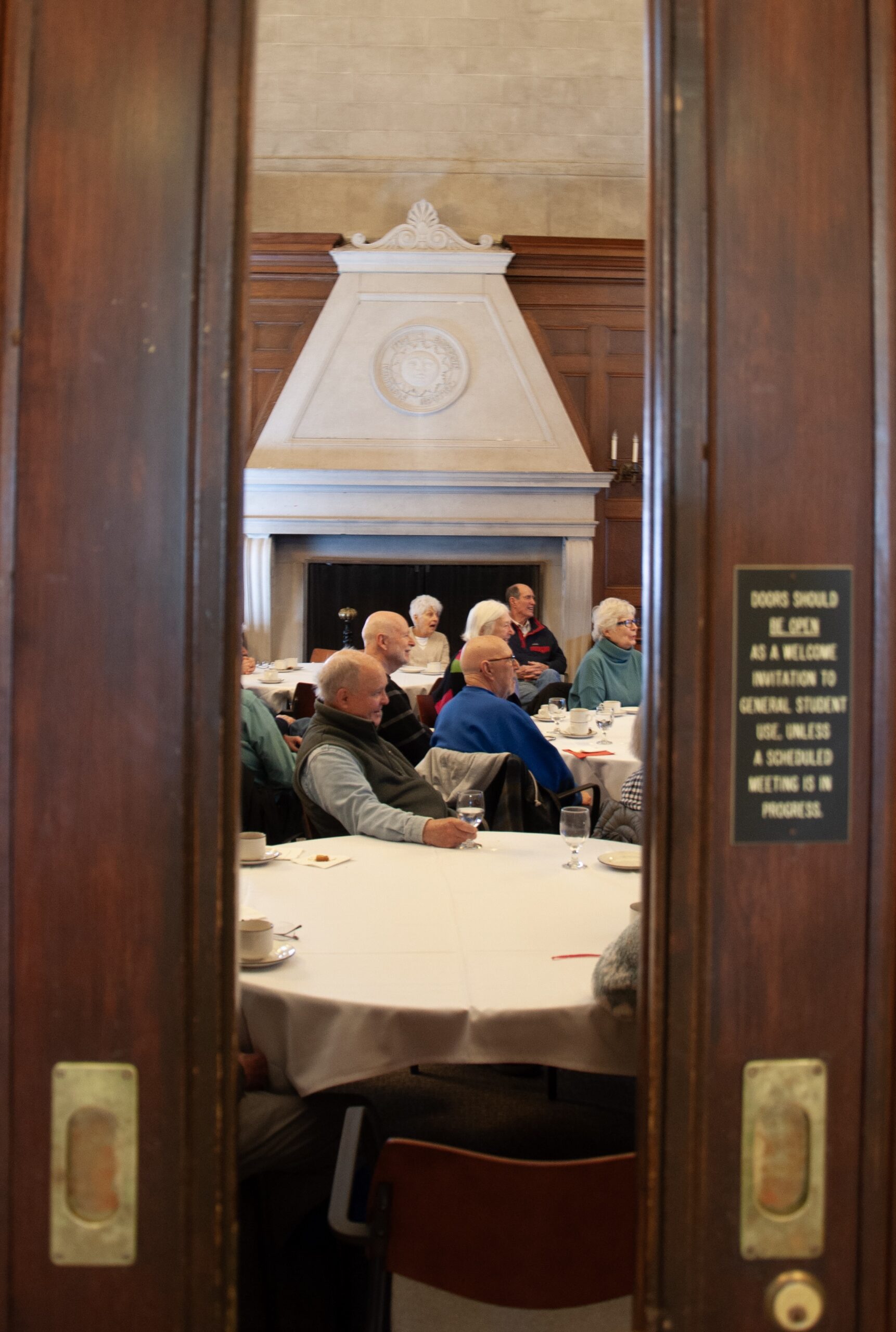
On Thursday, Professor of English Aaron Kitch delivered a talk reconciling understandings of William Shakespeare’s sonnets and the composition of both classical and jazz-based music. Just as Shakespeare’s early performances included musical interludes between acts, Kitch’s talk, titled “O For a Muse of Fire: A Shakespearean’s Secret Life of Making Music,” featured several moments of piano ranging from Bob Dylan songs to Domenico Scarlatti sonatas.
Kitch described that Shakespeare understood music to be equivalent to social order and saw the connection between musical harmony and structure to social harmony within the city-state.
After describing the thematic similarities of Shakespeare’s first 16 sonnets, Kitch revealed his overarching theory: that Shakespeare’s sonnets have the same effect as improvisations over chords—as the composition of music.
“[Shakespeare is] creating an underlying structure and wants you to pay attention to the variations and ornamentations,” Kitch said. “He is not just interested in the sonnet as an elite aristocratic form. He’s interested in it as a form of music.”
This musicality, according to Kitch, is what makes Shakespeare’s work worth studying so closely. During the talk, Kitch shared several Shakespeare lines underscoring his fascination with music.
To contextualize the musical background that led to his recent album “True Believer,” Kitch discussed his classical training as a pianist from the age of six and his experience throughout childhood performing in theater productions with his twin brother.
“I was lucky enough to have both of my parents buy me both a piano and a synthesizer. The synthesizer went in the basement … and I would play on the piano upstairs,” Kitch said. “I would play mostly classical music, so I was separating the two, but I also mixed them together.”
Kitch also noted that his first time listening to “Horowitz in Moscow,” particularly when Vladimir Horowitz performed Scarlatti, was another moment beyond the synthesizer that marked the beginning of his compositional journey.
“[Horowitz] plays the most beautiful line of music I’ve ever heard.… The show was sold out, and people tried to barge their way in. They were standing in the back, and the police were trying to arrest them as quietly as possible with handcuffs. And if you listen to the recording…, you can hear the handcuffs in the background because it’s so soft,” Kitch said. “Horowitz had an incredible ability to play softly and smoothly.”
Listening to Horowitz’s performances also taught Kitch about composition.
“In learning to imitate Horowitz, I learned so much about music and about the structure of songs,” Kitch said.
He then spoke about how he transitioned from purely classical music into rock music.
“Starting in high school, I wanted to be cool. Being a classical pianist was only cool for about six percent of my high school class,” Kitch said.
He emphasized the importance of playing and consuming rock music, particularly in the ’80s.
“If you listen to popular music today, you know that ’80s music has never gone away.… It’s still the architecture of popular music,” Kitch said. “It’s so simple, but it’s all about the sound. It’s about how sound makes you feel—how the sound works together and these structures, of course, that work together.”
Citing Dylan’s 1968 “All Along the Watchtower,” famously covered by Jimi Hendrix, Kitch reinforces his point, emphasizing the simplicity of Dylan’s underlying chord structure but noting the room this invites for improvisation.
“You can… add a blues overlay to [chords]. So, in taking that simple chord structure and trying to create different sounds out of it, I was intrigued by how many different styles I could get,” Kitch said.
Kitch ended the lecture with a recording of his song “Darkly Bright,” based off of Shakespeare’s Sonnet 43, and used this piece to highlight theater as a cultural institution and the influence of early modern literature on his music.
“On the surface, [“True Believer”] has nothing to do with Shakespeare or the Renaissance at all,” Kitch said.
Both Sonnet 43 and Kitch’s album, composed during the peak of Covid-19, circle back to finding community and striving for human connection.
Comments
Before submitting a comment, please review our comment policy. Some key points from the policy: