
BCMA gallery renovations bring refinished floors, new artworks and layout changes
January 30, 2026
 Abigail Hebert
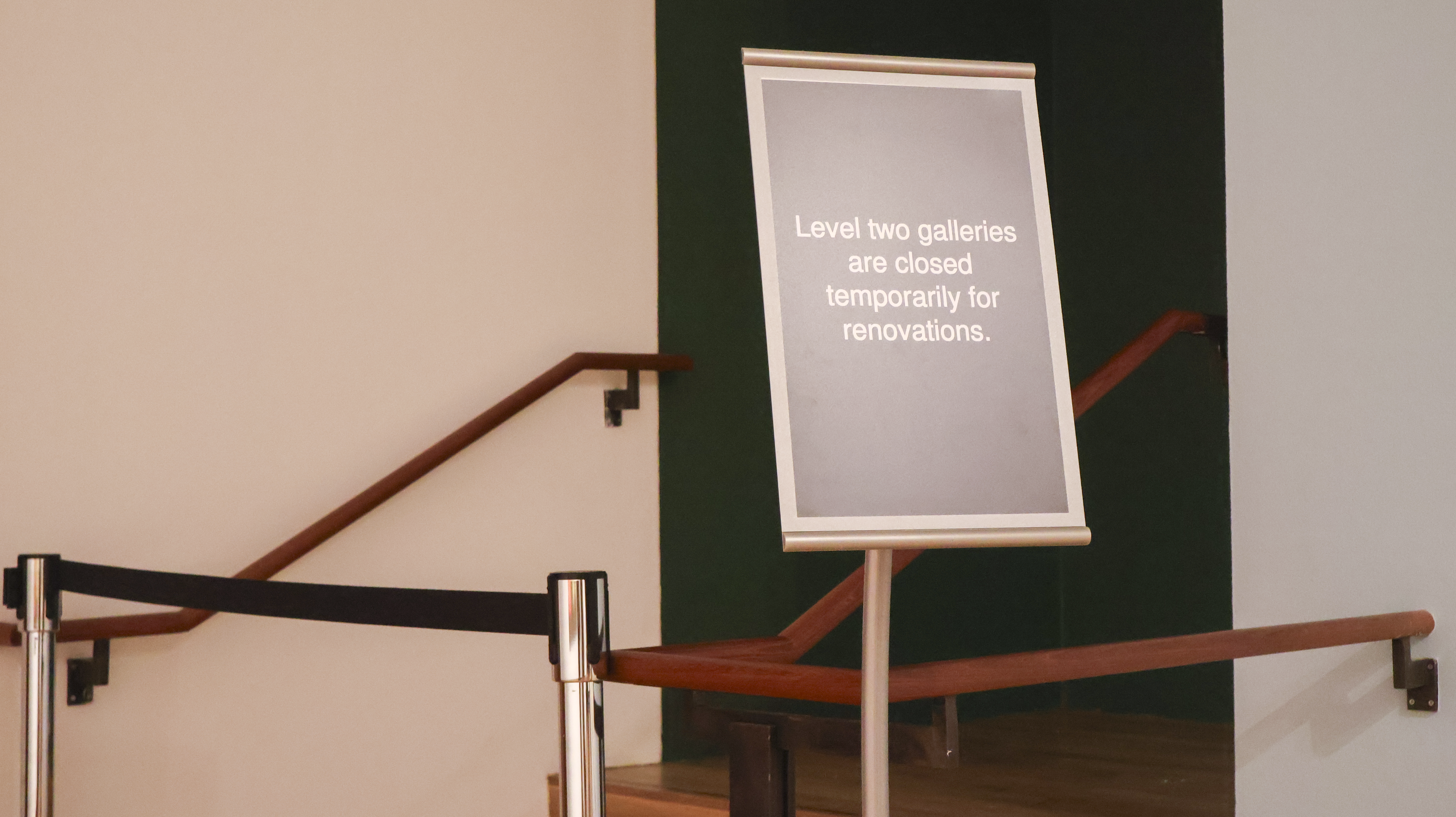
Students passing through the Bowdoin College Museum of Art (BCMA) may have noticed a sign blocking access to the second-floor galleries. These galleries are currently closed for renovations and are set to reopen in parts, with the Shaw Ruddock Gallery, the Markell Gallery and the Walker Gallery reopening on February 3, and the Boyd and Bowdoin Gallery reopening in March.
This is the first large-scale renovation to the BCMA since its two-year expansion that ended in 2007, in which 63 percent more space was added to the museum. Anne Goodyear, co-director of the BCMA alongside Frank Goodyear, explained the current renovation focuses on refinishing the upper floors.
“The upper floors had not been refinished since the time that the building reopened [in 2007]. I’m happy to say that we have lots of traffic…, and from winters such as this, floors in main buildings can take a bit of a beating, and so the time had come to refinish those floors,” Anne Goodyear said. “We also took advantage of the opportunity to refinish what we describe as an apron, which is a little wooden platform between the glass curtain walls and the stairwells. It turns out that [because of] swings in temperature here in Maine, there was condensation, and the effects of that condensation on wood needed to be addressed. ”
These technical renovations, however, will also be accompanied by some updates in the programming, especially in two permanent collection exhibitions: “Legacies: Art from Renaissance Europe and the Americas,” “Re|Framing the Collection: New Considerations in European and American Art, 1475-1875” and “Currents: Art Since 1900,” which expands on its predecessor “Currents: Art Since 1875.”
“I think what’s always the case in doing those types of upgrades to any building is it gives you a chance to step back and take stock of the programming one is doing as a whole in a given space,” Anne Goodyear said. “We have taken advantage of this opportunity to reinstall and to reorganize two major installations, one which concerns our historical collections, from the Renaissance era to the 19th century, and the other of which concerns our more modern and contemporary collections.”
These updates will include a replacement and rotation of the pieces that were on display while also bringing out artworks that were in storage or were recently acquired, such as “The Captured Runaway”(1856) by William Gale.
“The museum has more than 30,000 artworks in its collection, and at any one time, depending on the installations, we can only exhibit several hundred of them. So this gives us an opportunity to refresh the galleries. Certain pictures will stay on view because they are highlights of our collection, and people always look forward to seeing them, [like] Gilbert Stuart’s presidential portraits of Thomas Jefferson and James Madison,” Frank Goodyear said.
These curatorial changes will also be a chance for viewers to find new connections between different artworks.
“One of the fun things that the reinstallation gives us a chance to do is to create contiguity between historic artworks from our collection and objects that are in the Wyvern collection,” Anne Goodyear said. “Any time one puts artwork in different contexts, different meanings and different resonances appear. So we love that we’re able to change up the conversation and to give ourselves new perspectives on these objects. I think part of the reason that museums are so important is they provide a way of understanding our human identity by giving us a way to think about the larger human past, and that’s why it’s so important to us…, [and] those histories are really only meaningful when we think about how and why they matter in the present.”
This renovation will also establish a new layout, with the exhibitions changing places within the BCMA to create a chronological timeline.
“One of the things that visitors will experience is that you can now make a loop on the second level, and you can literally walk through history. We’ve set it up so that there is a sort of chronology that hadn’t existed previously,” Frank Goodyear said. “Now, you enter through sort of the oldest work…, and you eventually make your way to the present day.”
Amanda Skinner, the assistant director of museum communications, hopes that this reconfiguration will provide more opportunities for students to see a narrative flow.
“We hope that having this new, reconfigured layout might offer an opportunity for the permanent collection of the museum to be a bit more clear to students, and hopefully that because of that clarity, would further facilitate the use of the museum and its permanent collections as a resource for students, which is a message that we really hope to get out there,” Skinner said.
Comments
Before submitting a comment, please review our comment policy. Some key points from the policy: