
Faculty and Staff for Justice in Palestine sponsor talk featuring student speakers
December 5, 2025
 Abigail Hebert
On Wednesday night, guests gathered in Kresge Auditorium for an event sponsored by Faculty and Staff for Justice in Palestine, titled “Where Do We Go From Here?” Students spoke on the past and future of Israeli-Palestinian relations and Zionism as an ideological project.
Abhi Peddada ’27 opened the event with a history lesson and call to action.
“Many people in the U.S. have started discussing the Palestinian cause since October 7,” Peddada said. “However, its history is more than a century old, and understanding this history is essential if we want to understand why a ceasefire, however welcome, is nowhere near enough to undo the structures of violence that underpin the Zionist project.”
Peddada continued by recounting the violent oppression Jewish communities across the world have faced, noting that Palestine was only one of several areas considered for the site of the creation of a Jewish state and that it was contested.
“When the first Zionist Congress met in 1897, it confronted a basic problem: where to build such a state, and how,” Peddada said. “Various sites were proposed before the movement eventually concentrated on Palestine. But Palestine was not empty, nor was it up for taking.”
Peddada connected this history to the current context of pro-Palestinian protest in the United States.
“The same century-long dispossession that unfolded in Palestine also produced a century-long tradition of organizing here in the heart of the imperial powers that sustain Zionism,” Peddada said. “Palestinian activism in the global North is not new. It is a century-long tradition rooted in anticolonial struggles and has been repressed by imperial governments for just as long.”
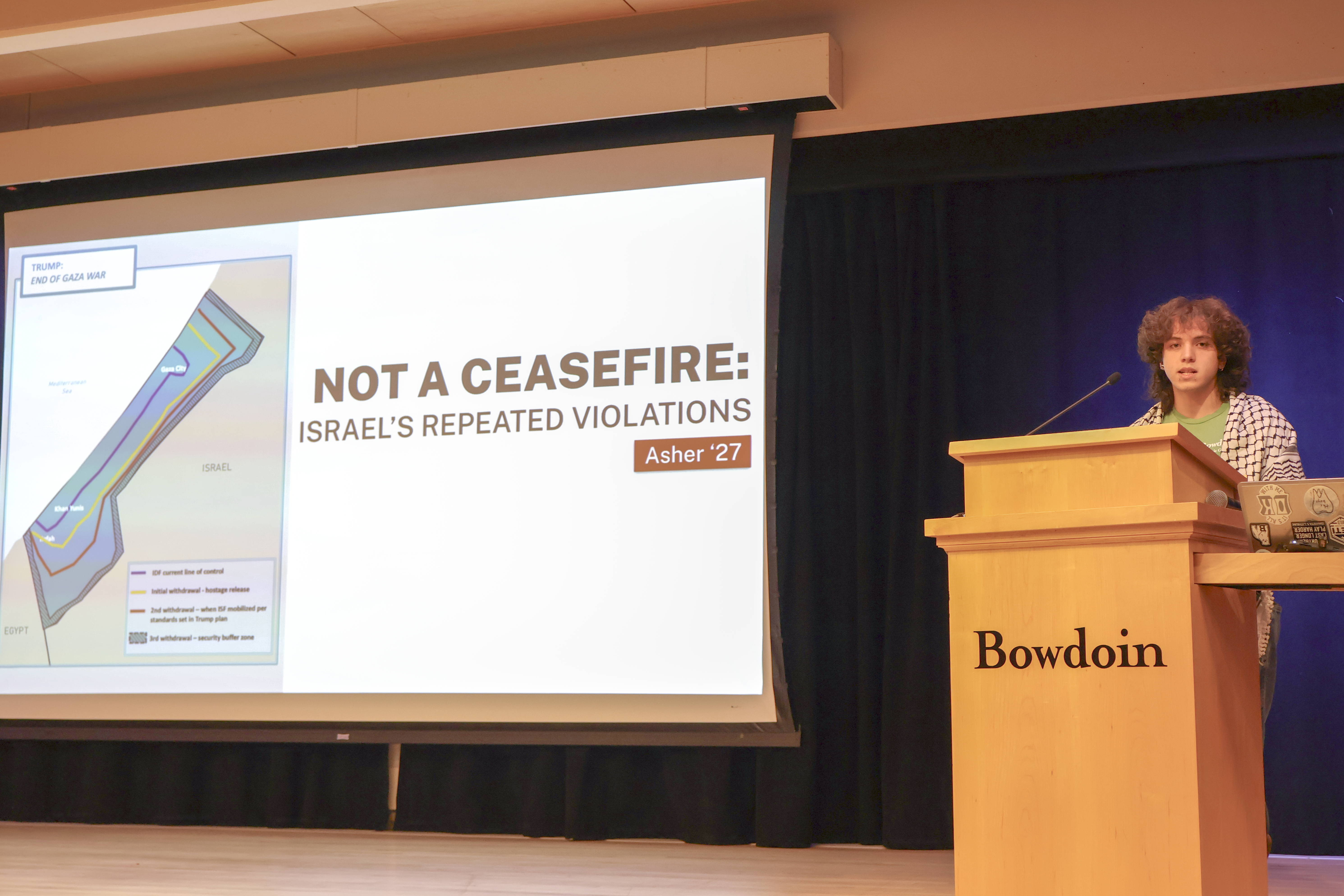
Asher Feiles ’27 spoke next, discussing the repeated violations of a ceasefire by Israel. He said that every armistice agreement between Israel and Palestine has only been a momentary pause, with no changes to the underlying machinery of oppression.
“Since the ceasefire was announced on October 9 [of this year], Israel has violated it on over 500 separate occasions for both ground and air assaults, resulting in the murder of over 350 Palestinians and further restriction of aid,” Feiles said.
Feiles continued to list specific incidents of strikes on civilians in the Gaza Strip since the announcement of the ceasefire. This included a day-long bombardment of the Gaza Strip that killed 104 people on October 29, a strike that killed two Palestinians last week and a bombing beyond the yellow line (the temporary boundary established under the ceasefire).
“This year’s harvest has seen the highest number of settler attacks since 2020,” Feiles said. “Israel also continues to starve Gaza aid, while the current ceasefire agreement stipulates that 600 trucks are supposed to enter the strip daily, only 24 percent of this quota—just 145 aid trucks—are being allowed to enter the strip.”
Feiles ended with a critique of ceasefires in Gaza as a whole.
“The historical record is overwhelmingly clear and consistent across the decades in its indication otherwise, ceasefires have never been held because they were never designed to halt the violence generated by this state. They function instead as ideological instruments that mask and reinforce the Zionist regime,” Feiles said.
Cedar Greve ’26 also discussed the 20-point peace plan proposed by the Trump administration, describing it as unacceptable.
“What is presented as a neutral technocracy functions as an external authority that decides the terms of life and political development, while denying Palestinians control over their own institutions,” Greve said. “While the plan gestures vaguely towards a ‘pathway to Palestinian self-determination,’ it provides no timeline, no enforcement mechanisms and no binding commitment to the sovereign state.”
Greve stated that the peace plan will only result in a puppet state for Palestinians.
“A ceasefire, however urgent and desperately needed, cannot be mistaken for the end of a so-called conflict. A temporary halt in fighting does not dismantle a system designed to control and dispossess an entire people,” Greve said. “For those of us living in the imperial core, the ceasefire is not a signal to slow down but rather a reminder of the political terrain we occupy.”
Comments
Before submitting a comment, please review our comment policy. Some key points from the policy: