
Theodore Kerr discusses history of AIDS memorials
November 13, 2026
 Abigail Hebert
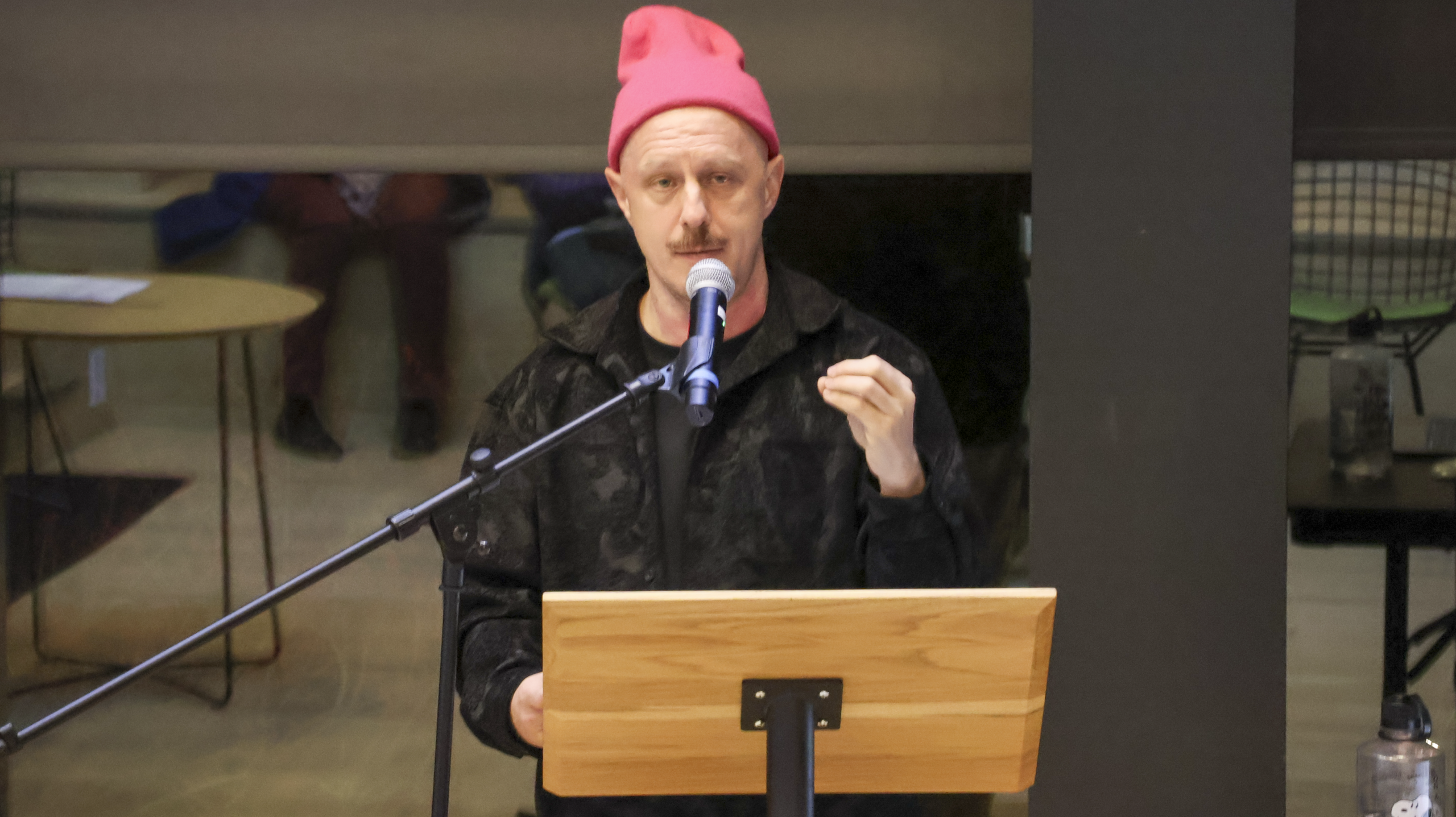
On Tuesday, Bowdoin hosted Brooklyn-based writer and organizer Theodore Kerr in the Roux Lantern to speak on the history of AIDS memorials and the possibilities of expanding our view of what memorials can look like. His talk, titled “This could be an AIDS Memorial: Public Memory in an Ongoing Crisis” kicked off Bowdoin’s AIDS Action Series, which will run from November 10 to December 4.
Assistant Professor of Gender, Sexuality, and Women’s Studies Jay Sosa introduced Kerr and his approach to studying and creating AIDS memorials, exhibitions and his collaborative work “What Would an HIV Doula Do?” Kerr began his presentation with a single sentence on his first slide: “If living well is the best revenge, then maybe supporting people historically marked for premature death is the best memorial.”
Kerr expanded on AIDS memorials, specifically quilts, as tools to represent lives, places and identities that can be near or distant. He took the audience back to the start of quilts as a vehicle for representation and mourning AIDS victims, starting with Cleve Jones and his 1985 candlelight march in honor of Harvey Milk, which then transformed into a quilting project.
Alongside the importance of AIDS as a historical event, Kerr stressed the significance of shining an equally strong light on the present-day epidemic and the lives it continues to affect. To embody this dualism, he proposed the metaphor of a butterfly, where one wing was the 40 million deaths attributed to AIDS since 1981, and the other wing was the 40 million people currently living with HIV. To Kerr, both wings are equally alive, flapping at the same time.
“In the middle is the body of the butterfly, which is where memorial lives, where memorialization lives. It’s where we hold our feelings about the dead, but also where we, the living, think about HIV and think about the dead. That’s something that I like to think about when I think about the quilt, but also when I think about just the enormity of this ongoing crisis,” Kerr said.
Kerr spoke of his experience collaborating with St. Louis’s Griot Museum of Black History to create a quilt panel honoring Robert Rayford, who is recognized as having the earliest known case of HIV/AIDS in North America. Kerr viewed his work crafting that representative piece, which involved looking for Rayford’s unmarked grave in St. Louis and informing others about him through academic papers as part of his individual contribution to memorialization. He urged attendees to contribute to this task in their own ways.
“[As] students and people who care about the university or at least could get in the room, think about how your scholarship could be a form of memorialization. Whose names are you saying? Whose contributions are you making sure live on? Your citations are a memorial practice if you want them to be,” Kerr said.
Attendee Alonzo Wickers ’29 is a student in Sosa’s course, “The Ongoing AIDS Crisis.” For his class, Wickers was tasked with interviewing someone who had experienced the AIDS epidemic. When interviewing his father, Wickers learned of an important generational disconnect, which he linked to Kerr’s talk.
“The generations don’t quite grasp what each other’s experience was. And because gay history isn’t transmitted via families like most minorities, it’s critical that younger generations have some sense of what older generations’ experiences were. With that in mind, it would feel wrong not to attend this talk on memorialization and remembrance,” Wickers said.
Kerr ended the talk by emphasizing the importance of honoring the dead while fighting for those living with HIV.
“We thought a lot about how to honor a person who died with HIV. But we’ve not done the same for people living with HIV.… As part of our process, the collective and I are not rushing to certainty. We want to sit with this question of why it’s more comfortable for us to tend to the needs of the dead and not the living,” Kerr said. “I invite you to reflect on the question … what does it mean to memorialize within an ongoing crisis?”
Comments
Before submitting a comment, please review our comment policy. Some key points from the policy: