
Portrait of an Artist: Muzi Wei’s ’27 process of finding liberation through deconstruction
November 13, 2026
 Isa Cruz
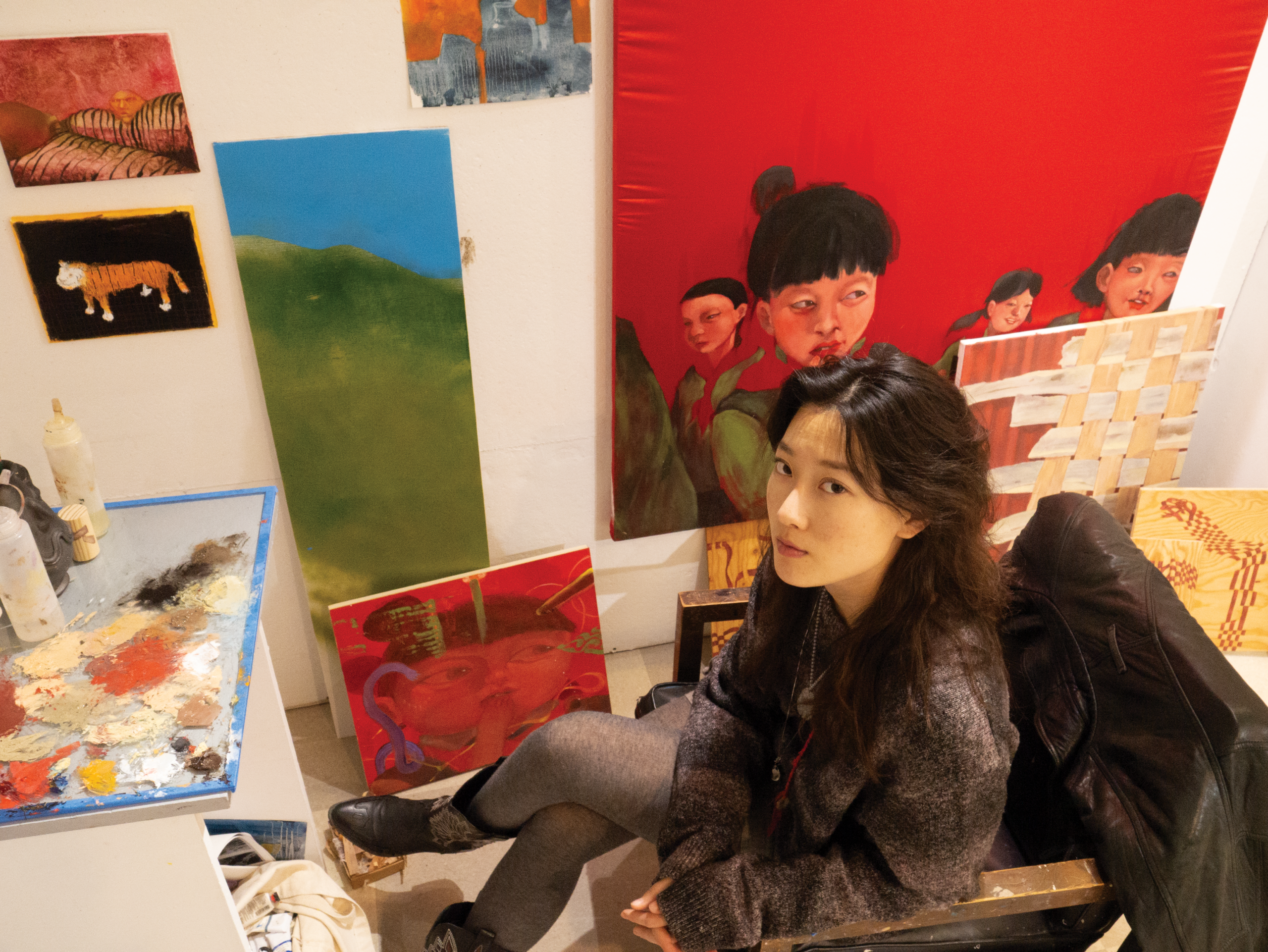
As an artist in many senses of the word, Muzi Wei ’27 has deeply explored an evolving creative identity during her years at Bowdoin through a range of creative spaces. She is an active member of the Bowdoin Cowboys, co-founded the Smith Union Lamarche gallery wall, co-founded her company Ananta Teas and continues to be an avid painter.
From her early years of childhood in the Henan province of China, Wei doodled and participated in dance, beginning with ballet. She moved to San Diego, Calif. at the age of 11 and her friends there introduced her to hip-hop, which sparked a passion that eventually led her to audition for the Bowdoin Cowboys. In middle and high school, she worked frequently with acrylic paints; now her medium of choice is oil paint.
Wei welcomed the transition from high school to college, where she took advantage of new academic opportunities to develop her artistic practice.
“I think prior to college I never received much criticism, [not] even constructive [criticism], for my work,” Wei said. “Coming in, I kind of felt like I was [the] cream of the crop, [like] I already knew what I was doing, but here, and also especially when I was studying abroad in Florence, is when I really got challenged.”
Wei’s professors have encouraged her to carefully deconstruct her artistic processes and ask questions about each decision she makes.
“Before, I felt like making things was more of a passive progress to get to some type of result, to some type of image and to some idea that I had,” Wei said. “Now, I feel like the way I approach making things is more about what I can find out in the process and not what I can realize in the final things.”
One setting where Wei continues to practice this deconstruction is her Painting II class taught by Visiting Assistant Professor of Visual Arts Genevieve Cohn.
“[Wei] has a real sense of herself as an artist, and from the very first class period, I noticed that she … has this self-directed curiosity about ‘what would happen if,’ or ‘I found this thing’ and ‘I wonder what,’” Cohn said.
Cohn observed that exploring the implications of materiality holds great weight for Wei.
“[Wei is often considering] what the actual material of paint means, what’s getting painted on, the histories that materials carry, how that informs the way we think about what we’re making and why we’re making it. That [interest] is something that has been a real strength of hers,” Cohn said.
In addition to interactions with professors, connections with peers have influenced Wei’s artistic identity.
“I feel like the visual arts department is a little bit of a bubble. Everybody knows each other because it’s small, and all the classes are so interactive. It does, I think, solidify me identifying myself with this group of creative people. Walking around campus and seeing those other creative people around, I do see myself as an artist,” Wei said.
The building of community through common values, appreciation of others’ free expression and mutual support has come to be a core driver of Wei’s artistic pursuits, from her tea company to her painting practice.
Beyond her time on the Cowboys and in visual arts classes at Bowdoin, which helped Wei realize the importance of community to her artistic endeavors, her recent travels through China have added layers to this understanding.
Wei journeyed to China with Jordan Wanigaratne, co-founder of Ananta Teas and a close friend from middle school, and visited established tea makers. Along the way, they also visited the Jingmai Mountain and met a diverse creative community that included tea makers, artists, photographers, painters, sculptors, singers, an acrobat and shoe manufacturers.
“It got me thinking about the community I want to create because at the end of the day, I realized that the community speaks so much for what you do,” Wei said. “I might have all the right messages and be able to say all the things that I want, but if it’s fallen on deaf ears and there’s not a community that engages with it, it’s pointless.”
The interactions she had on and off the mountain brought Wei a sense of courage. These conversations liberated her from her doubts and reservations, which in part arose from her non-traditional graduation plans of establishing a physical space that combines the ritual of tea with visual art.
“I feel like when I travel and meet these people it makes me realize all the lives that somebody could live and the fact that you do have free will to pursue whatever you want,” Wei said.
Wei’s commitment to pursuing freedom through her creative passions is what has led her to play with structure, both literally and figuratively.
“[As an artist I’m] multifaceted or sporadic, a little bit of both, because I feel that I engage with such widely different things while simultaneously, I am passionate about all of them,” Wei said. “In my work I feel that I don’t really stick to one style. I also don’t stick to one subject matter.… I don’t want to be confined by myself and by what other people perceive as me.”
Learning to take courageous steps to challenge normative practices has empowered Wei.
“I think [the empowerment comes] precisely through breaking down that structure and realizing I do have to design my own thing,” Wei said. “Realizing that, ‘Oh, I can,’ and there are so many different ways I can go about it, and there are so many people doing unconventional things that don’t exist inside a pre-established structure.”
Wei hopes that anyone, regardless of whether they are an artist, can hear the story behind Ananta Teas and her painting journey, and realize “I can” for themselves.
For students interested in following their own artistic passions and looking for financial support, Wei recommends reaching out to alumni group Delta Sigma/Delta Upsilon (DSDU), where she works as a student ambassador and the main contact for students.
Comments
Before submitting a comment, please review our comment policy. Some key points from the policy: