
John Roy’s long hike to Bowdoin Dining
October 2, 2026
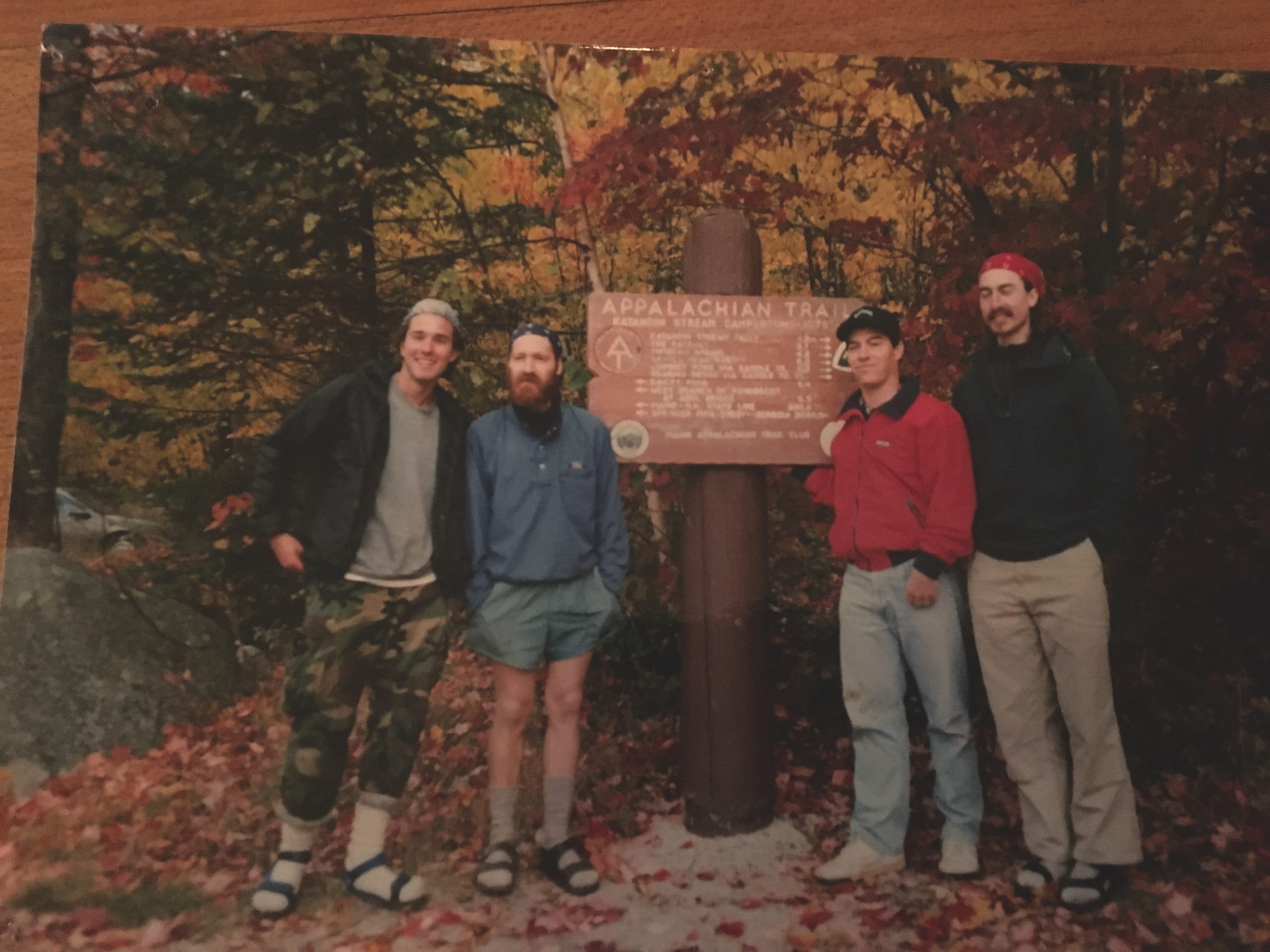 Courtesy of John Roy
When Moulton Union Operations Manager John Roy was in fourth grade, his brother Mike went to his class to share photos from when he had hiked the Appalachian Trail (AT). Little did he know, this presentation would stay in the back of his mind and inspire a life-changing experience. Years later, Roy and his friend, Kevin Cronin, met up for drinks and shook hands in a promise to do the AT, following in the footsteps of his older brother.
In 1989, over ten years after hearing his brother’s presentation at school, Cronin and Roy set foot on the trailhead of the AT at Mount Springer, Ga. All they had were maps from each state and a white blaze to follow. No phones. No service.
“[My brother] literally had jeans and a T-shirt; I had a cotton T-shirt, but I had, you know, some stretch pants or whatever,” Roy said. “So there’s the leaps and bounds of technology and phones, and we just didn’t have it, which I think is part of the novelty of it is to get unconnected.”
Roy had just graduated from culinary school at Johnson and Wales University, giving himself the gift of attempting the thru-hike the following spring. Cronin had just finished at Bates College and was going to Yale Divinity School the year after.
“We never really disagreed all that much. It was very complimentary. I knew his strengths, his weaknesses, what he liked to do, what he didn’t like to do,” Roy said.
Roy explained how every year the trail changes 100 miles or so, but the year they did it was 2,138 miles. They completed the thru-hike in 134 days, four and a half months, a month and a half faster than the average AT thru-hiker.
“Back then we were told that about 1,000 people a year would attempt to do the Appalachian Trail, and about 100 would finish,” Roy said. “So ten percent was the rate back then that we went with, and we did the whole thing.”
The two walked around 16 miles a day, staying at a shelter each night with water, an area to cook, change and clean. As they walked, they got to know each unique town, some of which catered to hikers and some of which did not. They stayed in youth and church hostels, and even a fire department along the way.
“You had good days and bad days,” Roy said. “Had swollen feet and went through moleskin and put on the same wet, dirty clothes every day because you couldn’t carry another set of clothes.”
The first thing they would do when they got to a new town each week was walk to the nearby post office to pick up one of their 19 predetermined food packages. At one point on trail, they lost a week’s supply worth of food to a bear in the Smoky Mountains, but encountered generous strangers along the way and an act of what Roy described as “trail magic.”
“Trail magic is when somebody has an opportunity to be a help, whether it be food or direction or clothing. The night before, we were at a shelter in the Great Smoky Mountains, and there was a couple, and they came up, and they said, ‘You guys must be thru-hikers,’ and we were like, ‘How’d you know?’ and he’s like, ‘Well, you stink for one thing, and we watched you eat.’ So it was wonderful. They gave us all kinds of food,” Roy said.
Roy described how his relationship with food changed after spending months carrying and preparing each ingredient and meal to become more simplistic. He has since carried this mindset to his life off the trail, working in dining at Bowdoin’s beloved Moulton Union or even at home, where he began to cut down on what he needs.
“The biggest thing is that you realize how quickly you can do without stuff,” Roy said. “If you can’t carry it, then you’re not taking it. If you really like Nutella that weighs six pounds in a jar, you could take that Nutella, but you’re gonna have to carry it.”
On their final hike on October 9th, it was snowing “like a son of a gun,” as Roy recalled. While it was beautiful at the base of the mountain, at the top of Mount Katahdin, it was a complete whiteout. The two couldn’t see any white blazes, so they followed cairns, mounds of stones left by previous hikers to mark the trail and keep them on the path.
“I don’t really have any memories of that final day. I had family and friends show up when we got done. They picked us up, brought us back home,” Roy said.
Roy and Cronin each wrote in journals to document their days and brought a camera, which they often look back on to reminisce and reflect on what it felt like to be on the trail.
“Back then, physically I knew I could do it. Mentally, I wasn’t sure of it. Now, it’s probably the exact opposite. Physically, it would be really demanding for me to do it, but mentally I could be able to,” Roy said.
After completing the AT, Roy went back to the summer camp he had been working at in Noble Book, then spent a couple of years in Charlotte, N.C., before coming to Bowdoin in October 2021, where he now works as the operations manager for Moulton Union.
“It’s a major commitment,” Roy said. “Not that many people have the opportunity to be able to take six months off and go hike the trail, rent gear and all that stuff. It’s a hard one to do, so do it when you can.”
Comments
Before submitting a comment, please review our comment policy. Some key points from the policy: