
Portrait of an Artist: Selima Terras ’26
April 10, 2026
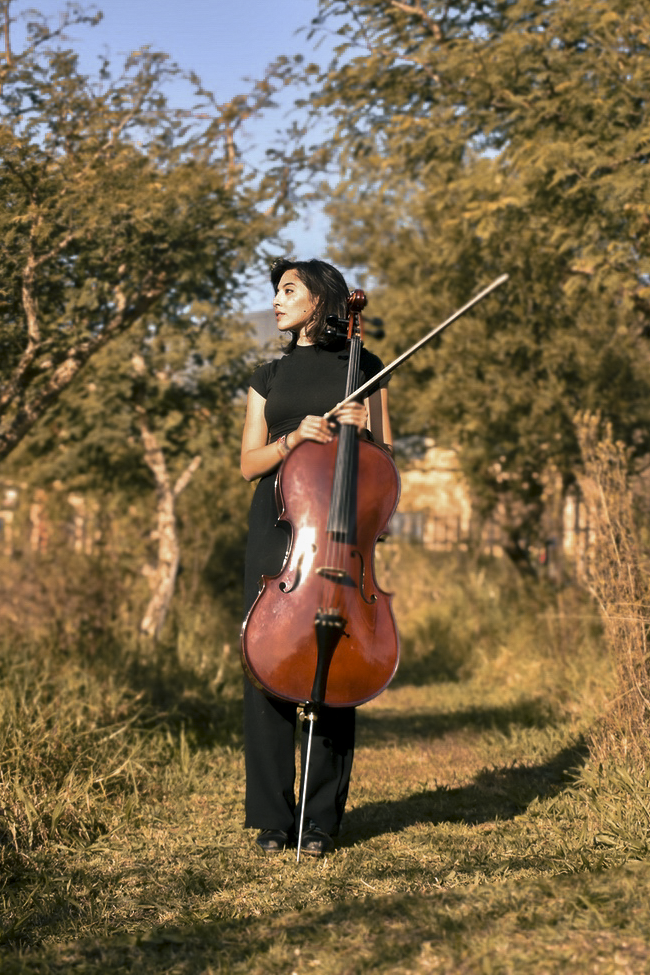 Courtesy of Selima Terras '26
For Selima Terras ’26, music has always been connected to understandings of community and home.
Throughout her childhood, Terras recalls writing music with her older sister. She explained that their songwriting evolved from lighthearted familial musings to a mechanism for understanding what was happening in their country, specifically during the Tunisian Revolution.
“That has always been my inclination, coming up with melodies,” Terras said. “In 2011, there was a change of systems going from a dictatorship to a democracy, but there was also just a lot of change in lived experience.… Everyone was starting projects, partaking in politics, engaging in civil society organizations. My sister and I writing songs around that time encapsulates that energy.”
Terras refers to this as “the time of possibility.” She began learning ukulele with her sister, and her neighbor began teaching her how to play the piano. While singing in a choir and observing the orchestra, Terras was inspired to study the cello, an instrument at the heart of her musical journey.
“This instrument is my teacher and my key,” Terras said. “My teacher because it teaches me patience and discipline … but also my key because it opens so many spaces. For example, at Bowdoin, my first week there, I joined the Middle Eastern ensemble, and I also joined the electroacoustic ensemble thanks to the cello.”
Exploring music through various instruments, Terras began to understand music as an effective communicator.
“In my context, we speak Tunisian dialect of Arabic, but that’s not specifically the language that is written.… There’s a disconnect between the language that you speak most directly with your family and friends and the language you write in,” Terras said. “Songs are this liminal space where you can use your language and be able to communicate your ideas most authentically.”
Terras emphasizes that music is grounded in social advocacy.
“I started writing songs to advocate for projects. I was part of organizing teams of different community projects. One of those was to raise awareness about racism in Tunisia, and I wrote a theme song. Then I finished high school in South Africa. I was organizing in the South African Ideas Festival, which is a youth entrepreneurship festival, and I also wrote two theme songs for that,” Terras said.
Terras’s experiences have allowed her to understand that her purpose as an artist is to build community through music. One of the ways she does so is by organizing community songwriting workshops in Tunisia.
“[The workshop] is a two hour experience where strangers sit in a circle. I sing the song, ground its story and its arc in our shared histories in Tunisia.… We reflect and I take the words and then we build a song together,” she said.
In addition to hosting songwriting workshops for non-musicians, Terras has also organized creativity training and community concerts.
“Music shares stories and cultures and sounds from people to people,” Terras said. “The concerts were held at cafes and community centers, and the whole idea was really to bring life to that space and that sharing music would also bring people together.”
After having her United States visa rejected prior to the start of her senior year, Terras has continued her studies at New York University Shanghai; however, she believes that studying anthropology and environmental studies at Bowdoin allowed her to better understand music as an effective communicator and community builder.
“My studies are informing what I think is important. And music is always my tool to enter spaces, bring people together and make things happen,” Terras said. “That’s also my way of relating and connecting to Bowdoin—honoring the classes I’ve taken, the people I’ve met, the tools, and digesting them and developing meaningful things out of them.”
Terras is currently using her songwriting workshops to combine her love for anthropology with music.
“I’m turning my community songwriting project into research. I’m doing an autoethnography of what my experience of creating these workshops in Tunisia has been and what kind of structures they reveal in the discourses that come up when people are given space to share their experience and create together,” Terras said.
Terras also hopes to better connect music with her studies of the environment.
“I need to learn more about land and farming communities in Tunisia … as climate change is threatening water resources,” Terras said. “My next step, when I come back to Tunisia, is to do the songwriting workshops but try to build the link more clearly to ecological communities and farming communities, because my workshops are called ‘Imagining Futures through Music.’”
Reflecting on her time at Bowdoin and her current studies in Shanghai, Terras illustrates that music carries meaning across borders.
“Today I’m actually organizing my first community songwriting event in Shanghai,” Terras said. “I’m curious what comes up here. I feel like a new world of possibility brings new opportunities and new ways of thinking and relating to music.”
Comments
Before submitting a comment, please review our comment policy. Some key points from the policy: