
Artist-in-residence George Lopez offers a musical interpretation of BCMA exhibit
May 1, 2026
 Addison Moore
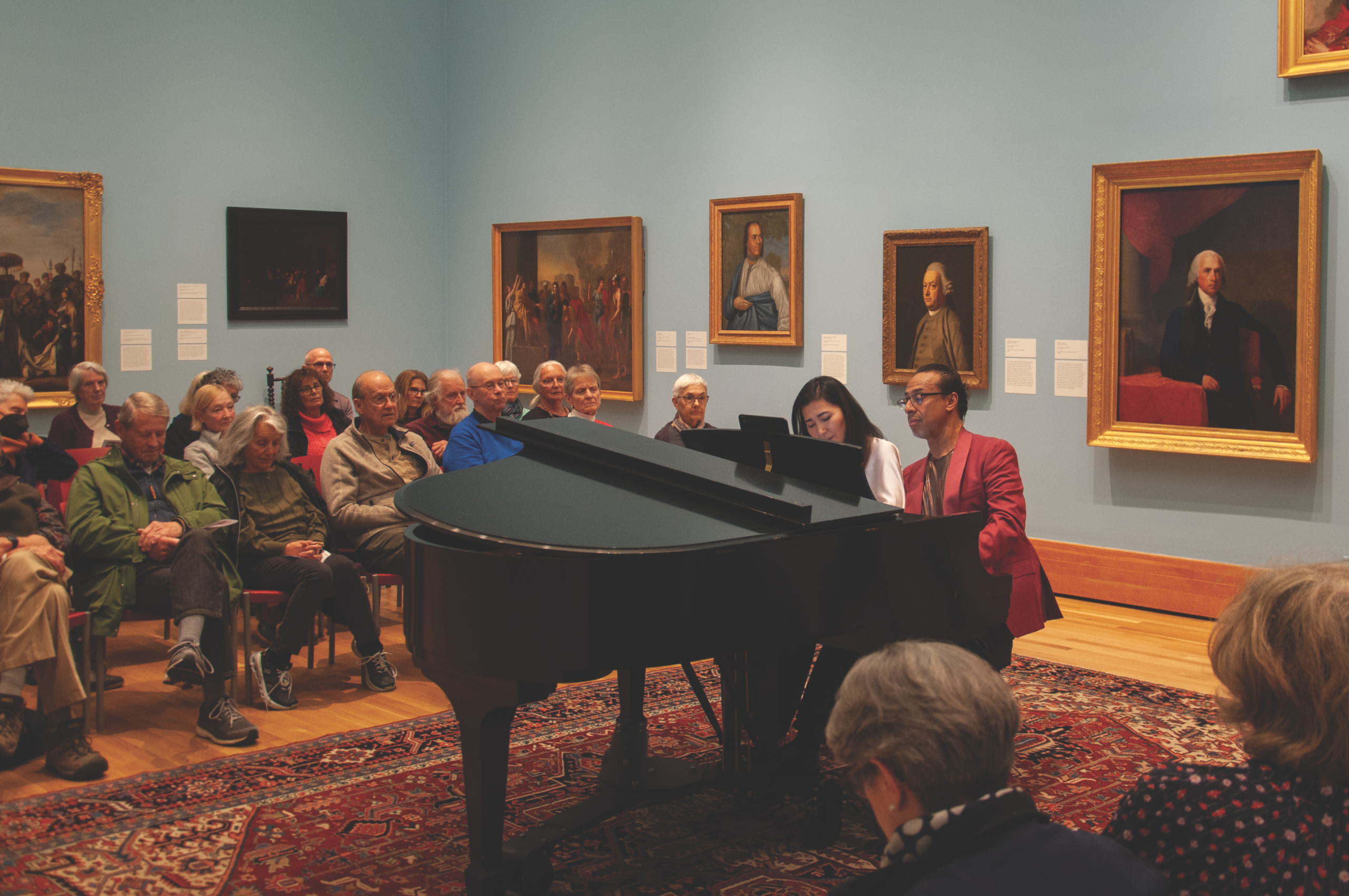
On Thursday, Beckwith Artist-in-Residence George Lopez performed ten songs interpreting the exhibition “Hung Liu: Happy and Gay,” a collection of works exploring his experience in Cultural Revolution China. Once a semester, “Music at the Museum” pairs a specialized live music program with an exhibition at the Bowdoin College Museum of Art (BCMA).
“In a way, what you’re hearing today is a soundtrack to the exhibit,” Lopez said. “Children marching under the Communist flag in groups. This was what was inculcated through the xiaorenshu books that were so popular from the mid-twentieth century until the 1980s in China. This final piece of this opening set is about violence that is perpetrated on children.”
Between compositions, Lopez explained how the low-pitched marching themes or high-pitched trills engage with themes of childhood while rebelling against strict social systems. In China during the Cultural Revolution, xiaorenshu books were palm-sized picture books containing information on Communist values and loyalty to Mao Zedong. The xiaorenshu acted as effective propaganda for socializing children into Maoist thinking.
Cassandra “Casey” Mesick Braun is a curator at the BCMA and works with Lopez as he constructs the programs for “Music at the Museum.” She offered insight on themes from artist Hung Liu’s work that inspired Lopez, specifically how Liu interrogated childhood and regime in Maoist China.
“The works that she produces that are in this exhibition are very playful. … But also they are so subversive and political, making strong statements about what it was like to grow up under a dictatorship and such a fascist regime,” Braun said. “I think that some of the themes [Lopez] is pulling on are things like subversion, complicity and renewal, and I think [Liu’s] work really speaks to all three of those.”
As part of the performance, Lopez tied exhibition themes to stories from his own life. He shared how time spent in Japan highlighted similarities between Japanese culture and his own Central American culture. His anecdote segued into how artist Hung Liu immigrated to the United States after the Cultural Revolution and found renewal in Mexican communities.
“[Liu] begins to recognize that Mexicans and Mexican-Americans of the era are suffering much of the same things that her people suffered … lack of housing, lack of resources, lack of opportunity,” Lopez said. “She ‘adopts ancestors,’ and helps curate an exhibit in Sacramento of Chinese and Mexican art. She embraces Mexican ancestry as part of her own cultural and personal experience—I just thought that was beautiful.”
Lopez’s mixing of the personal with music, history and art appeared to effectively communicate Hung Liu’s work and the artist’s experience with China during the Cultural Revolution. Braun shared how Lopez’s performance interweaves multiple creative mediums to educate the audience on history and art.
“I think in Western society we separate visual arts from music from poetry from literature, but when you look at the creation and reception and consumption of these various forms of creativity, they’re often intermeshed and intertwined.… I think one of the things that [Lopez’s] programs have done successfully is really demonstrated the ways that music, composition and performance are also historically situated,” Braun said. “They have roots, they change, they [evolve].”
Lopez’s program entertained and educated an audience of townsfolk, students and faculty alike. Fostering community by weaving art mediums is one of the event series’ primary goals. Braun elaborated on the BCMA’s mission with art, education and community.
“The museums on campus have this unique charge to be resources that extend beyond sort of the campus, the faculty and student community. And one of the things that I love about the ‘Music at the Museum’ program is that there are people who come because they are regular visitors of the museum, [and] there are some that come because they are avid fans of performance and music,” she said.
By the end of the event, Lopez entered into the “Renewal” portion of the program. He emphasized how Hung Liu created a new China for herself and her family through art, quoting her ideology that “history is a verb.”
Lopez introduced the final song in the program, “Flowing Stream,” by Chinese composer Liang Shuang.
“[Flowing Stream] is a beautiful representation of the evolution and the renewal of what the Cultural Revolution tried to take away from its people,” Lopez said.
Comments
Before submitting a comment, please review our comment policy. Some key points from the policy: