
Met curator Boehm explores Netherlandish carving, fascination with the miniature
April 22, 2026
 Andrew Shi
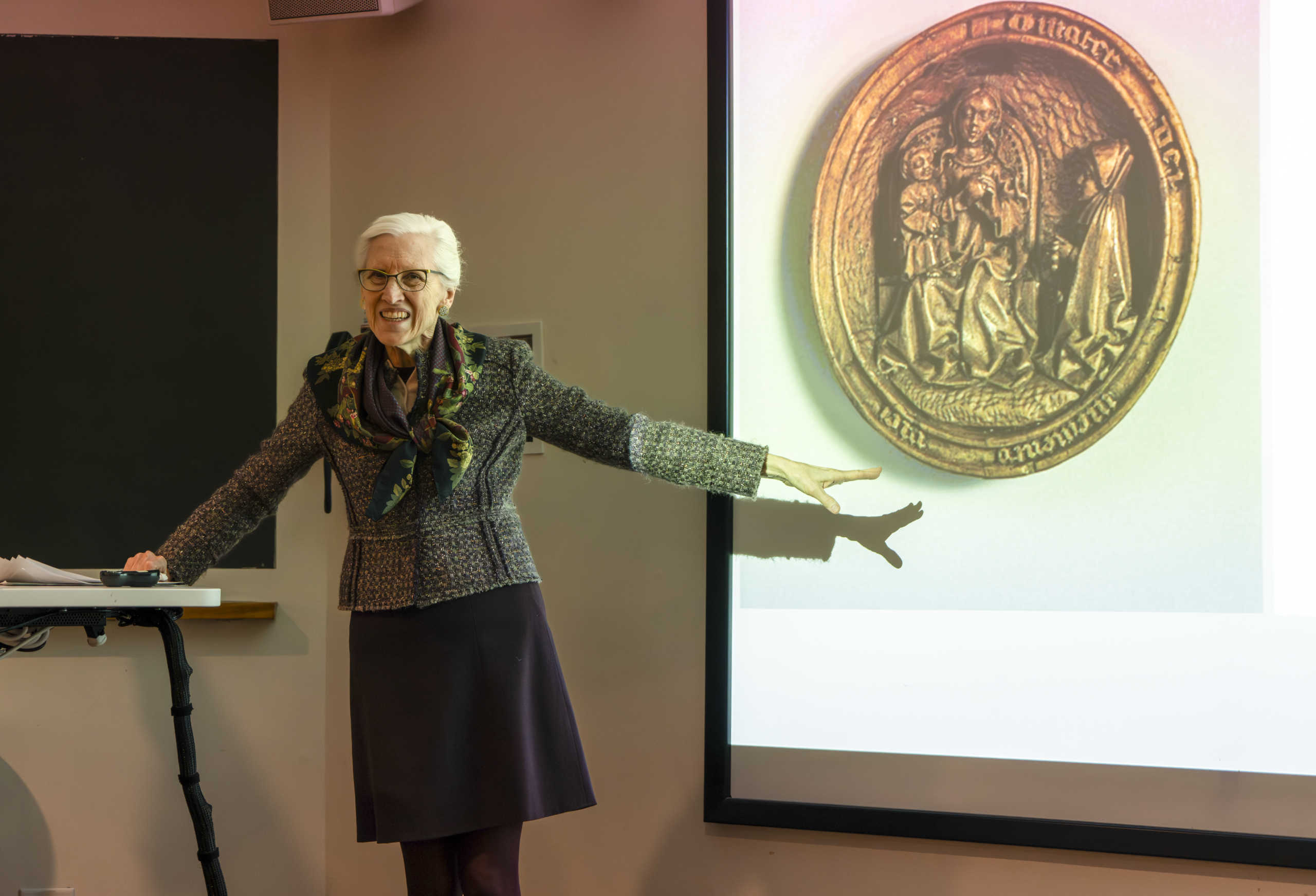
On Tuesday evening, Barbara Drake Boehm, curator emerita at the Metropolitan Museum of Art, spoke to students and faculty about one of the tiniest treasures Northern European art has to offer: carved boxwood prayer beads. The talk, entitled “In a Nutshell: Mystery and Meaning in Miniature Boxwood Carvings,” explored why these private devotional objects have garnered such attention from the art history world and beyond.
Boehm, a graduate of Wellesley College and the Institute of Fine Arts at New York University, has spent her career working in medieval art curation, most recently as the Paul and Jill Ruddock Senior Curator at the Met Cloisters before reaching emerita status. She has curated a range of exhibitions over her career, most famously “Search for the Unicorn,” an exploration of the mythical creature in French tapestry.
Recently, her attention has turned to Netherlandish miniature boxwood carvings, a fan favorite at the Met. Boehm began her talk by highlighting the public’s fascination with these items.
“One of the things that happens with these small objects … is that the public really notices them in a museum that has thousands of objects of all sizes, shapes and materials,” she said. “These are objects that touch people for reasons we don’t fully understand. When we move a sculpture in the medieval department of the Cloisters, nobody notices. But if we move one of these little objects, we get calls from the desk, ‘Where are they? Somebody moved the prayer bead.’”
Boehm explained that this fascination with the minuscule is not limited to the world of European art, highlighting an innate human interest in the tiny.
“When I went to the Islamic Museum in Doha, there’s a whole case full of little, tiny Quran manuscripts. These particular examples are later, but again, it speaks to a kind of fundamental human fascination, a kind of Alice in Wonderland, miniature, fall into something, absolutely tiny and wonderful,” Boehm said.
Boehm continued, addressing one of the main goals of her lecture: finding connections between her audience and the objects.
“One of the things you have to do as a curator is always think about the ‘who cares’ factor,” Boehm said. “Why should you care about these little objects made in the Netherlands around the year 1500? Why should it matter to you?”
Her lecture emphasized the importance of materials in understanding the meaning of the items. Due to a particular biblical translation, it was commonly understood at the time that the cross on which Jesus was crucified was constructed of boxwood, Boehm explained. Boehm used a French carved depiction of Palm Sunday to illustrate boxwood’s connection between the religious and material worlds.
“If you look, this is from the relief of the choir enclosure from 14th-century Notre Dame in Paris, and you see, it’s a representation of Palm Sunday. Jesus on the donkey coming into town, and the people climbing up in trees to welcome him, and look what they’re waving. It looks an awful lot like a boxwood tree,” she said. “So, boxwood has a meaning within the medieval church and in the church today that is greater than you might have otherwise guessed, as a wood of the cross.”
Boehm noted that there is a dearth of understanding of the artists of the carvings, especially when compared to carvers of larger pieces, such as German master sculptor Tilman Riemenschneider.
“This is before the artist’s celebration of self,” she said. “You’re part of a workshop. You are proud of what you do. You might be in a guild. It’s the work that matters, not the celebration of you as the creator. Another thing might be that, because it’s not in an inherently precious material, the recordkeeping … might be less precise.”
Professor of Art History Stephen Perkinson, a friend and colleague of Boehm, reflected on the lack of information surrounding the artists of these works.
“I think about how we know [Riemenschneider’s] name, even though he doesn’t sign anything, because his work involves big projects. We have a kind of corporation signing a contract. And so, these must have been much more sort of intimate, one-on-one transactions between a leader of a shop and a client. And so that’s the sort of documentation, if it ever existed at all. These handshakes have vanished, as there [are] no monograms,” Perkinson said. “It’s hard to measure. It’s quite amazing to think about that.”
Boehm circled back to the meaning of her talk’s title, warning her audience against oversimplifying the stories of these small objects because of their size.
“You should be wary of anything that is presented to you in a nutshell, because it usually means you can’t put it in a nutshell,” she said.
Comments
Before submitting a comment, please review our comment policy. Some key points from the policy: