
Writer and podcaster Coleman Hughes offers a rebuttal of race consciousness and affirmative action policies
April 3, 2026
 Addison Moore
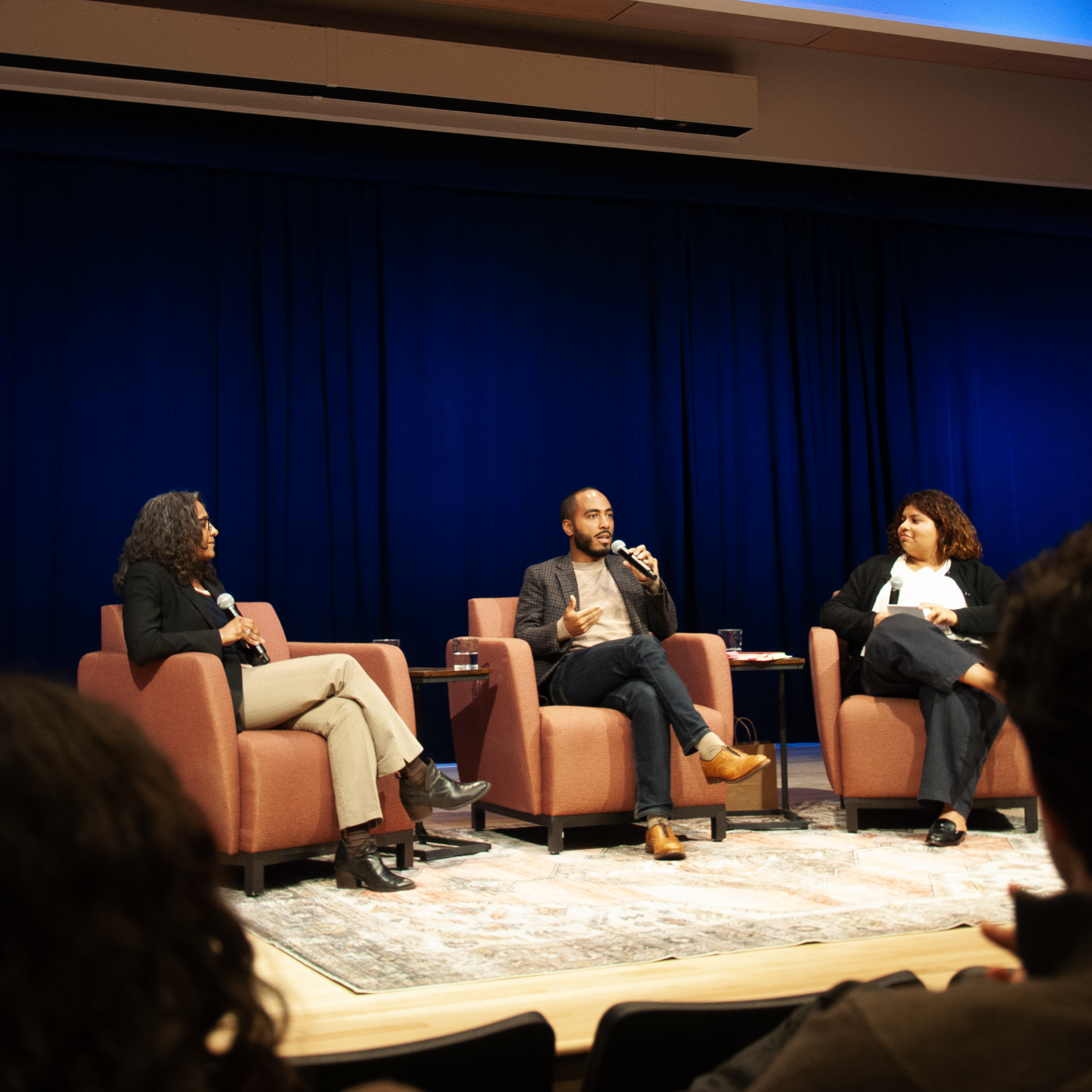
On Tuesday afternoon, students, faculty and community members assembled in Kresge Auditorium to hear writer and podcaster Coleman Hughes’s lecture as a part of the Viewpoint Exchange series. Hughes, who is currently a columnist at The Free Press, was joined by Professor of Africana Studies and English Tess Chakkalakal and Abigail Ramirez ’26 on stage to discuss his book “The End of Race Politics: Arguments for a Colorblind America.”
While the term “colorblindness” typically carries baggage, Hughes insisted on a different vision for its use.
“For me, what it means to be colorblind is to try your very best to treat people the same, regardless of race,” Hughes said. “I think the more controversial part for people, depending on who you ask, is to ask the government not to treat you differently on the basis of race. And so far as a government has an interest in correcting imbalances in society, that should be done on the basis of socioeconomic [status and] class instead of on race.”
For Hughes, America has progressed to the point where race should not be used as a proxy for need.
“So if I’m applying to college, let’s say you’re using race as a proxy [for disadvantage]—that system would identify me as a disadvantaged student, even though I grew up in an upper-income household in a wealthy suburb,” Hughes said. “Whereas, if you’re selecting on socioeconomics, you’re going to correctly identify that I’m actually not the type of kid that needs a leg up. There could be a white kid from Youngstown, Ohio that grew up in much more difficult circumstances.”
Continuing with his focus on higher education, Hughes explained how he viewed the emphasis on race during his undergraduate experience at Columbia University as harmful.
“It was possible to come in as a Black student and just say, ‘I’m going to live in Black student housing. I’m only going to talk and hang out with people like me. I’m going to choose a major that is mostly people like me,’” Hughes said. “And therefore, I’m going to do my four years basically siloed and intentionally not experiencing both the benefits and the discomfort of diversity.”
Hughes discussed how, in his book, he calls the modern focus on race “neo-racist.” He explained to the audience how this modern version differs from traditional bigotry.
“It sells itself as a noble pursuit of social justice. It says that people of color, Black people, Hispanics, etc, are in a way morally superior to white people, that we have an innate and indigenous knowledge of what is good in the world, and that essentially what white Americans should do in the presence of people of color is just shut up and listen,” Hughes said.
Hughes justified his position with the work of Martin Luther King Jr., contrasting King’s views with what he sees as the failures of the modern social justice movement.
“In [King’s] final book, “Where Do We Go From Here: Chaos or Community?” he dedicates all of chapter two to critiquing the Black Power movement, which was sort of the [Black Lives Matter] of its day. And one of his critiques is that it should have been called ‘Power for Poor People,’ not Black Power, because he argued that social policy should be looked at in terms of class,” Hughes said. “This philosophy that actually won the Civil Rights Movement was not wokeness or neo-racism, it was effectively colorblind classical liberalism plus nonviolent activism.”
Hughes discussed how he sees affirmative action as harmful for students of color.
“They found that what was happening with a lot of Black kids at Duke University is that they were just as likely as [first years] to want to do hard science majors, to do engineering, chemistry and so forth, but because they were admitted with lower standards, they were feeling like the dumbest ones in the class. And so what did they do? They switched to softer sciences and humanities,” Hughes said. “They found the exact same thing happened to what other class of students? Legacy admits and student athletes: [the] same exact phenomenon.”
For Michael Bagnoli ’26, Hughes’s lecture was relevant to his coursework and offered a different perspective.
“We were talking about race in my political theory class on Alexis de Tocqueville.… Tocqueville also talks about how Americans value equality over freedom, or have a more lasting ardent love for equality over freedom,” Bagnoli said. “And I think in some ways that that is what the ‘neo-racist’ policies are aiming at—equality at the expense of freedom—or at least Tocqueville [would] see it that way. Overall, I thought it was serendipitous.”
Comments
Before submitting a comment, please review our comment policy. Some key points from the policy: