
Professor of Government Michael Franz examines outside group spending in American elections
April 3, 2026
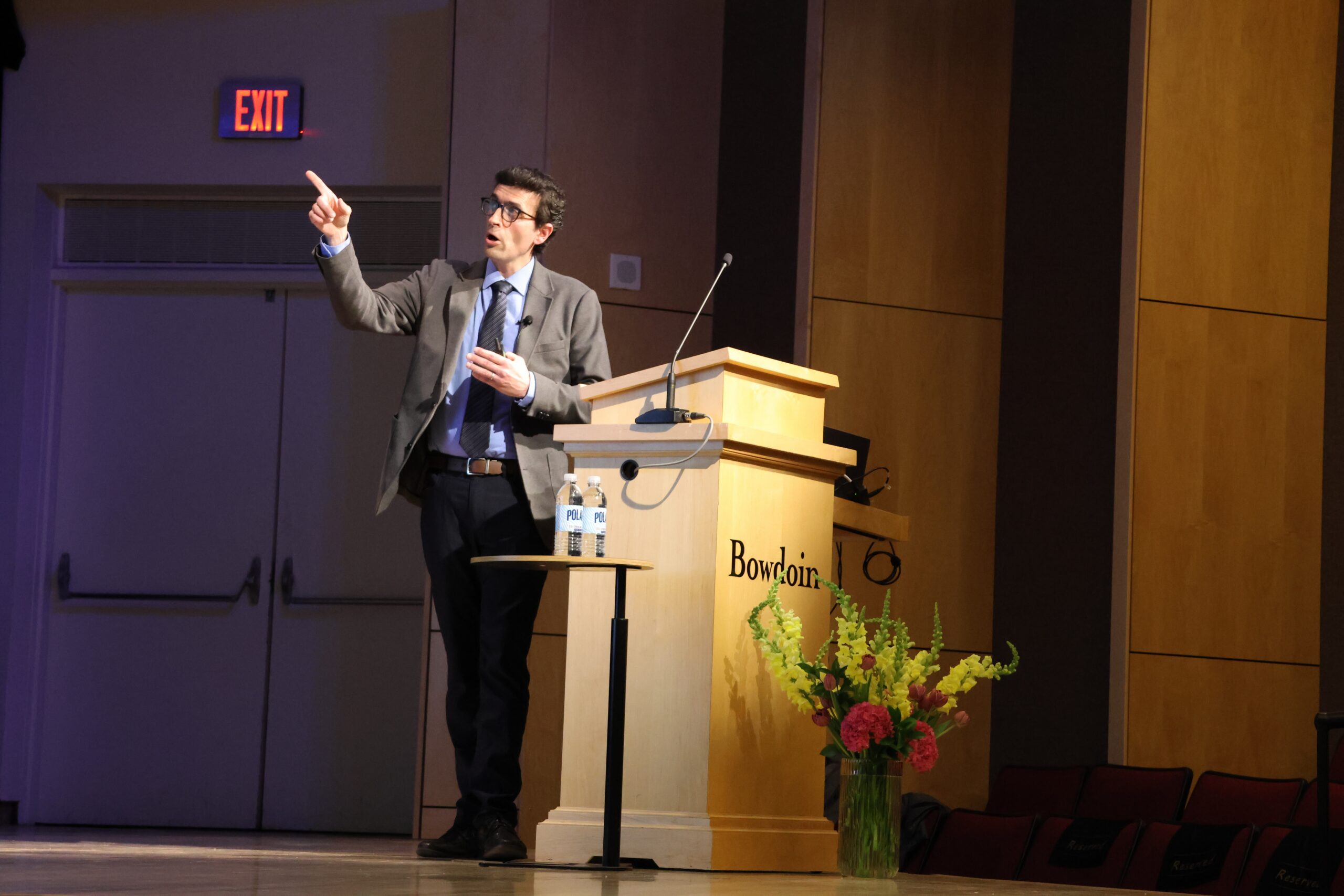 Addison Moore
On Tuesday, Professor of Government Michael Franz delivered his inaugural lecture in Kresge Auditorium as the DeAlva Stanwood Alexander Professor of Government. In the lecture, titled “Choices and Changes: Interest Groups and Their Continued Role in Elections,” Franz discussed the history of outside group spending and the current scale and scope of interest group activity in American elections.
After an introduction from President Safa Zaki, Franz began by sharing that his interest in interest group involvement in American elections dates back to when he joined the Bowdoin faculty in 2005 and that he hoped to focus the lecture on his many years of research on the topic.
Noting increasing partisan polarization in the 1990s, Franz explained that groups like the National Rifle Association (NRA) began taking greater interest in political debates. He presented political advertisements from NRA personality Charlton Heston to explain how issue advertisements, those not explicitly endorsing a candidate in an election, had no limit on contributions. Franz dubbed this the Charlton Heston loophole.
“This was a massive loophole in the law that outside groups and political parties figured out in the late 1990s. As long as they didn’t tell you who to vote for, it was considered an issue ad, and it could be paid for any way they really wanted,” Franz said.
Congress closed the Charlton Heston loophole in 2002 with the Bipartisan Campaign Reform Act (BCRA) in 2002, commonly known as the McCain-Feingold Act. BCRA was upheld by the Supreme Court in 2003. The most significant challenge to BCRA was presented by Citizens United, a group which had made a documentary critical of Hillary Clinton. The group argued advertisements for their documentary ought not to be subject to regulation under BCRA.
In 2010, the Supreme Court made a broad ruling on the Citizens United case, exempting outside groups from campaign finance regulations.
“Outside groups can really do whatever they want, and they justify this partially as a First Amendment right of these outside groups,” Franz said. “You can pay for these ads any way you want.”
Citing data from the Wesleyan Media Project, of which he serves as a director, Franz explained that the McCain-Feingold Act had worked as intended by decreasing party spending in elections after 2002. Outside group spending, on the other hand, was around ten percent in 2000 and hovered there until the Citizens United ruling, after which it rose sharply. However, the spending is not evenly spread across elections but instead is concentrated in competitive races.
“In the last two elections, over one in three ads on the air were from outside groups. These are interest groups like the NRA; there are other types of groups, like super PACs,” Franz said. “They’re really interested in the most competitive elections where control of Congress is up for grabs.”
Franz explained three types of outside groups: dark money, full disclosure and partial disclosure. Dark money groups are nonprofits that spend money on elections and do not have to publicly reveal their donors by tax law. Full disclosure groups, most often super PACs, raise money from large donor individuals who must be disclosed. Partial disclosure groups are the dominant group, receiving money from both individuals and dark money sources.
“In 2024, the majority of spending from outside groups were for these partial disclosing super PACs that accepted significant sums of money from 501(c)(4) organizations,” Franz said.
As a result, Franz explained that the dark money total in the 2024 elections reached a conservative estimate of $1.9 billion.
Franz then explained his recent research on interest group spending in the digital advertising space. Given the lack of regulation in digital advertising for political candidates, Franz has developed new technology to track outside group spending in these spaces.
“We were able to get these assessments of how much spending in federal races is sponsored by outside groups. And in 2024, it was a significant amount,” Franz said. “On social media platforms and on [connected TV] for the full cycle, 60 percent of the spending in federal elections is likely coming from these outside groups, many of whom were partial disclosing groups.”
Franz finished by advocating for regulations increasing transparency. These could include requiring nonprofits that spend money on elections to disclose their donors, limiting spending on digital election ads and requiring groups to put their Federal Election Commission codes or Employer Identification Number tax labels on their ads.
“Even if we can’t limit the amount of money that’s spent in the electoral process, we might be able to have a better and more complete picture of who’s spending it,” Franz said.
Attendee Jed Cohen ’28 noted Franz’s use of data to highlight the magnitude of campaign finance issues the U.S. faces. He also appreciated Franz’s practical solutions centered around regulating for greater transparency.
“[Franz] mentioned that close to $2 billion in the last set of federal elections came from unknown sources,” Cohen said. “I think that’s definitely something that we don’t want going on in our elections.”
Comments
Before submitting a comment, please review our comment policy. Some key points from the policy: