
eARTh exhibition spotlights various interpretations of the Earth in the Roux Center
April 3, 2026
 Abigail Hebert
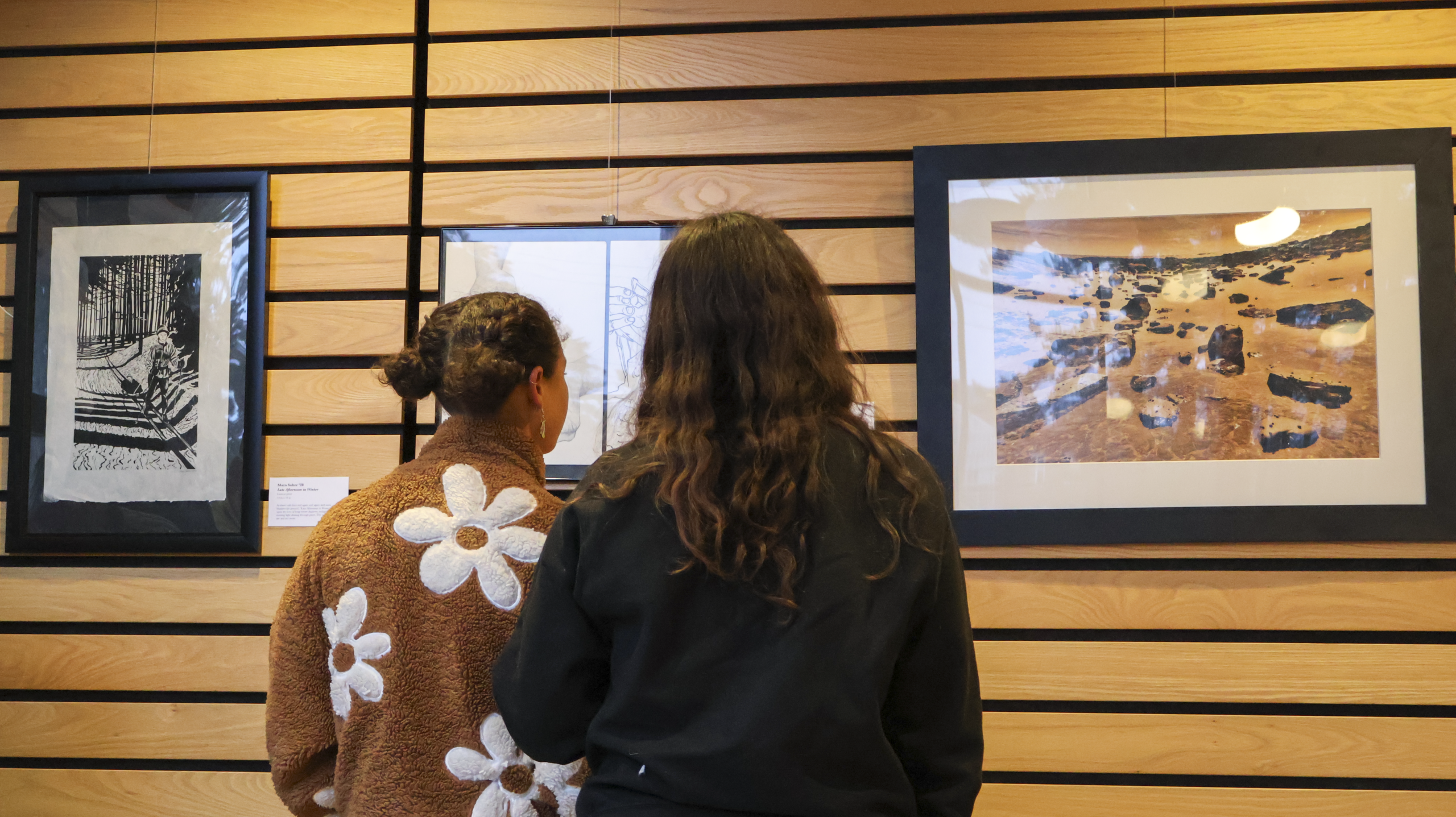
On Thursday, student curators Tess Mooney ’26 and Caitlin Panicker ’26 welcomed students and community members to the opening of eARTh, an art show “celebrating Earth in its beauty and fracture.” As the audience clustered on the wooden stairs, Anaïs Létard ’29 and Isa Alvidrez ’29 read from their poems, “I Hated the Earth” and “What Do They Mean To You?” The readings were followed by words of appreciation to Earth and Oceanographic Science Academic Department Coordinator Bridget Spaeth, Program Manager for Environmental Studies and Roux Building Manager Rosemary Armstrong and Maya Salter ’28, who provided installation assistance.
Featuring the works from 20 students, faculty and staff, the exhibition spreads across the Roux Center for the Environment from the first to the third floor, where viewers can easily stop to observe the artwork as they move through the building. This is the third eARTh exhibition since its inauguration in 2021. Mooney and Panicker were motivated to bring the show back to life after curating an art show together in 2025.
“We decided to do this art show after having curated an art show last spring called ‘Field (Art) Work’ about Kent Island student artists-in-residence’s artwork,” Mooney said. “We had a really fun time putting it together last spring, so we wanted to do another one. I know that … the Earth and Oceanographic Science Department has a history of putting on eARTh art shows, and there’s been a couple of years of hiatus from that. We wanted to bring it back at the suggestion of [Spaeth], the department coordinator.”
As Mooney and Panicker aimed to show a diverse range of perspectives, the curating process focused on finding ideal placements for each piece rather than choosing from the submitted works.
“We wanted to make it as accessible and open to the whole campus as possible,” Mooney said. “Last year, the art show was a lot more focused in its scope…. This year…, we have a combination of student, faculty and staff [submissions], which is what we were hoping for…. Everything that was submitted is being included in the show.”
This diverse group of artists was reflected by the varied mediums featured in the exhibit —from nature photography to a cardboard gull to political commentary. Artists took various spins on the topic of “Earth in its beauty and fracture,” illustrating personal stories, the importance of land in history and picturesque landscapes. Mooney explained why the Roux Center was the perfect place for such diversity.
“Really, the only theme that we had when we were doing our call for art was it had to be Earth-related, and people can interpret that pretty broadly,” Mooney said. “The Roux Center is also a nice space to do this, because we don’t have a ton of external constraints about what work we can display. That makes space for people who haven’t displayed their work before, or who aren’t necessarily professional artists, to feel comfortable sharing their work.”
Anaïs Létard ’29 shared the message behind her poem, “I Hated the Earth,” one of her two works featured in the exhibition.
“For [“I Hated the Earth”], I really wanted to convey how you can go through your own personal struggles and how that can also relate to nature,” Létard said. “The main idea behind that poem is that the Earth seems so pristine, or it seems like everything is working perfectly…. Everything has a sense and a plan.”
Mooney also submitted three works to the show, featuring locations from Maine to Iceland to Utah. One of her prints, “Garnets,” featured a self-portrait of Mooney on a rock outcrop, looking at the brilliant red stones.
“Garnets are little red minerals that have grown on a lot of the rocks in midcoast Maine,” Mooney said. “I spent a lot of time focusing on these rocks this semester for an independent study … [and] looking at the rocks in a really analytical way…. I think that the places that they grow and the story they tell of the history of this part of Maine’s coast and continental collision history is really interesting. And I think it’s also beautiful.”
To Létard, eARTh provided a good opportunity to combine her two interests: creative writing and the environment. Létard emphasized the importance of this interdisciplinary combination.
“One of the main reasons I find it really important to combine [art and environment] is that it helps people have a personal connection to what’s happening. It’s very easy to get lost in bad news reports and statistics and conceptualizations of science. And you’re like, ‘I can never understand that,’ but if you transmit that information through art, we’re trying to find ways to connect with people on a more personal level. There will be more ways for people to feel like they want to get engaged or to understand what’s actually happening,” Létard said.
The artwork will be available to enjoy in Roux until the end of the school year.
Caitlin Panicker ’26 is a member of The Bowdoin Orient.
Comments
Before submitting a comment, please review our comment policy. Some key points from the policy: