
Katie Petronio ’07 and Quincy Leech ’17 deliver Everett P. Pope lecture on leadership and service in Marine Corps
December 5, 2025
 Isa Cruz
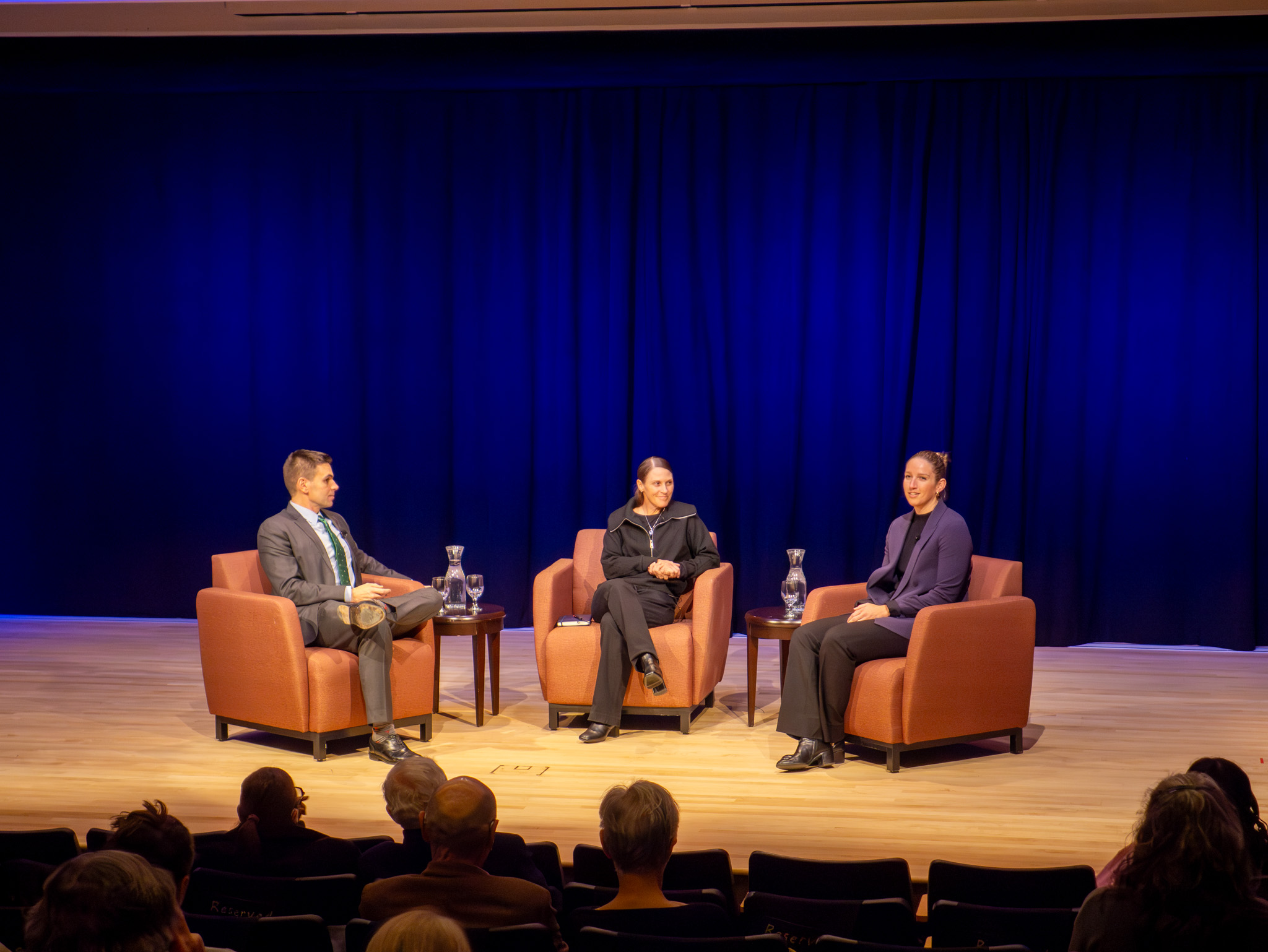
Last night, retired Lieutenant Colonel Katie Petronio ’07 and United States Marine Corps (USMC) ground intelligence officer Quincy Leech ’17 returned to campus to reflect on their service and deployment in the Marines. Gill Barndollar ’04, a former USMC infantry officer and co-founder of the Bowdoin Marine Corps Society, moderated the discussion, which was held in Kresge Auditorium.
To begin the talk, Petronio and Leech discussed their motives for joining the Marines. Both were inspired by their family’s history of serving the country.
“My mother and my father were both in the Army. My mom [operated] helicopters, and my dad was a combat engineer in the Persian Gulf. And service was really a no-brainer from that point—just living up to their example of trying to be such exceptional human beings,” Leech said.
After discussing their inspirations for joining the Marine Corps, Leech and Petronio reflected on the high and low points of their service. Leech described her time working with her last unit in the Marine Forces Special Operations Command (MARSOC) as one of her most memorable experiences.
“The real highlight was my last unit at MARSOC, with just such an exceptional group of individuals that had such a depth of knowledge from each aspect of the intelligence pillars and being able to see what they can really do when given the opportunity,” Leech said.
Petronio and Leech agreed that the unpredictability of life and risk of death was a significant challenge during their time in service. Petronio reflected on a time when she lost a fellow Marine to suicide, a loss that was especially difficult for her to process.
“It makes sense to lose someone in combat, right? You know you’re going into something, and there’s a likelihood you’re all not going to come back. But when you realize how we lost somebody here, back home, that’s not as easy to process,” Petronio said.
Reflecting on her position as an officer, Leech emphasized the weight of her decisions in combat and how those could directly impact the Marines in her charge.
“Every second that you delay confronting a poor choice, or every night that you spend after a long exercise, you[’re] waking up and thinking about how you could have done something better,” Leech said. “Those are definitely low lights and things that I still think about today that drive me to make better choices or make harder ones that are the right ones in the moment.”
Barndollar also asked Leech and Petronio how their experience at Bowdoin prepared them for their time in the Marines. Leech found the variety of perspectives she encountered at Bowdoin especially helpful in equipping her to make difficult decisions.
“One of the things that I really appreciate about Bowdoin was [that] you’re coming to a place with so many different people,” Leech said. “That was such a formative part of my life, being able to then take that into the Marine Corps, where you do have to have a lot of hard, very frank conversations and then still maintain those relationships going forward.”
After discussing their time at Bowdoin, Leech and Petronio reflected on the possibilities of upcoming wars that the U.S. could be involved in. Petronio discussed the necessary differences that Marines might have to take when facing near peer competitors, such as powerful geopolitical rivals like Russia and China.
“[With] a near peer competitor…, we have to think about the sky. We have to think about naval influence and naval fires,” Petronio said. “We’ve gotten way too comfortable playing land army against a one-legged adversary.”
Leech emphasized that past conflicts such as World War II or the United States’s interventions in Vietnam, Iran and Afghanistan, while different from what might come next, still inform the future of the Marine Corps.
“We shouldn’t forget the lessons that we learned from the blood, sweat and tears that we expended in Iraq and Afghanistan and elsewhere when we encounter conflict [in the future],” Leech said.
Leech and Petronio also discussed their experiences as women in a male-dominated career field. Petronio explained that the pressing needs of the Marines consistently overrode rules and expectations regarding gender.
“For all of the combat engineers, you had to be a male combat engineer working in [a combat engineer battalion] to support the infantry,” Petronio said. “There was a 78 percent casualty rate. There was no one left, so I got to go. So I was already breaking these rules, and I did it really well.”
One of Leech’s final points was that during her time at Bowdoin, she found a sense of community among other students who shared her goal of joining the Marine Corps.
“You do have resources to ask questions, and you have people who graduated before you [who] you can call and ask questions,” Leech said. “So I think that just speaks highly of the Bowdoin community, which is so tight-knit.”
Comments
Before submitting a comment, please review our comment policy. Some key points from the policy: