
BOSS reveals increased AI usage, campus reactions to recent events and Hastings Initiative
December 5, 2025
Introduction
“Do you give a damn?” For 86.7 percent of respondents to this semester’s Bowdoin Orient Student Survey (BOSS), the answer is yes. Drawing from 336 anonymous respondents across all class years, the survey captured student sentiment on a variety of topics pertaining to campus life and the Bowdoin community.
Current events
Roughly 60 percent of respondents reported that they voted in the recent 2025 U.S. elections, while 34 percent chose not to vote and 7.9 percent are ineligible to vote in the U.S. Political opinions have not shifted dramatically compared to the previous year. Respondents on average scored a 27.8 on the political leaning scale, with 0 representing the furthest left and 100 the furthest right.
Compared to the First Year Student Survey, the Class of 2029 shifted 1.6 points to the right on the political leaning scale since the start of the school year, sitting at 26.6 and following a similar trend seen in the Class of 2028. The Class of 2026 ranks the most right-leaning with a 29 on the scale, while the Class of 2027 ranks the most left-leaning with an average score of 26.2 points.
Respondents strongly approved of New York City Mayor-elect Zohran Mamdani ’14, with a general approval rating of 8.39 out of 10.
When asked about The Office of Safety and Security’s decision to postpone a student-led vigil for Charlie Kirk, 57 percent of respondents were satisfied or very satisfied with Security’s response. Thirty-four percent of respondents were neutral to the decision, while nine percent of respondents were unsatisfied or very unsatisfied with the response.
The three percent that reported feeling very unsatisfied with Security’s response also had an average political leaning of 64.5 out of 100, compared to an average of 25.6 for those who were neutral, satisfied or very satisfied with the decision to postpone the event.
Regarding finances, around 93 percent of respondents were aware of Bowdoin’s tuition increase for the current academic year.
Academics and AI
When asked whether they thought their major required more faculty, respondents with majors categorized by the College as Humanities and Fine Arts topped the list with the most perceived need. On the other hand, respondents with majors in the College’s larger departments, such as government and legal studies, chemistry, and economics, were found at the bottom of the scale of perceived need for faculty by students.
Students continue to find the implementation of Workday controversial, despite the Class of 2029 having never used Polaris for course registration. Among those who have experienced both registration systems, 74 percent of respondents either slightly or strongly prefer Polaris.
The new model of first-come, first-served class registration by seniority provided through Workday has also shifted the proportion of students who got their first-choice classes. Eighty-six percent of respondents from the Class of 2026 received their first choice classes, while only 47 percent of respondents from the Class of 2029 reported the same outcome.
Since the College’s implementation of the Hastings Initiative for AI and Humanity following Reed Hastings ’83’s $50 million donation, approval ratings for the Hastings gift have decreased. On a scale from zero to ten, the current score of four represents a mildly negative attitude toward the program, down from an approval rating of 5.64 last semester. Despite this, general artificial intelligence (AI) usage among the student body has increased from 87 percent last semester to around 91 percent this semester, with roughly 72 percent of respondents reporting some sort of AI usage allowed in their courses.
Approval ratings
To determine student opinions on different entities within the Bowdoin and Brunswick communities, the Orient asked respondents to rate their approval of various individuals and groups.
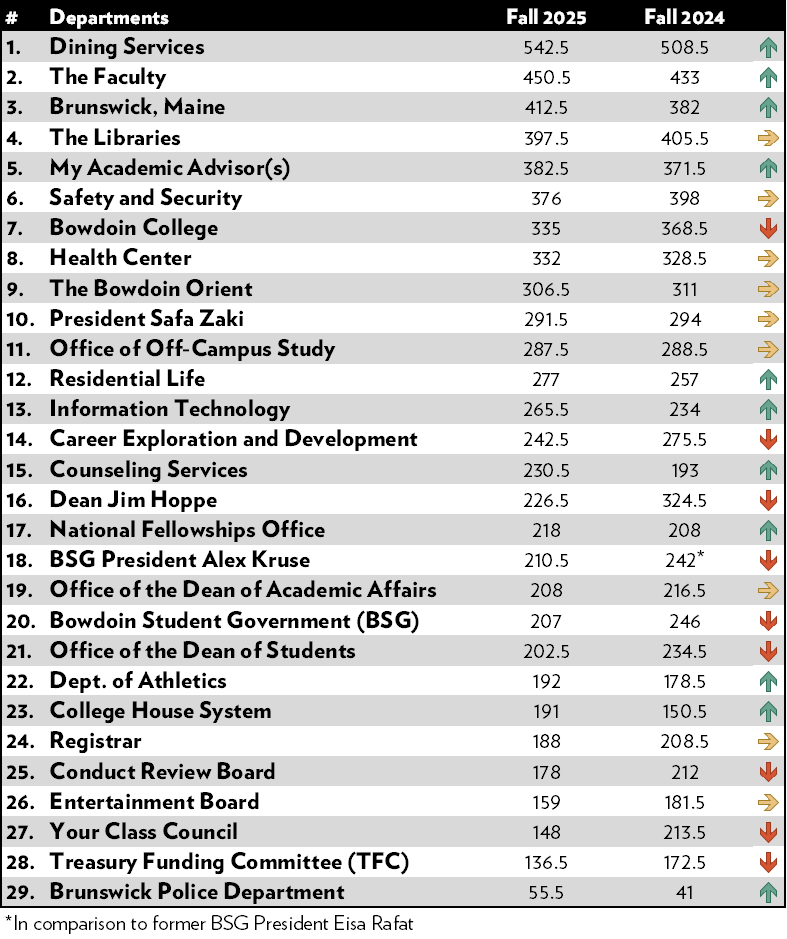
Since last year, ratings of different entities have been converted into scores and ranked accordingly to better reflect student opinion. Points are awarded by assigning weights to responses and then calculating the total sum for each department. “Strongly approved” responses received two points and “approved” responses were awarded one point. “Neutral” responses counted as a half-point, while “disapproved” and “strongly disapproved” responses negatively impacted the total sum awarded by one and two points respectively.
 Shihab Moral
The Dining Service continues to hold the top spot of student approval on campus, securing a net approval score of 542.5—an increase from 508.5 last year. Faculty followed in second place with 450.5 points, while Brunswick (412.5), the libraries (397.5) and academic advisors (382.5) rounded out the top five. Notably, four of the top five entities saw their approval scores rise compared to the fall 2024 BOSS.
At the other end of the spectrum, the Brunswick Police Department remains the lowest-ranked entity with a score of 55.5. However, this score represents a 14.5 point increase from last fall’s score of 41. The Treasury Funding Commission also sat near the bottom of the list, ranking 28th of the 29 entities listed.
Senior Vice President and Dean for Student Affairs Jim Hoppe recovered from his drop to 27th place last semester, improving to 16th place with a score of 226.5. The Office of the Dean of Students similarly improved from last semester’s rankings but still ranks lower than its score from fall 2024. Approval for Class Councils plummeted from 213.5 points to 148 points, ranking at 27th place this semester.
Mentality
While a majority of students do not have an opinion on the College House system, respondents across all class years voted MacMillan House as the best house on campus. Sophomores also ranked MacMillan first but viewed Quinby House in a more positive light, placing it in second place compared to the larger student body, who ranked Quinby in sixth place.
Nearly all students—94 percent—have found belonging and community at Bowdoin, the same percentage as the previous year. This begs the question: Is the “you belong at Bowdoin” merch working?
What comes first, the student or the College? When asked whether they describe themselves as “a student who goes to Bowdoin” or “a Bowdoin student,” 79.3 percent of students viewed themselves as a Bowdoin student.
Finally, nearly 87 percent of respondents give a damn, which is a ten percent increase from last year but consistent with previous years.
Abdullah Hashimi, Shihab Moral and Kaya Patel contributed to this report.
Comments
Before submitting a comment, please review our comment policy. Some key points from the policy: