
Howard French talk recenters Africa’s role in global history
November 21, 2025
 Andrew Shi
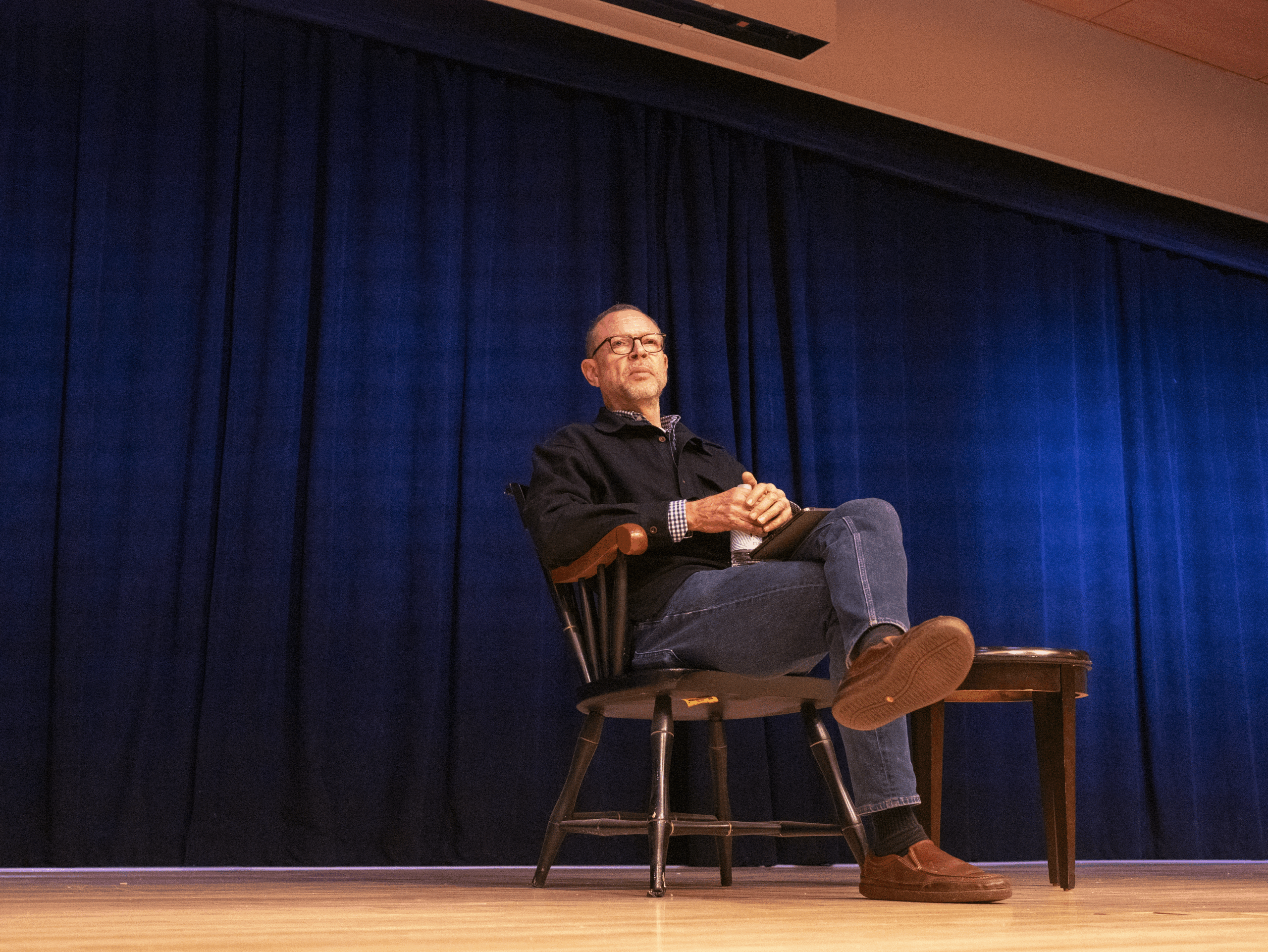
On Wednesday evening, author and Columbia University Graduate School of Journalism professor Howard French presented a talk in Kresge Auditorium titled “Right in the Thick of It: Africa’s Uncredited Role at the Heart of Our History.” French explored how Africa has been central to the social and economic developments that drove global trade and commerce over hundreds of years, with a focus on former President of Ghana Kwame Nkrumah and other African leaders.
The talk was the seventh and last installment of this semester’s Viewpoint Exchange speaker series and was introduced by Senior Vice President for Inclusion and Diversity Benje Douglas.
French began the talk by discussing how his initial career path as a freelance journalist shaped his interest in the topic of African history.
“I was a freelancer in West Africa right out of college,” French said. “I sort of stumbled into journalism quite by accident. I knew I wanted to write. I always loved to read. I … began to travel around and was completely enthralled by how different, how stimulating it was to be in an environment so different from anything I had known previously.”
French eventually became a foreign correspondent and senior writer for The New York Times, going on to write a number of books. He discussed how one of his books, “Born in Blackness: Africa, Africans and the Making of the Modern World, 1471 to the Second World War,” aims to highlight African contributions to human development.
“It is the story of how Europe ‘discovered’ Africa, particularly West and Central Africa, and how, in the aftermath of this discovery, Africa and Africans actually changed the world at least as much as Europeans changed the world. We are really not prepared to hear that, in general, as a society,” French said. “If you get any education at all, you get socialized into these [Eurocentric] ways of thinking very at a very early age.”
French went on to describe how a West African expedition from Mali transformed European commerce and increased European recognition of Africa.
“Beginning in 1325 to 1326…, a man in an empire called Mali … set off on a pilgrimage to Mecca, and he stopped along the way in Cairo in 1326, carrying more gold than any single individual in human history before or since has ever controlled.… Word of this fabulous wealth spreads into Europe very quickly,” French said.
Next, French discussed his latest book, “The Second Emancipation: Nkrumah, Pan-Africanism and Global Blackness at High Tide,” drawing inspiration from his time as a New York Times journalist in the Ivory Coast. The book focuses on Kwame Nkrumah, the former president of Ghana and a leader in the Pan-Africanist movement, as well as other seminal figures like Marcus Garvey.
“[Nkrumah] was a catalyst and spark, motivator and example setter for almost the entire continent,” French said. ”Kwame Nkrumah was associated with Pan-Africanism…, something that you can trace at least as far back as a person named Marcus Garvey, who was born in Jamaica and who spent his … most active years briefly in the UK and then subsequently in the United States, forming a global movement.”
According to French, Kwane Nkrumah studied in both the United States and United Kingdom, where he began his career as a politician and activist before he became leader of Ghana.
“He applies to law school, and he gets kind of seduced into … the African student movement in the UK and quickly emerges as a leader,” French said. “He’s got talents. He has ideas. He is somewhat charismatic.… [The movement] recruits Kwame Nkrumah with the offer to become secretary general of the party.”
French also discussed James Horton, a historical figure who was born in Sierra Leone and changed his name to Africanus as an affirmative act of pride for Africa. According to French, Horton was instrumental in developing ideas for African self-governance.
“[Horton] returns to Sierra Leone, and he begins to advocate … for a regional government in Africa that would erase colonial divides and provide a place for African governance under the sovereignty of colonial powers but without their direct interference,” French said.
According to attendee Henry Stack ’27, who read part of one of French’s books for a class, the talk was a necessary refocusing on the largely ignored role of Africa in global history.
“Africa [being] at the center of world history is not something that’s told, and it’s not something we learn about,” Stack said. “It’s very central to everything in world history. And I think … what the book really points out is that it’s a failure of our education system.”
On December 3 at 4 p.m., the Office of Inclusion and Diversity will hold an event taking suggestions for next year’s installment of Viewpoint Exchange.
Comments
Before submitting a comment, please review our comment policy. Some key points from the policy: