
Write your own labels: “hyperVISIBLE” showcases the whimsical in the American diaspora
November 20, 2026
 Addison Moore
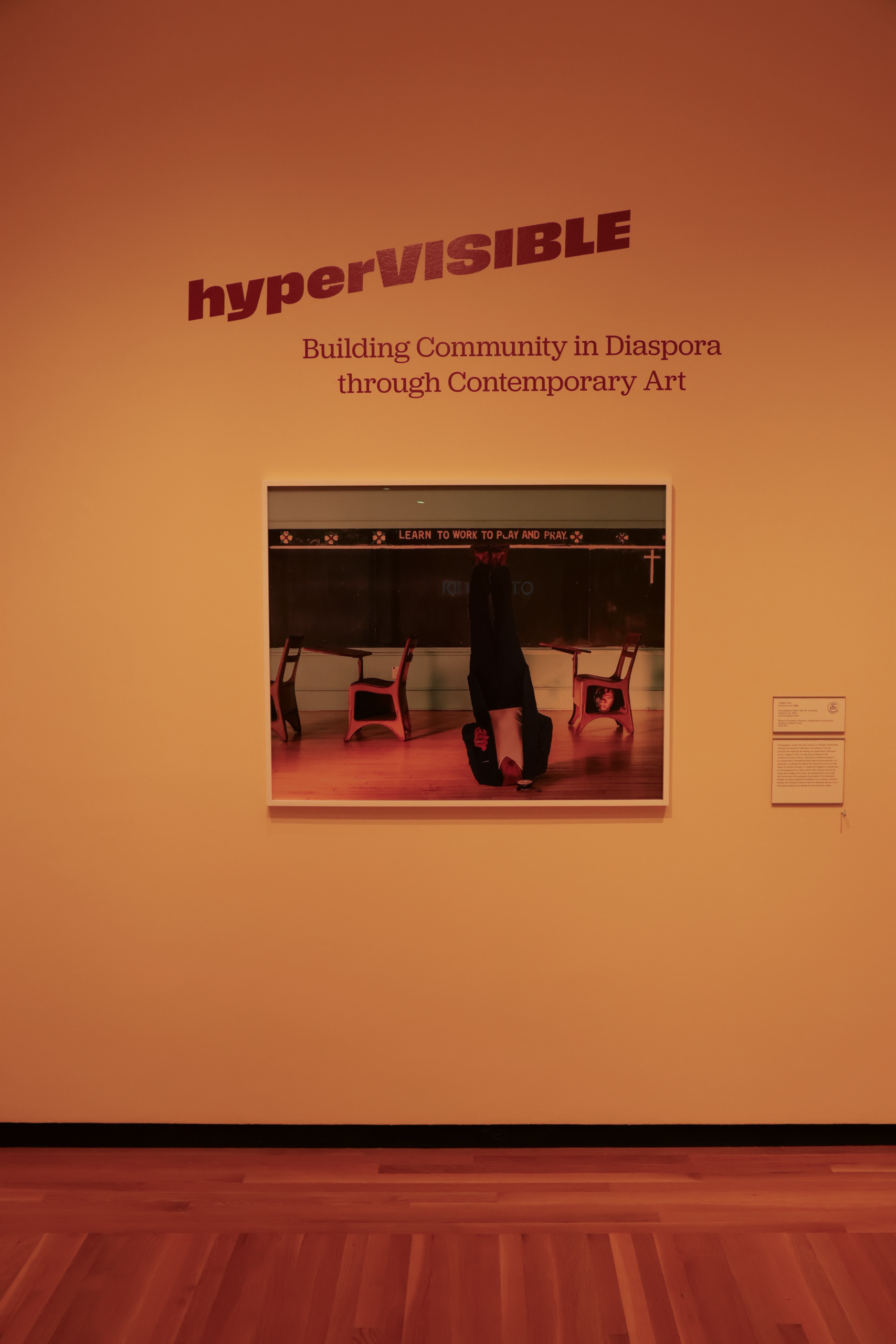
On Thursday afternoon, the Bowdoin College Museum of Art (BCMA) revealed a new exhibition curated by Edwin Kim ’27. Titled “hyperVISIBLE: Building Community in Diaspora through Contemporary Art,” the exhibition features eight artists representing various diasporic experiences in the United States. The exhibition is hosted in BCMA’s Becker Gallery, a space often curated by Bowdoin students and faculty in collaboration with BCMA staff.
“Finding ways that we can reach [students and faculty] meaningfully is sort of our biggest goal,” BCMA Curator Casey Braun said. “So one of the most effective ways we can do that is actually by working with students on their projects.”
Kim reflected on his experience seeing a previous faculty-curated exhibition in the gallery as inspiring his decision to curate his own exhibit, “hyperVISIBLE.”
“I remember ‘Without Apology,’ which … was co-curated by the Asian Studies department and the museum,” Kim said. “It was on the Asian American diaspora and the Asian American experience. I saw that in my first year. And it was awesome.”
He recounted feeling like his experience as an Asian American living in New York City was being reflected in these works, especially the sculptures of ceramic artist Stephanie Shih. She creates ceramic copies of everyday objects that are familiar and hold sentimental value for many in the Asian American community.
“[Shih] started creating these ceramic replicas of pantry staples and food items that she grew up with in her Taiwanese American household in New Jersey,” Braun said.
“Looking at that, I was like, this reminds me of walking to H Mart as a kid or going to a Chinese grocery store with my mom. It feels so out of place, but seeing it recognized as … worthy in a museum made me feel … like I also deserve a place in a museum, or I deserve a place at an institution like Bowdoin. It validated a lot of my experience,” Kim said.
Shih’s piece can now be seen in “hyperVISIBLE,” along with other artworks that Kim curated to foster student conversation around diasporic experiences beyond the Asian American experience.
“I thought it would be really cool to gear a show more broadly on the American diaspora, that allows more people to walk into these stories,” Kim said.
Braun, who supervised the curation process, recognized how the mission of broadening the conversation reflects in Kim’s curatorial choices.
“I especially love the way that [Kim] has thought about ‘Weaving Portals.’ …[The piece] looks like a portal. So for him, this was an invitation for visitors to enter this space of being open to learning about new cultures and new experiences,” Braun said.
Braun reflected on how the process of collaborating with student curators like Kim, who bring with them their personal experiences, introduces a current student’s experience to artworks that often span across time and space.
“These are artworks that will be here in perpetuity. So really thinking about the museum and its collection as a community, a living archive, that is reflecting ideas and experiences of a specific moment at a specific time,” Braun said.
When asked about curating the exhibition around the term “hypervisible,” Kim remarked with unfiltered honesty to start.
“I just thought it was a cool word at first,” Kim said.
But as Kim began to explore the diasporic experience, he realized he wanted to expand the dialogue on diasporic artists beyond just their hypervisible biographies or nationalities to include the complexities they represent.
“I think a lot of these artists were trying to represent the feeling of being seen in a way you don’t want to be seen,” Kim said. “A lot of the time … I feel seen as an Asian American, but I want to be seen as so much more than that, and conversation kind of stopped.”
Kim also recognized the whimsical aspects of the migrant lifestyle that are overshadowed by the hypervisible focus on the struggles.
“Especially … now … immigrants [are] so visible in the media…. Everything that’s been talked about in the time of our lives are these horrible things. There’s so much more to the diasporic experience. There’s so much beauty, joy and whimsy in our experiences and I think a lot of these artists represent those balances between … uncanny and whimsy,” Kim said.
Braun echoes this sentiment, hoping audiences can find the diasporic experience inspiring, amid a contemporary world that seems to threaten it.
“We’re living in a world and in a moment where difference is often treated with fear or anxiety, and I hope that what this exhibition does is actually impress on people the many ways that people … all bring to the table different experiences and worldviews that are equally challenging and beautiful,” Braun said.
Kim hopes that his exhibition can provide space for people to not just observe but participate in this diverse array of experiences. “hyperVISIBLE” features a table with a stack of labels and a hook next to each artwork. Visitors are encouraged to write their own feelings and observations on the labels and to hang them alongside the artworks, incorporating their voices into the exhibition.
“This show is less about commenting on the … idea of diaspora and its politicality, [but] more about intending to create a space for students who feel like … they share something with that identity,” Kim said.
Comments
Before submitting a comment, please review our comment policy. Some key points from the policy: