
Film screening explores Latin American Black resistance
September 25, 2026
 Addison Moore
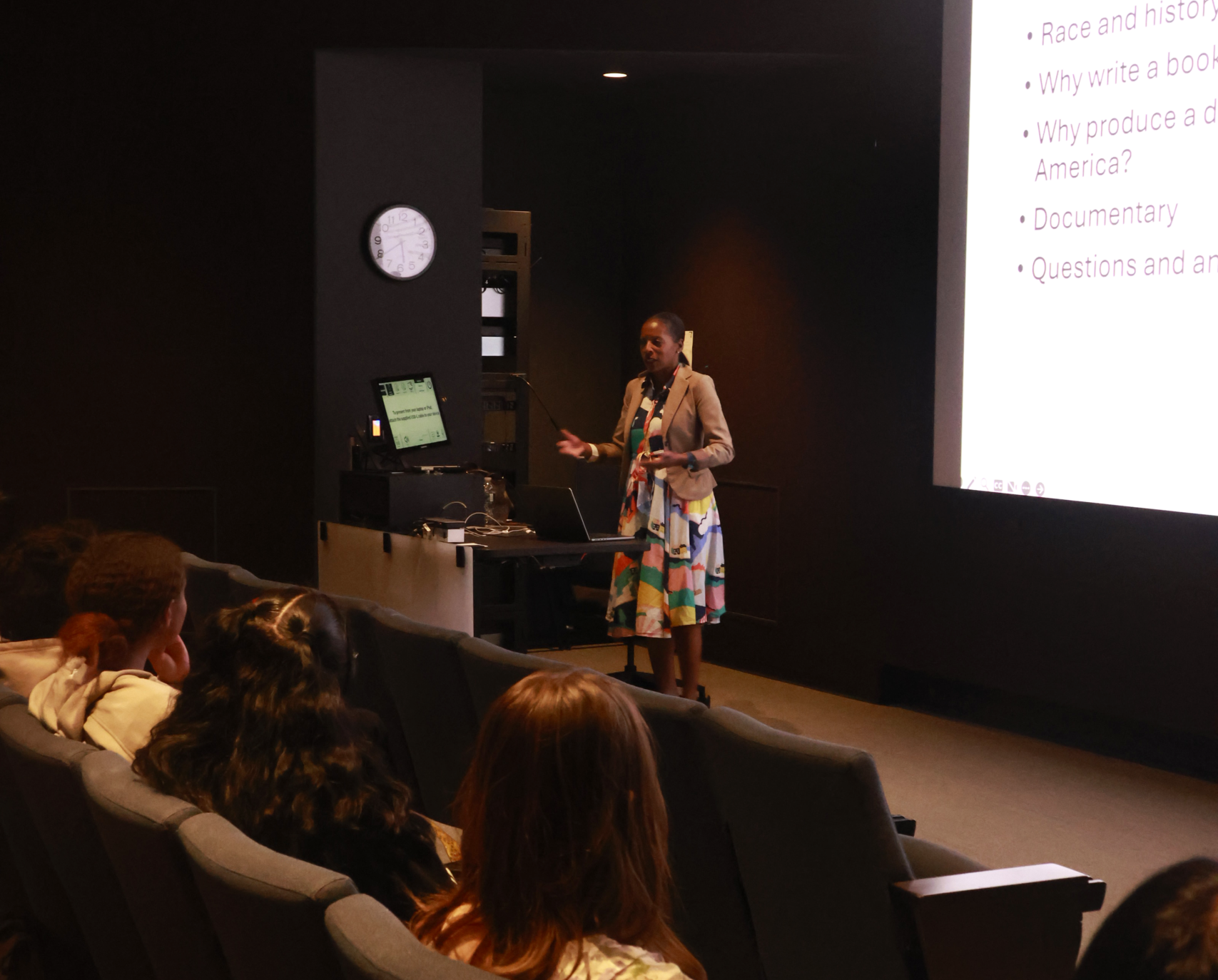
On Thursday, students and community members gathered in Mills Hall for a screening of “Black Lives Matter in Latin America,” hosted by the Latin American, Caribbean, and Latinx Studies (LACLaS) department as a part of the “Communities in Focus” lecture series and co-sponsored by the Africana Studies department. Following the documentary, director Dr. Gladys Mitchell-Walthour led a discussion on the documentary process and the African diaspora and compared racial movements in Latin America and the United States.
Michele Reid-Vazquez, associate professor of LACLaS and director of the LACLaS Program introduced Dr. Gladys Mitchell-Walthour, Dan Blue endowed chair of political science at North Carolina Central University, who traveled to Bowdoin to present her film.
Mitchell-Walthour studies Afro-Brazilian politics and social, gender and race policies in Brazil. She is the author of “The Politics of Blackness: Racial Identity and Political Behavior in Contemporary Brazil” and “The Politics of Survival: The Political Opinions of Social Welfare Beneficiaries in Brazil and the USA.”
Following the publication of “Black Lives Matter in Latin America: Continuities in Racism, Cross-National Resistance and Mobilization in the Americas” in 2024, which she co-edited, Mitchell-Walthour organized a symposium of the same name at the historically Black North Carolina Central University. She wanted to create a space for scholars and activists to gather from countries like Brazil, Peru, Argentina and the United States and examine racial politics and resistance across the Americas.
“We wanted to put out this work so that people can see the long history of activism as well as learn more about the policies put in place to advocate for Afro-descendant populations throughout Latin America,” Mitchell-Walthour said.
With so many contributors in the same place, she saw a chance to reach a wider audience than she could with the publication alone.
“Well, since I’m going to have a symposium, and we’re going to have people here from Brazil, Peru and Argentina, why don’t I think about a documentary, which might appeal more than this huge book,” Mitchell-Walthour said.
The 25-minute documentary, partly filmed at the symposium, features interviews with its participants whose stories of police brutality, violence and marginalization show that Black resistance in Latin America began long before the 2020 Black Lives Matter protests, with roots stretching back to slavery.
“People have been mobilizing for years,” Mitchell-Walthour said. “So the idea that like there was no resistance, and all of a sudden, [there was the] Black Lives Matter [movement] in Latin America, that all was very strange to us.”
Mitchell-Walthour also compared the “myth” of meritocracy in the United States to the “myth” that there is no racism in Latin American countries, where without explicit or historical segregation policies like the U.S.’s Jim Crow Laws, their cultures seek to discount racism maintained through unwritten custom.
“This is the idea that if you have racially mixed people, [and] racially mixed populations, there’s no racism.” Mitchell-Walthour said. “The myth that political elites put out to deny racism is to say we have racially mixed people, so we’re not racist—racism is over there in the United States, in South Africa [not in Latin America]. But today, largely among both scholars and activists, people refer to that as the myth of racial democracy.”
Mitchell-Walthour argued that racial democracy hides a long history of inequity. She explained that an estimated 4.9 million enslaved Africans were brought to Brazil, compared to the around 338,000 brought to the United States. Even though slavery ended 23 years later than it did in the United States, she said many still assume it was less harmful and that some of her students did not even know Black people existed in Latin America.
Lucianno Alessandro Rosa ’30 reflected on the event and his experience with family from Peru.
“We always talked about racism with family, and we never think about racism being a thing in South America, even though … it is in reality,” Rosa said.
Her stop at Bowdoin is only one of many to universities across the country, as Mitchell-Walthour has prioritized sharing her message with students..
“It’s important for students to know that the world is bigger than the United States and that people are doing so much [in Latin America] that is relevant to what’s going on here, and so we need to be in conversation [with others],” Mitchell-Walthour said.
Comments
Before submitting a comment, please review our comment policy. Some key points from the policy: