
Bowdoin Maker Space lab instructors highlight the intersection of technology and art
September 18, 2026
 Abigail Hebert
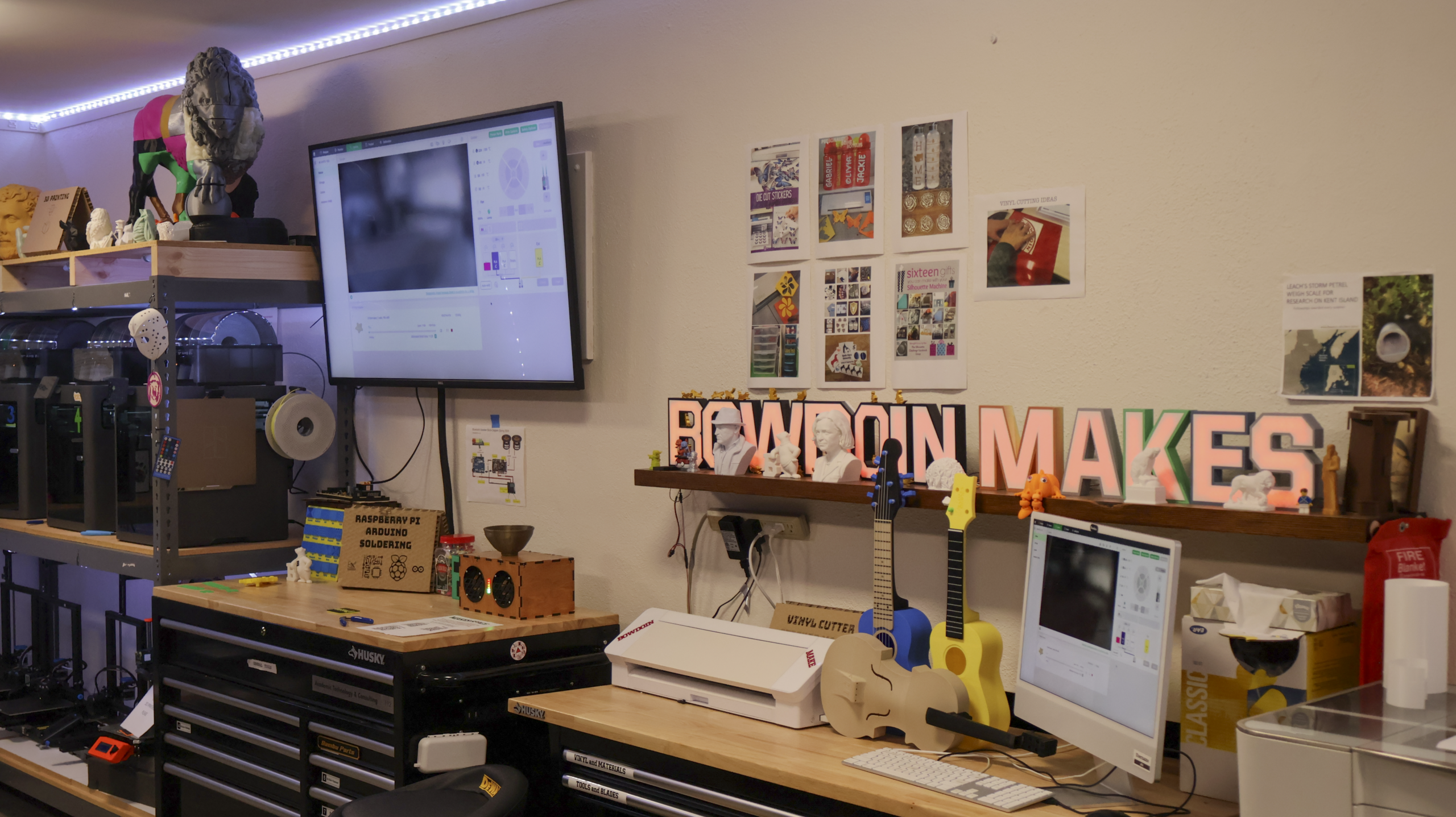
On your way to or from a meal in Thorne Dining Hall, you might walk by the Bowdoin Maker Space, tucked into the side of Jewett Hall. The Maker Space hosts multiple kinds of 3D printers, a laser engraving machine and electronic engineering materials.
This semester, the Maker Space has started crafting night programming to draw in more students, including dorm decor creation, 3D printing students’ faces, making fidgets and more.
Rachel Li ’29, a student lab instructor, hopes the programming will help students realize the capabilities and vast breadth of technology and art the Maker Space offers.
“The Maker Space is a creative and sharing space for every student that is willing to come, but most students at Bowdoin don’t know about the Maker Space, so we are trying to spread [the word],” Li said.
Saron Workineh ’28, who has been working at the Maker Space since the spring, hopes that these events will encourage more students to visit. Even though crafting nights are open for students to make anything, Workineh hopes programming will especially help attract students interested in learning about 3D printing.
“This year, we’re trying to post like, ‘We’re doing this tonight,’” Workineh said. “Like, ‘We’re printing a vase tonight.’ It will draw people in more than just saying, ‘We’re open tonight.’”
Workineh sees these crafting nights as an opportunity to teach students how to 3D print, so they can use the technology in the future.
“We try to teach people instead of just doing it for them.… There are some interactive programs in the Bambu Lab [3D printers],” Workineh said. “[For example], last night, we were looking at a software for people to design their own vases, since it’s very straightforward.”
These programs have also given students a chance to use the Maker Space’s new Bambu printers—newer, more advanced models that use artificial intelligence to enable more efficient printing. These printers maintain temperature better than the previous ones, can change textures and colors and are generally less prone to error.
Arlette Mutabazi ’29, another student lab instructor, has found the Bambu printers much easier to use.
“You can mix up colors and specify what each layer will look like and have the printer coordinate the filament switching automatically,” Mutabazi said. “So, now you could easily come in late and work on something quick and leave it printing overnight with no worries of failures.”
While the Maker Space has previously worked with classes or students doing research, Mutabazi also hopes to work on more creative or unconventional projects with other groups on campus.
“We are trying to organize a cookie project with Bowdoin dining. Students will explore their creativity by designing cookie cutters that will be used while baking cookies. Afterwards, [Bowdoin] dining and the students will work together to recreate the forms and share them with the Bowdoin community,” Mutabazi said.
The student lab instructors not only help other students at the College express their creativity but also provide them a way to connect with their imaginations. Workineh used the 3D printers to make a head massager, and Mutabazi recalled how a friend used the Maker Space to make Chinese New Year decorations.
“I really liked one of the themed nights organized by one of my coworkers, the Chinese New Year night,” Mutabazi said. “All the prints and designs really brought alive the spirit of the festival.”
Workineh hopes that students will take advantage of the possibilities for exploration that the Maker Space offers anyone interested in technology, art and any type of creation.
“You can make anything,” Workineh said. “It’s like a genie.”
Comments
Before submitting a comment, please review our comment policy. Some key points from the policy: