
In defense of the chicken tender
May 1, 2026
 Bobin Park
Here is something I know about you: There was a version of you, not so long ago, who could be made completely content by a five-dollar box from a drive-through window. Or perhaps it was your most recent meal at Supers. Maybe you didn’t think about the chicken at all: You just ate it, it was good, and that was the whole story.
That version of you was onto something.
I have a detailed rating system for every chicken tender or nugget I have eaten in the past four years. There are three categories (meat, breading and experience), each with ten potential points for an overall total of thirty. I can assess a tender from a single bite. I have debated the merit of cafeteria tenders with the same seriousness that academics reserve for geopolitics. No, I did not plan on becoming this person. But I have made my peace with it. More than that, I’ve come to believe that being this person is, quietly, one of my better attributes.
Fine dining has convinced an alarming number of people that dinner is an intellectual and sensory exercise. And somewhere in the middle of all that seriousness, we started treating silliness like a character flaw.
Chicken tenders are the solution to it all.
Like many others, I grew up a picky eater, not as a preference, but as a physical reality I couldn’t explain. For me, textures were the problem. My mother’s cooking was wonderful, but the feeling of it in my mouth was sometimes unbearable. Chicken tenders were the thing that worked, every time. I didn’t know at the time that I had Sensory Processing Disorder.
Years later, in a therapist’s office, the pieces clicked into place. It wasn’t immaturity or pickiness. It was just how I was wired. And somehow, understanding that made me want to own the chicken tender thing rather than outgrow it.
What started as a practical joke among friends developed into an odd tradition. Following many requests, I went on to make an Instagram account dedicated to reviews (@sofiaschickenreview). During my senior year of high school, I decided to write my CommonApp essay about my love for tenders. I knew I was being completely ridiculous.
Similarly, the chicken tender also does not take itself seriously. This is its greatest virtue. It has no major origin story to invoke, no regional identity to defend. It is suspected to have originated in Manchester, New Hampshire. A burger carries the weight of Americana. A chicken tender carries only itself: golden, crisp, unpretentious and completely, disarmingly good.
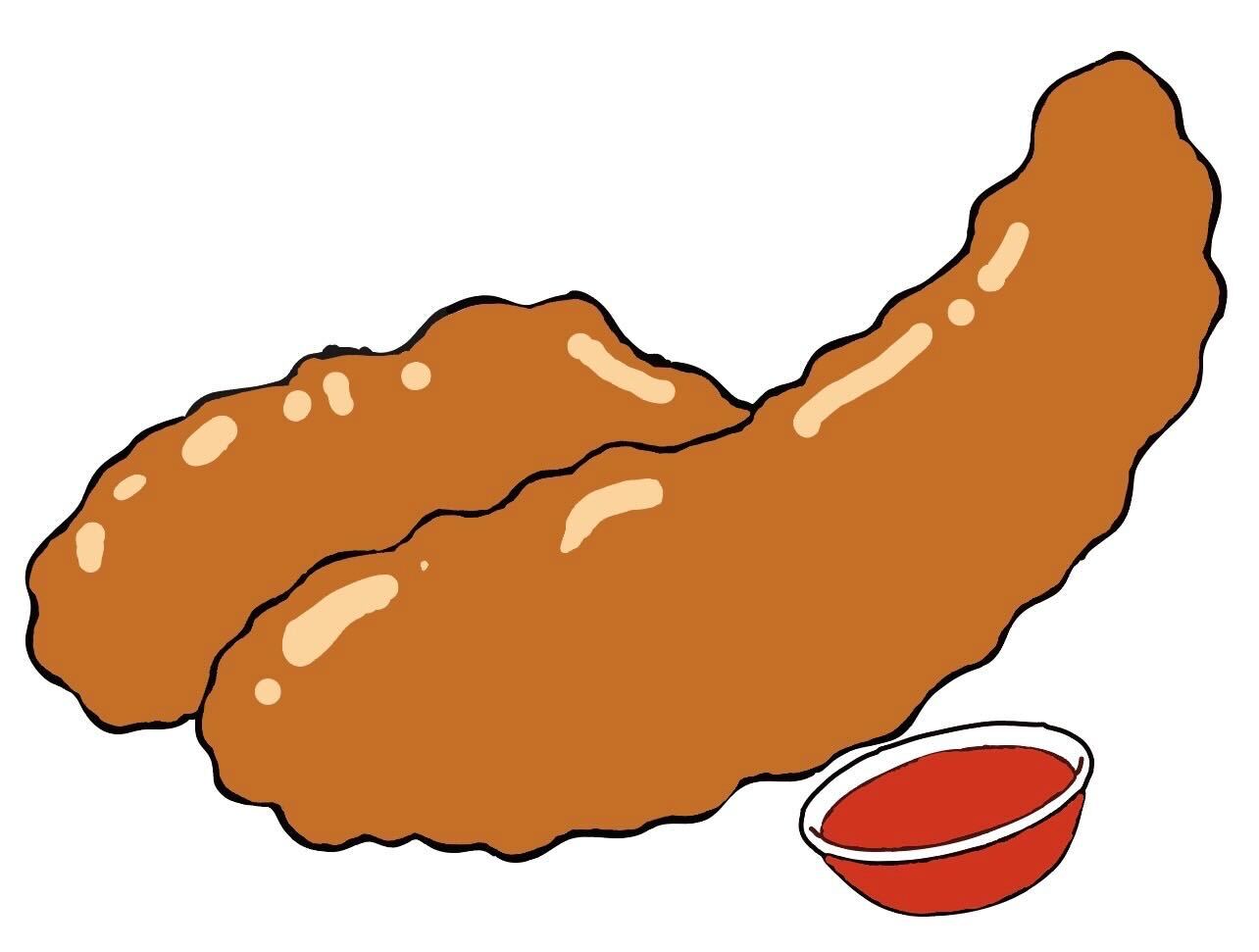
There are still rules to its existence, of course. The shape should taper: oblong, flat, vaguely cylindrical. The breading is everything: it must shatter at the first bite and stay connected to the chicken beneath it. Sauce is optional, but shouldn’t be necessary.
We spend a lot of energy, in college especially, on the project of becoming serious people. We curate our opinions, our playlists and even our dinner orders to emulate someone we would like to be in adulthood. We may even post our food before we eat it. We perform sophistication because it feels like progress, like evidence that we have outgrown something embarrassing.
But there is a particular kind of courage in the refusal to outgrow things. In insisting, against all social pressures, that the dinosaur-shaped nugget was good, in fact, it was great. That delight doesn’t require justification, and that silliness is not the opposite of intelligence, but one of its finest expressions.
Caviar is delicious, probably. A steak dinner is a wonderful thing. I am not here to argue against pleasure, or richness or the occasional indulgence in extravagance. But there is a kind of elitism that creeps into food culture, into all of culture, that quietly insists that simple pleasures are lesser ones. That the children’s menu is something to graduate from.
It isn’t. Wanting a chicken tender is a form of loyalty to the version of yourself who hadn’t yet learned to be embarrassed about what made you happy. The chicken tender is perfect, not despite its simplicity, but because of it. It is proof that the most honest pleasures are often the least complicated ones.
So order the tenders. You don’t have to explain yourself to anyone.
Sofia Martin is a member of the Class of 2029.
Comments
Before submitting a comment, please review our comment policy. Some key points from the policy: