
As reading declines in America, overconfidence soars
April 22, 2026
 This
piece represents the opinion of the author
.
This
piece represents the opinion of the author
.
 Julia Costle
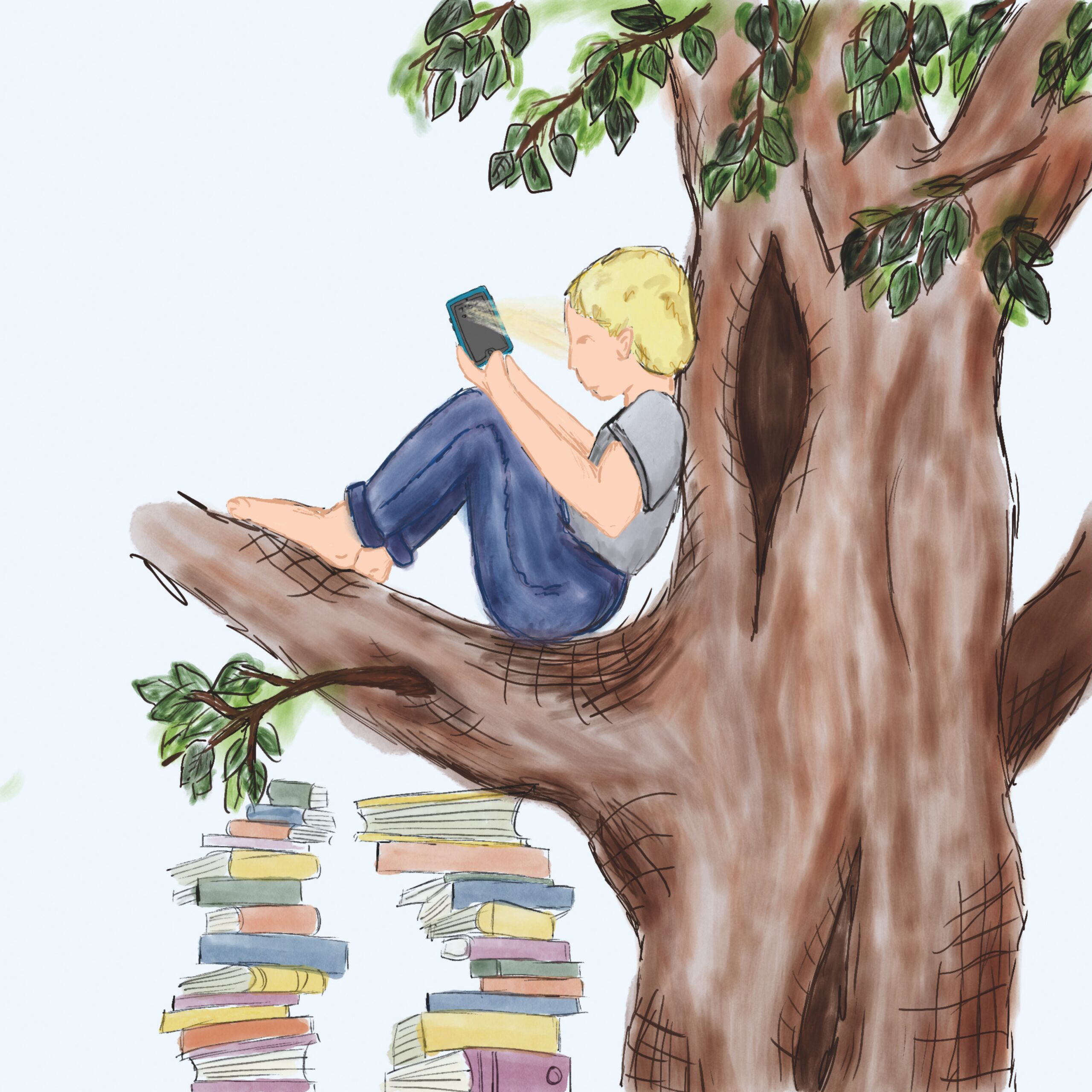
What is the most powerful tool humans have to experience lives beyond our own? What, more than anything else, sparks the fires of our imagination, increases our emotional intelligence, unites us with one another and shows us how much we don’t know about the world? What is declining in America at a faster rate than ever before?
Reading.
One of my mom’s favorite mottoes is, “Life is too short to read bad books.” The implication of this is twofold: Not only should we all be reading, but we should all be reading stories that inspire us, that move us. For those who have grown up with similar bookish proverbs, it is all the more depressing to see that America no longer finds reading important or beautiful.
The average American reads at a seventh to eighth grade level, according to a 2023 study by the OECD. From 2017 to 2023, U.S. adults’ average literacy scores declined by 12 points. According to the National Assessment of Education Progress, 40 percent of fourth graders are scoring below their “basic” standard in reading, the highest percentage since 2000.
Numerous articles from both The New York Times and The Atlantic show that an increasing focus on postgraduate job prospects, combined with the omnipresent digital world, means that unprecedented numbers of students at elite colleges lack the desire and attention span to read even a single book from cover to cover.
Ironically, these statistics are disproportionately more terrifying to those who read. So what happens when an entire population stops reading? Simple. We forget why we ever did it in the first place.
An educated, curious, literate citizen knows that a true democracy requires literacy to function. A well-read citizen can see the strengths and failures of the systems around them and devise solutions. A well-read citizen can understand a broad range of perspectives beyond their own, better equipping them to help others. A well-read citizen understands their own biases and faults with greater acuity, knowing what is needed to grow and improve. A well-read citizen understands the dangers of the Dunning-Kruger effect.
Imagine this: Someone asks you a question in a subject area in which you have considerable knowledge. You begin to respond with a complex answer, only to see the person’s expression immediately become disinterested, distrustful or accusatory when your answer is not adequately straightforward or black and white. By tuning you out, the questioner implicitly sends you the message that perhaps they know more than you—or that you’re simply not worth listening to.
Behold, the Dunning-Kruger effect in action, visualized as follows: on the x-axis, knowledge about a subject. On the y-axis, confidence in said subject. When knowledge is low, confidence spikes because we don’t know how much we don’t know. Once we learn more about said subject, our confidence sinks because we start to understand how much we don’t know. Beyond this point, as learning increases, confidence grows gradually rather than with a single erratic spike as before.
This initial spike of confidence is instinctive, primal, ingrained in our human nature and utterly destructive. In America, the Dunning-Kruger spike has become a collective phenomenon magnified on a scale larger than ever before, and it’s causing political and social polarization to soar.
When we don’t read, we stop learning how to see beyond what is right in front of us. Our beliefs and ideas stagnate, leading us to believe we must be right because we haven’t encountered or experienced alternative perspectives. We become stubborn and uncompromising, refusing to listen to those we believe are wrong, or to acknowledge that someone may know more than us—because this acknowledgment would mean betraying the beliefs we structure our lives around.
This close-mindedness caused by a lack of reading has only served to perpetuate and exacerbate extremism, anger, judgment, prejudice, bullying and violence. It halts progress and prevents positive change. It confirms stereotypes of Americans being uneducated. It decays truth. It tears friends and families apart in thousands of unseen ways.
So, if you haven’t read a book in the past year, or two, or five, try doing so. If you have, read more books. Get recommendations from friends and teachers. Tell your friends to read. Keep them accountable. Keep yourself accountable. Because when we read, uncertainty lives on, and democracy with it.
Elan Cohen is a member of the Class of 2028.
Comments
Before submitting a comment, please review our comment policy. Some key points from the policy: