
Jonah Goldberg and Tyler Austin Harper discuss the state of American conservatism
April 10, 2026
 Addison Moore
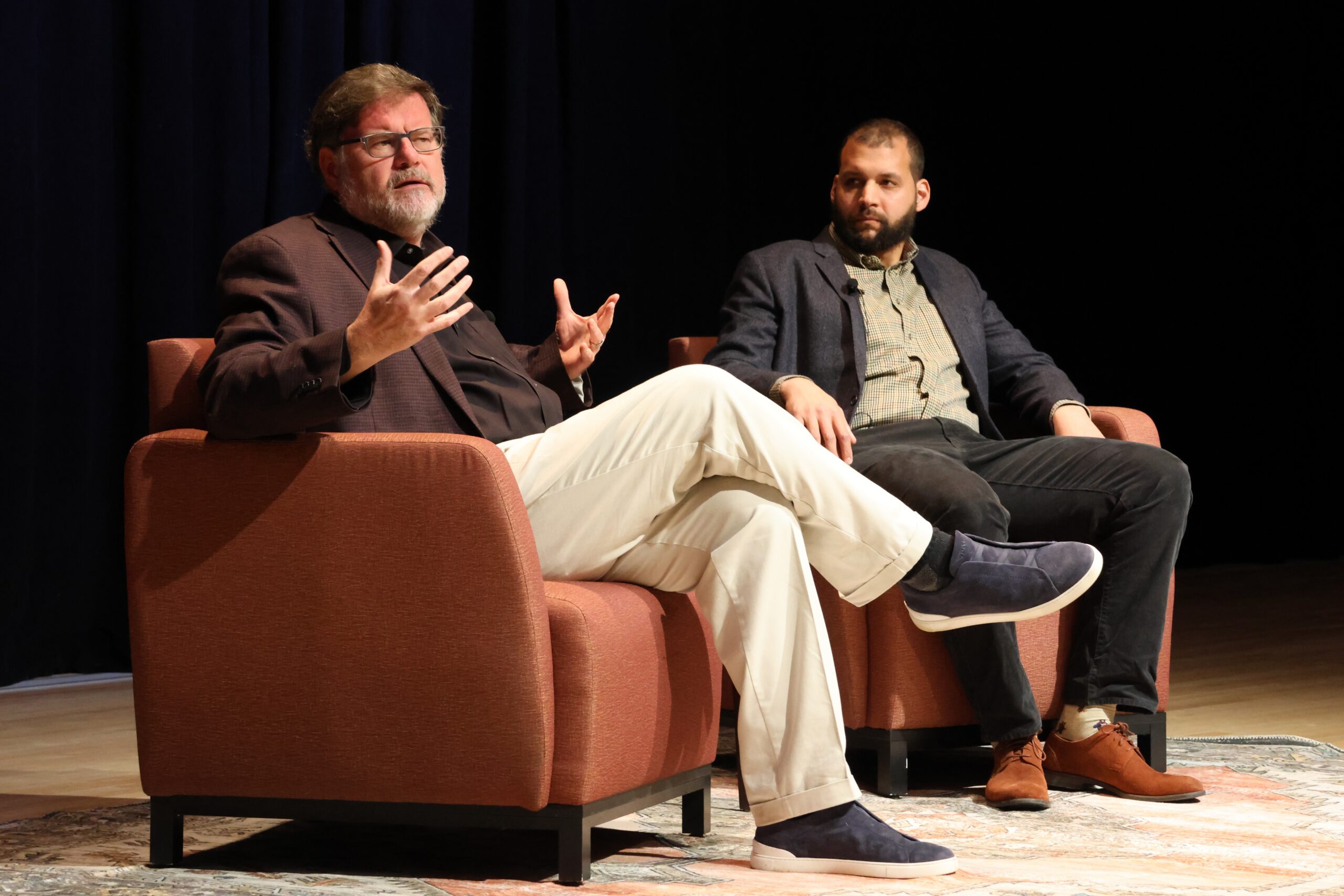
On Thursday afternoon, students, faculty and community members gathered in Kresge Auditorium to hear a conversation between Jonah Goldberg and Tyler Austin Harper. The talk, titled “The End of Conservatism?”, is the latest event in the Viewpoint Exchange speaker series. Goldberg, a former contributor to Fox News who is the cofounder and editor in chief of conservative magazine The Dispatch, answered questions from audience members and Harper, a contributor to The Atlantic who was formerly an assistant professor of environmental studies at Bates College.
Goldberg opened the conversation by commenting on the state of American conservatism, explaining how his view of the term is shaped by its classical definitions.
“Conservatism literally means to conserve. It means to hold on to things that you think are worth holding on to and pass [them] on to another generation. Preservative, in some ways, is almost a better word.… In Iran, the conservatives among the Shia clerics are the most hardcore, dogmatic people. And in America, conservatives, in my understanding of it, are trying to conserve essentially a liberal tradition of the American family, and that makes us different than conservatives elsewhere. Friedrich Hayek once said that America is the only place in the world where you can call yourself a conservative to be on the side of liberty,” Goldberg said. “It is entirely possible that what I call conservatism is going the way of the dodo.”
Goldberg continued by explaining the different and unintuitive ways that he views President Donald Trump as having changed the Republican Party.
“[Trump] has moved that Republican Party, in many significant ways, to the left. Now the fact [that] the left, for very understandable reasons, hates him with the blinding heat of 1000 suns, makes it very difficult for them to see it, but he has made the Republican Party nominally pro-choice on abortion,” Goldberg said. “He’s moved the party leftward on trade. He’s moved the party leftward on all sorts of constitutional theories.”
Goldberg then spoke about the relation between democracy, populism and emotions of the electorate.
“I like arguments. Democracy is about arguments. Democracy is about disagreement, not about agreement. Elections are about disagreements. And populism has this sort of ‘China syndrome’ logic that says anything in our way is illegitimate,” Goldberg said. “When I make these arguments, and I could go on an anti-populist riff for hours, people will say, ‘Well, you just don’t get it. You don’t understand that people are angry.’ I do understand that people are angry, and I do agree that people have really good reasons to be angry. And then I’ll say, ‘okay, when was the last time you were really, really, really angry and made a great decision?’”
In response to a question posed by Harper, Goldberg explained that he views Trumpism as a personality-centered movement that will end with Trump’s death, citing some of the political commentary surrounding the 2016 presidential election.
“Throughout the primary season, every pundit would trot out the same cliches. You know, [Trump’s] riding high now, but the laws of political gravity haven’t been repealed, and eventually he’ll come to Earth,” Goldberg said.
“We were all wrong, and the thing that we got wrong was that the laws of political gravity do not apply to Donald Trump because he is a subject to the laws of celebrity gravity, and it’s a totally different gravity.”
During the Q&A session following the conversation, Goldberg dismissed the role of wealthy donors in campaign financing, arguing those donating large amounts are more shrewd and informed than easily-swayed small-dollar donors.
“If you’re [a politician] taking in a million dollars after doing a hit on [Sean] Hannity, well, all you’re doing is talking about how the woke want to make your children vegan, gay people. I’m sorry if [people are] falling for that bullsh*t,” Goldberg said. “Don’t tell me that these proles have as much reason and foresighted ideas about the role of Athenian democracy as somebody who actually is spending enormous amounts of time interviewing politicians and talking to people about what their policy programs are. It’s just institutionally different things.”
Mohamad Hijazi ’29 discussed his reasons for attending the talk.
“We’re seeing a lot of damage and schisms from conservatism within the United States, whether it’s the [neoconservatives] in office or the far-right Groypers threatening basic rights,” Hijazi said. “I wanted to see if, for once, a conservative could actually say something new in a wave of [changes] in foreign policy.”
Comments
Before submitting a comment, please review our comment policy. Some key points from the policy: