
“Bunk Beds” explores LGBTQ+ romance and radicalism
April 10, 2026
 Addison Moore
Last weekend, students, faculty and community members filled Memorial Hall’s Wish Theater to see “Bunk Beds,” a dance performance brought to campus by the Department of Theater and Dance.
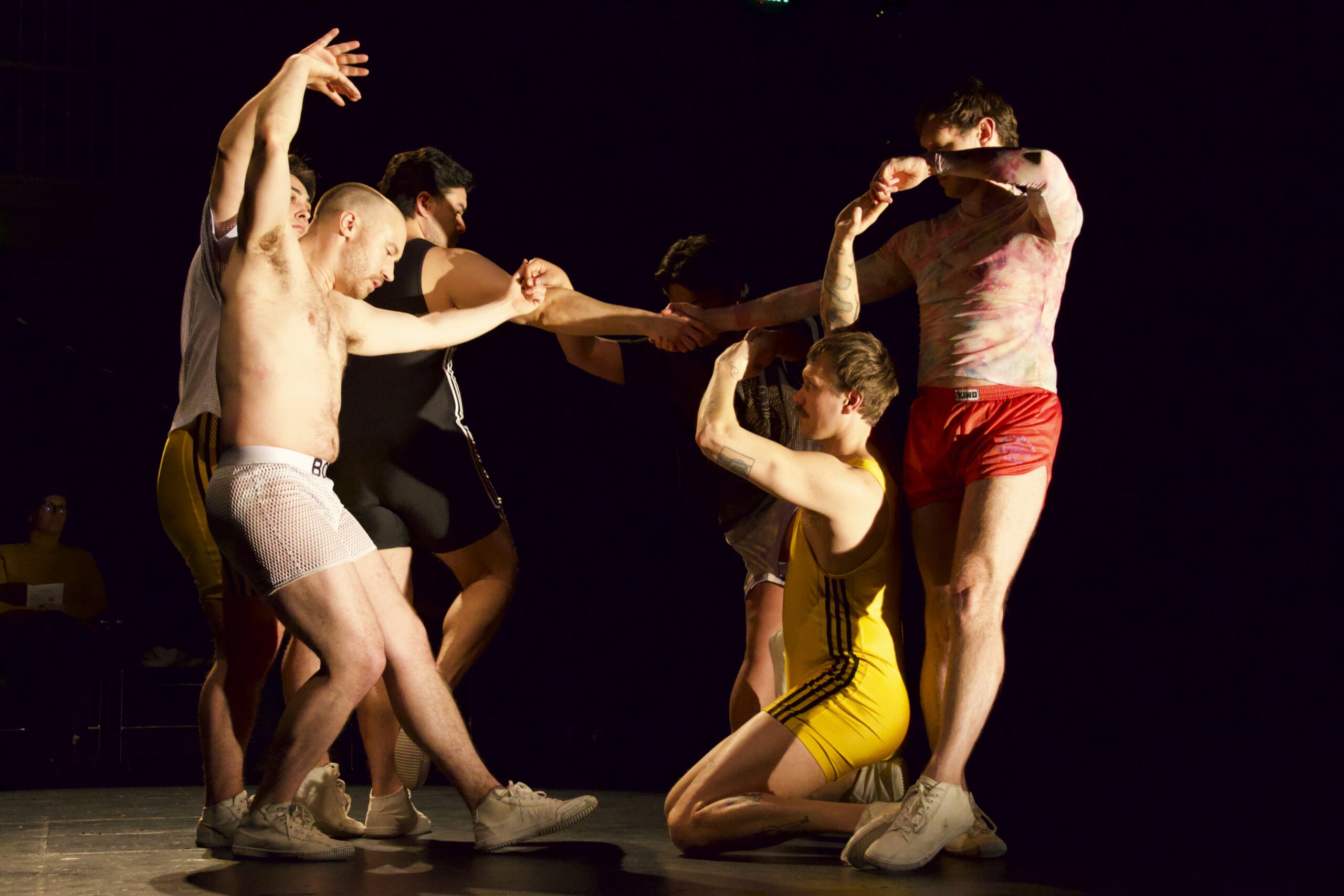
With performances Friday and Saturday nights, “Bunk Beds” explored themes of LGBTQ+ romance and radicalism, highlighting the way in which artistic legacies are created and preserved. The show was performed by Big Boy Dance, the creative home of Tristan Koepke, a Maine-based choreographer and an assistant professor of dance at Bates College.
Koepke’s work explores themes including speculative masculinities and contemporary gay phenomena, and “Bunk Beds” is no exception. “Bunk Beds” expands on choreographic material from Koepke’s previous work, including 2023’s “There’s Only One Bed” and 2024’s “There’s More Than One Bed.”
Before the performance began, dancers were already moving as the audience entered the theater. The piece then moved through multiple stages, featuring a monologue and a song by one of the dancers, an extended period in which the dancers held hands and moved in an amorphous mass and improvisation near the end.
“Bunk Beds” explores the relationship between two titans of experimental music and dance, dancer and choreographer Merce Cunningham and composer John Cage, seeking to reframe and transcend conventional narratives of their collaboration.
In an email to the Orient, Associate Professor of Creative Arts Aretha Aoki explained how these narratives often do not mention Cunningham and Cage’s identities.
“Merce Cunningham and John Cage were lovers and artistic collaborators whose experimental approach influenced major movements in dance and art. Often the focus is on how their work eschewed story, emotion and predetermined meaning and doesn’t consider or examine their queer identities in relationship to their aesthetics, which were developed in a time when being gay was illegal,” Aoki wrote.
Aoki discussed how the performance is important in the way that it can elevate these previously unseen identities.
“‘Bunk Beds’ embraces the Cage [and] Cunningham experiment, which is incredibly technical and demanding to execute, and does so in a way that elevates queer intimacy and relationship, bringing what perhaps has been unseen or unacknowledged to the surface,” Aoki wrote.
She continued, explaining how the performance can highlight that Cunningham and Cage’s collaborations were deeply political, even if it is not always seen as well as how homophobia and resistance have shaped dance.
“It raises important questions around the political implications of their collaborations and the extent to which homophobia, and various forms of resistance to homophobia have shaped canonical western dance history,” Aoki wrote.
Aoki discussed an article written by Neil Greenberg, one of Cunningham’s former dancers. The piece, “Queer Thoughts on Merce Cunningham,” discusses the implications of Cunningham’s work from an LGBTQ+ perspective.
“I was relieved that my charge in Cunningham’s work was to go onstage and simply dance: I no longer had to hide my sexuality. Within Cunningham’s work I found permission and encouragement to be both my gay self and a dancer, to dance queerly,” Greenberg wrote in the 2025 article, published by “The Drama Review.”
However, in the article, Greenberg discusses how, paradoxically, such a reading of Cunningham’s work was actually against his wishes as an artist.
“Any such consideration of Cunningham’s (homo)sexuality in relation to his artistic work deviates significantly from his own wishes and from the persistent party line that such biographical information is immaterial to an understanding of his art,” Greenberg wrote.
Aoki discussed how the article is essential to exploring these questions.
“The Neil Greenberg article … explores these questions from his particular perspective as a former Cunningham dancer,” Aoki wrote.
In a message to the Orient, attendee Martina Tognato Guaqueta ’28 reacted strongly to the performance.
“Bunk Beds was a uniquely evocative experience,” Tognato Guaqueta wrote. “I was really impressed with the connection of the dancers and the feeling that their choreography conjured.”
Comments
Before submitting a comment, please review our comment policy. Some key points from the policy: