
Belief in the soulmate
April 3, 2026
 This
piece represents the opinion of the author
.
This
piece represents the opinion of the author
.
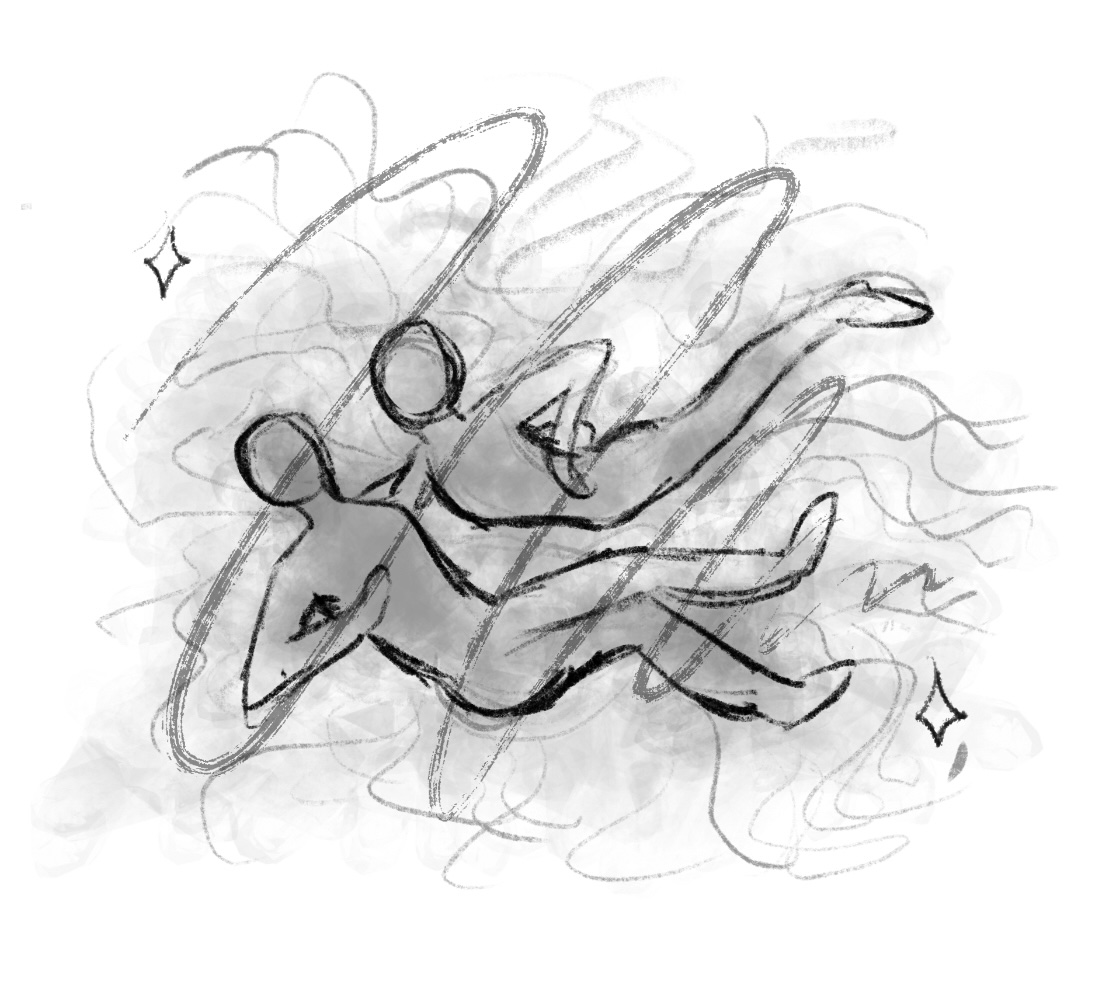 Brigit Len Tabuena
Logically, it is odd to believe that out of the billions of people in the world, you’d find your overall best match from the infinite labyrinth of probability. After all, you can share uniquely strong connections with many individuals throughout a lifetime. And if the growth we experience just from one semester to the next turns us into such different people, it becomes even harder to believe that a singularly predetermined “best match” could align with the invariable paths of personal growth.
I’ve found that what I seek in a partner shifts with the values I’m drawn to at a given stage of my life, perhaps spontaneity at one point and stability at another. Relationships may thus feel right at a particular moment, even with the awareness that they may not last beyond it, and that does not make them any less meaningful while they do. One way to make sense of the value of different connections is through the idea that we may encounter multiple “soulmates” throughout our lives. But can we truly equate a temporary glimpse of a strong connection with the feeling of a soulmate?
By definition, a soulmate must be something sentimentally stronger than a meaningful connection. It must be much rarer than the feeling of meeting someone new and feeling like you’ve known them and even rarer than falling in love itself. It exists on an almost inexplicable new plane of connection where intuition seems unusually refined to the point where you feel capable of anticipating the states of mind of another, and sensing their inner world in a way that is too precise to be accidental. The level of connection is less about compatibility but more about an intense burst of emotions that seems to fundamentally alter yourself and your perception of the world around you. Although it’s almost poetic to think of the intensity of that experience as a once-in-a-lifetime event, the idea of a singular soulmate is logically unlikely. Yet the appeal of believing in it regardless is more about trust in the promise that a connection could be so uniquely profound, it enables you to uncover parts of yourself you might not otherwise encounter.
That belief, however, becomes far less appealing in practice. Taken with enough seriousness, it can trap you somewhere between two unideal camps: (1) becoming fixated on one person to the point that no absurd number of attempts is sufficient to convince you the connection may not be right or (2) adopting near-fatalistically high standards, where holding out for a “perfect” partner diminishes the appreciation of other fulfilling connections. It can push dating into an oscillation of being either stressfully high stakes, with the statistically challenging goal of finding the one in eight billion, or a hollow endeavor where anything you don’t recognize as fitting the soulmate mold is treated as failure. It reduces connections to a rigid winner-or-loser binary, where relationships are either meant to be or not. Even more daunting is approaching life not only with faith in a singular soulmate, but with the conviction that you have already found and lost that person. Under that belief, the past becomes so elevated that it quietly dims the strength of any future connection, perhaps by raising the standard, but ultimately through a mindset so rigid that anything outside of it is diminished.
Yet I continue to believe in the soulmate for reasons I myself can hardly comprehend, and this remains an attempt to convince myself otherwise. The belief persists not because it is logically sound or practically appealing, but because it speaks to a desire to believe that one connection in our lives might transcend the mathematical bounds of probability and chance. And maybe the lingering belief in the soulmate says less about the truth of whether such a person exists and more about how we hope to be known and valued by one another.
Comments
Before submitting a comment, please review our comment policy. Some key points from the policy: