
“Creating the Modern: Works on Paper,” a gift from Howard Haimes ’76, explores modern art’s coming of age at BCMA
March 27, 2026
 Riley Nelson
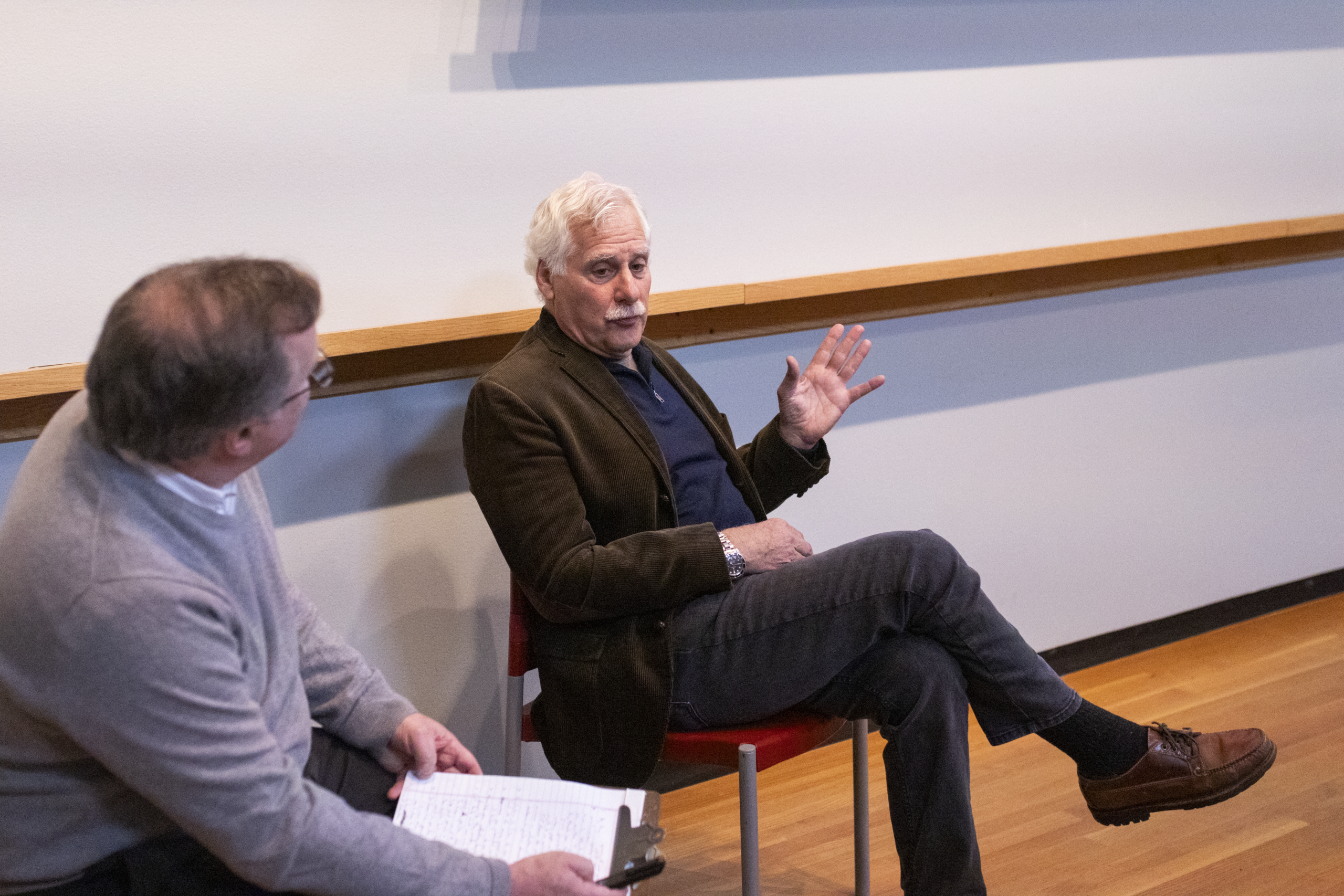
On Thursday, the Bowdoin College Museum of Art (BCMA) celebrated the opening of its newest exhibition—“Creating the Modern: Works on Paper”—thanks to a gift of 24 pieces from Howard Haimes ’76 in celebration of his 50th reunion.
The paintings, from various different artists such as Paul Gauguin, Wassily Kandinsky and Josef Albers, were all created between 1893 and 1947, a time of rapid expansion, according to BCMA co-director Frank Goodyear.
“It’s always interesting to sort of compare historic periods with one another. I think everybody who grows up says, ‘The world is changing so quickly,’” Goodyear said. “The world was truly changing quickly at the end of the 19th century, because of industrialization because of the rise of globalization at that time.”
The exhibition was largely curated by Taylor Dunn, a master’s student at Howard University who interned at the BCMA this past summer. Goodyear met with her on the first day of the internship and requested she find a common theme to connect the works that Haimes gifted the College.
“It’s not enough just simply to take a group of artworks and put them on the wall. There’s got to be some kind of thematic focus. There’s got to be a throughline that ties it all together,” Goodyear said.
The through line was “Creating the Modern,” which explores how the artists featured in the gallery were exploring forms and techniques during a time of globalization. These styles, such as abstraction, cubism and surrealism, ushered in a new kind of visual art.
“The artists who are representing this show are fond of breaking the rules. They’re fond of, perhaps understanding a tradition and wanting to problematize that tradition. They want to think about how to depict the landscape and their place in the landscape in new ways,” Goodyear said. “And out of these sorts of questioning of tradition, new forms of visual expression are born.”
As movement across the world became more accessible, artists used these new landscapes to influence their work. Gauguin, for instance, moved to the South Pacific for three years, developing his art practice there. One of his pieces is on display in the BCMA, depicting two abstract figures embracing.
“We were looking primarily at European artists. And one of the things that we were noticing, and especially it was evident in some of the prints that were included, was that as modern transportation systems were being introduced and global trade is accelerating, artists themselves are traveling widely and portraying new types of subjects,” Goodyear said.
The only non-European artist featured in the Gallery is John Marin, whose three pieces displayed are watercolor landscapes of Phippsburg, the town Haime now lives in.
Haime initially came to Bowdoin expecting to be an economics major, but after taking a printmaking class with then-Professor Thomas B. Cornell decided to study art—eventually earning his master’s in painting and sculpture from Queens College.
“I thought maybe I would really be an artist, but at that period of time, I needed something to support myself. So one thing led to another, so I moved away from it,” Haime said.
Haime eventually became a curator, and this particular collection came to fruition over the course of 40 years.
“I probably started [collecting] in the late 80s,” Haime said. “I think the last item I bought was probably two years ago. It’s been a long time.”
Now, most of his collection is on display in the BCMA—where 20 of the pieces will join the Museum’s permanent collection and four will remain with Haime and his daughter.
“I gave most of it [to the College]…. It had to be all or nothing,” Haime said. “At one point these were distributed among three houses, but now I’ve downsized to a house with all windows, so I don’t have any places to display them and I don’t want them just sitting around.”
The exhibition will be open for three months, perfect timing for Haime and the rest of the Class of 1976 to see the collection when they visit campus for reunion in May.
Comments
Before submitting a comment, please review our comment policy. Some key points from the policy: