
Winter work: What the Offer cannot provide
February 27, 2026
 This
piece represents the opinion of the author
.
This
piece represents the opinion of the author
.
 Mia Lasic-Ellis
The Offer of the College is a gilded promise. But it is not enough for me. One day, I will build a house with my own hands, so I have taken work as a carpenter’s apprentice. I am paid $25 an hour, and my work is entirely separate from my life as a college student. Perhaps many of you, like me, seek forms of knowledge not available at Bowdoin. I encourage you to look outside the College for what you need; there are mentors in every sector who will not turn away an earnest effort to learn. I think it best to explain myself with a story.
Jon said it would be semi-indoor work today. That means outdoors. I wear blanket lined jeans and knit wool socks under my 12-inch camel-brown muck boots. Above the belt, a skintight thermal, a wool sweater, a cigarette-stained John Deere hoodie and a Remington camouflage hunting parka. My body hides under it all, thin and long with strong, wiry limbs. Putting each item on, I feel like a soldier readying for battle. My truck died last week, so Jon picks me up on his way. At the site, I step out into the winter morning, and the freezing wind seeps through each layer in search of skin, burning my face raw.
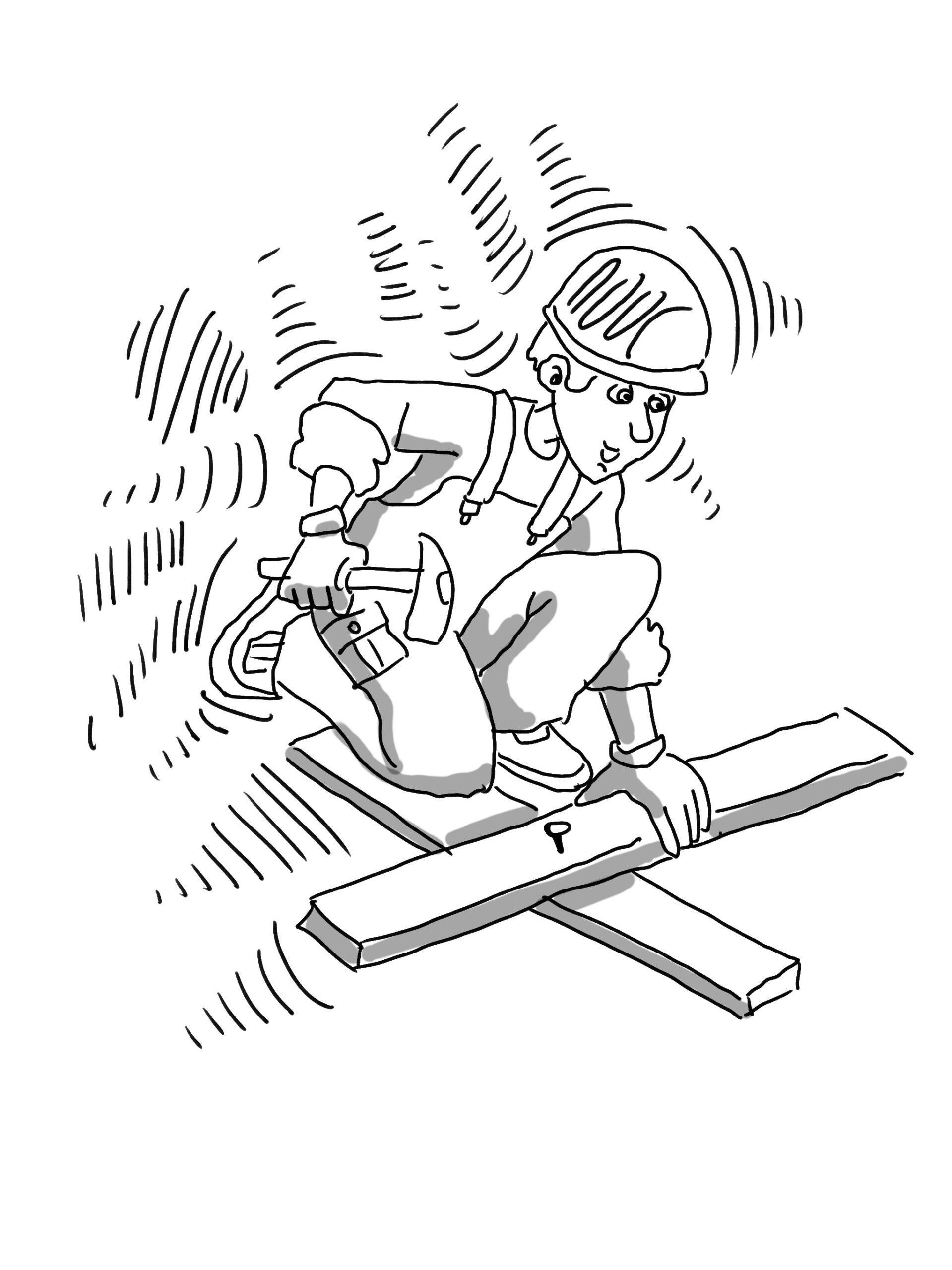
The sun, not yet risen in the starless sky, glints through the trees on the low horizon. No one idles. The fresh smell of the wood shavings like incense and the scraped-chuck of working hands fill my nose and ears before ringing out into the snow-dusted woods which stretch for miles. Wielding a Skillsaw in my right, I mark lengths and angles with my tape and square before plunging the blade down to make my cut. The saw shoots violent gritting vibrations up through my hand and right arm, which travel left across my collarbone and set my entire frame shaking softly. The use of my own saw is not a right. It is a privilege I have paid for in sweat. The men shout widths, lengths and angles of all variety at me—
“Two eight by 20 long to long at 45 degree miters!”
“Five 13 inch 2 by cripples!”
“Gimme more screws!”
By midmorning, we move as one crew. I lose myself in the work, slipping into a sweet rhythm as the heat of my straining muscles pulses out from under my skin. When the sun slips over the treeline, the acres of snow-covered woodland surrounding the skeleton are set aglow in dazzling white. The temperature rises from ten to 15 degrees Fahrenheit.
Five miles south, the heated classrooms of Bowdoin College buzz with conversation and pencil scribbles. I take classes Mondays and Wednesdays, spending three fifths of my fleeting college days at work. It is a sacrifice I have made for the last three semesters. Fifteen months ago, I was bitten by the roguish notion that I already had enough diamond wisdom and utter crap floating around my brain, and that I’d better set down and do something instead of filling up my mind with a kind of knowledge that I didn’t need anymore. I felt myself at risk of imploding, and seeking to stave off some violent combustion of the intellect—overstuffed and bored senseless with abstractions and interpretations—thought to temper my accumulated academic knowledge with learned skill. I was empty after days of discussions and papers, weary of cultivating parts of myself already grown strong. Seeking wholeness, I looked outside the academic world I had always known.
Jon, the master craftsman who hired me as his apprentice, knows calculus and Shakespeare. Though his eloquence and thoughtfulness make him a more complete man, they hold little worth at the job site. A carpenter’s truth lies in the body. He strikes his hammer heavy, and carries on in silence.
At lunch, conversations and jokes are flung around the site. Some of the tradesmen are learned men and talk about Hemingway and Huxley. Each man respects the others for good sound craft—nothing more.
I carry 80-pound bags of shingles on my right shoulder and gingerly make my way up ladders to the roof. It is grueling work, and the others tell me to “be manly” and quicken my pace. The next day, a swollen red sore on my shoulder where the pressure concentrates will sting under a hot shower. It is one of an infinite number of tiny injuries sustained daily, and the men pick splinters from their hands like specks of dirt and carry on.
Up on the roof, I am given a nail gun. “Bang! Bang! Bang! Bang!” Four precise rhythmic shots through each shingle. Last year, I shot a three-inch nail clean through my left pointer finger, the pinhead sticking out above the fingernail and the point coming out the other side. I pulled it out and the warm sticky blood dripped for five minutes all over my shirt and pants. The men laughed and called me names,
“Dumbf**k!” “Greeny!” “Ha! Now you’re a real carpenter, kid!”
I laughed along with them. Then back to work.
“If you don’t need to go to the hospital, you’d better get working,” Jon said with a smile. If I had stopped that day, he would have been well within his rights to fire me. On jobs like these, anyone who cannot learn to endure physical pain will not last. The men taught me to bear the splinters and bruises and tweaked backs in silent acceptance. This is the tradesman’s code. It may seem cruel, but a part of me knows this is the way it ought to be.
The smell of sawdust and sweat and hot metal meld together, clinging to my clothes and exposed skin. The day ends as the sun disappears back over the treeline. Jon and I ride back as men, workers no more, free to talk about geopolitics and parenting and life. Jon attends anti-ICE protests and pays his taxes with a smile. He wants his daughter to attend college in Canada to get away from it all. Deeply skeptical of corporate America and bureaucracy, this is the life he has chosen.
Jon drops me off back at school. We shake roughened hands, and he’ll pick me up at 7:30 a.m. on Thursday. In my dorm, I lather my body twice with soap in the shower—once for cleanliness, once more to kill the smell. My closet holds two wardrobes, one for each part of myself. I won’t ever wear my work boots around campus. It feels disrespectful to the hard work they’ve done. I trade them for sneakers and put on a wool sweater and a thrifted cashmere scarf. My transformation complete, I head off to my friends a better carpenter than yesterday and perhaps a more whole man.
Not everyone should take up a hammer, but if Bowdoin cannot provide the knowledge you desire, you must have the courage to seek it out on your own. The gods of luck reward curiosity and grit. If you knock on ten or 20 doors, one will surely open in warm embrace.
Nate Berg is a member of the Class of 2027.
Comments
Before submitting a comment, please review our comment policy. Some key points from the policy: