
Tressie McMillan Cottom addresses constitutional crises in MLK lecture
February 6, 2026
 Abigail Hebert
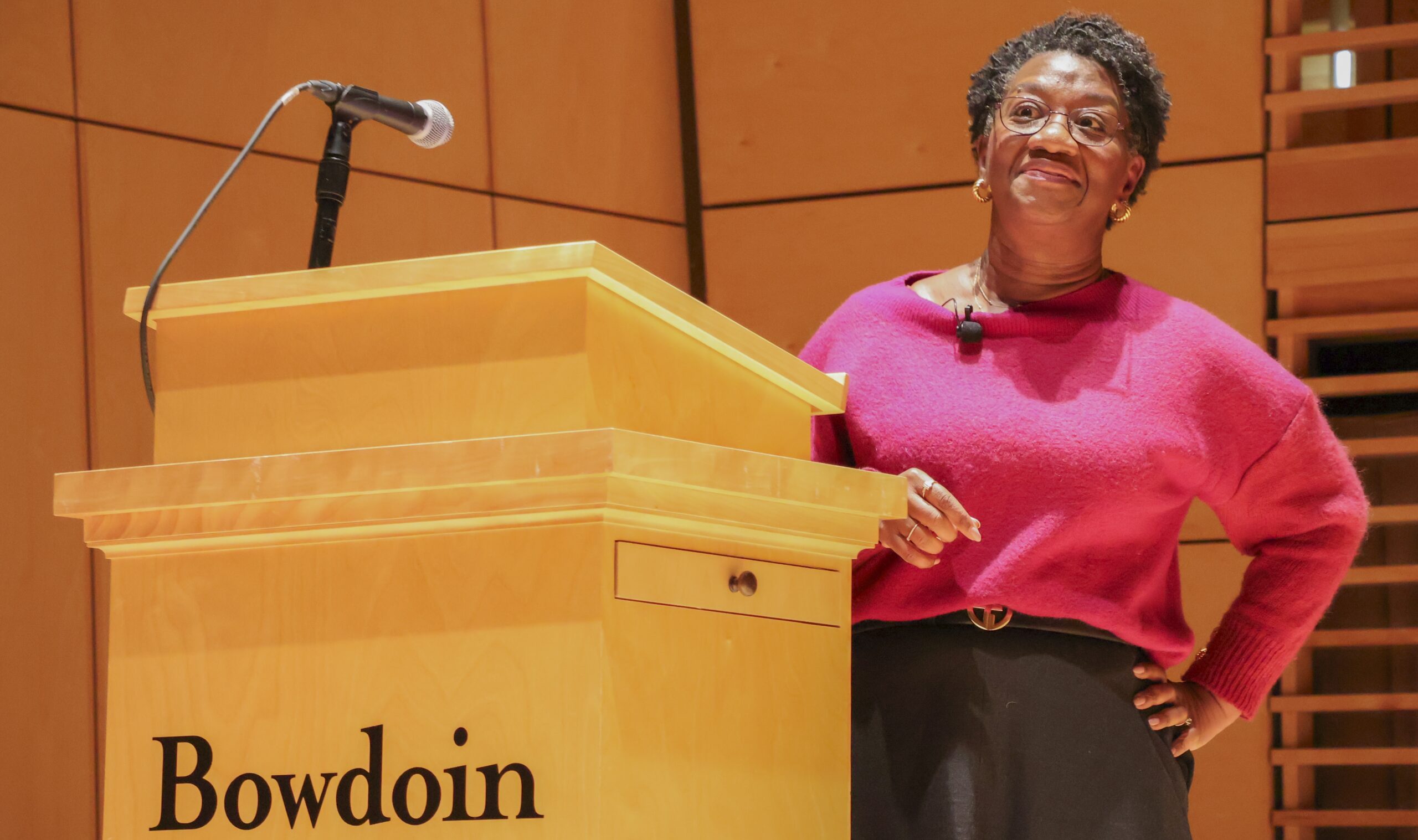
On Saturday, sociologist, professor and MacArthur Fellow Tressie McMillan Cottom delivered Bowdoin’s annual Rev. Dr. Martin Luther King Jr. Commemorative Lecture in Kanbar Auditorium, speaking about the current political environment and events that have already defined 2026. McMillan Cottom is the author of “THICK: And Other Essays,” which was a finalist for the National Book Award for nonfiction, as well as an opinion columnist at The New York Times.
McMillan Cottom began her talk by noting that it was taking place amid exceptional times.
“This is one of those times I do not take lightly either your invitation or your willingness to convene for a conversation that I promise you will not be easy,” McMillian Cottom said. “Nothing meaningful or important to say right now is going to be easy.”
McMillan Cottom started by describing the killings of Renee Good and Alex Pretti by U.S. Immigration and Customs Enforcement (ICE) agents in Minneapolis as fundamentally wrong.
“I would describe this as execution-style, up close so that they could see what they were doing. Several bullets to the brain and to the chest in broad daylight on a public street in front of hundreds of witnesses, circulated to tens of millions of people who can see with their own eyes how [Good] and [Pretti] died,” McMillan Cottom said. “I do not think that there is any confusion about what happened. Any confusion about what happened—they’re only rationalizations about who deserved what.”
Commending the mass protests that have taken place across the country, McMillan Cottom praised the bravery of countless individuals who chose, some for the first time, to stand up against perceived injustice. During these dark moments, McMillan Cottom has observed that euphemistic language is used as a safeguard, and that speaking plainly without the need to hide, obscure and soften harsh realities is what Martin Luther King Jr. and other civil rights activists of his time did.
“I think part of their legacy is in teaching us that there is a time for good metaphor, and then there is a time to speak plainly, and I think that we are in such a time,” McMillan Cottom said.
Decrying the present-day actions of federal agents as government-sanctioned violations of civil liberties carried out among American neighborhoods, McMillan Cottom described this chaos as a sign of weakness on part of the perpetrators.
“Violence is designed to be a spectacle. It is intended to terrorize all of us by how ruthlessly it is allowed to terrorize a few of us…. They know they cannot shoot us all, but what they can do is they can create a political spectacle that says, ‘It could be you.’ That’s the same work that lynchings once did,” McMillan Cottom said. “But the spectacle … [shows] the administration cannot compel the majority to legitimize its actions. If you could, you wouldn’t need to do public spectacles.”
McMillan Cottom argued that simply voting is not enough to convince Congress and those in office to pass regulations, including those on the surveillance apparatus threatening the viability of the Fourth and Fifth Amendments.
“We are to fight like our lives depend on it, and we are to remember that we do not get all that we fight for, but we must, and always have had to, fight for everything that we get,” McMillan Cottom said.
After the event, attendee Miu Yatsuka ’28 commented on the impact of the lecture, saying she found it inspiring.
“I think it’s easy to feel isolated when witnessing everything that is happening,” Yatsuka said. “But the idea of fighting for people when you’re exhausted from that fight, finding nourishment in [that], was a really powerful statement, and, honestly, very important for Bowdoin, because it’s hard. We don’t want political indifference or indifference in any form.”
Miu Yatsuka ’28 is a member of the Bowdoin Orient.
Comments
Before submitting a comment, please review our comment policy. Some key points from the policy: