
Lessons from the Black radical tradition
February 6, 2026
 This
piece represents the opinion of the author
.
This
piece represents the opinion of the author
.
 Ailee Jones
In “The Wretched of the Earth,” Algerian decolonial theorist Frantz Fanon wrote: “Each generation must out of relative obscurity discover its mission, fulfill it, or betray it,” Although he wrote this in 1961, this quote could not ring truer in the current political moment.
We’re seeing the settler colonial and genocidal entity known as the United States rear its ugly head as we’re seeing the further empowerment of the Immigration and Customs Enforcement (ICE) by the current Trump administration. Tens of thousands of people have been violently snatched away, put into detention centers and face many abuses in these centers. Additionally, as we are barely one month into the new year, ICE has killed Renee Good, Keith Porter, Alex Pretti and others who have died in detention centers.
This violence has galvanized people who are new to organizing and protesting to get involved. While this galvanization is remarkable and needed, it’s still inadequate if we wish to see the abolition of ICE.
As a student who is not new to protesting or organizing spaces (even at Bowdoin), I found the general strike, in which those participating do not work or spend money, and the protest that occurred last Friday in Portland to be very underwhelming and harmful to the movement.
Firstly, the people I went with did not know about the protest or general strike until the night before. A strike is not a direct action you plan on short notice; it requires a lot of organization, as many of the people participating are working class and live paycheck to paycheck. A strike needs to be planned to ensure that people (especially Black and brown working class people who are targets of ICE raids) participating can pay their essential cost of living.
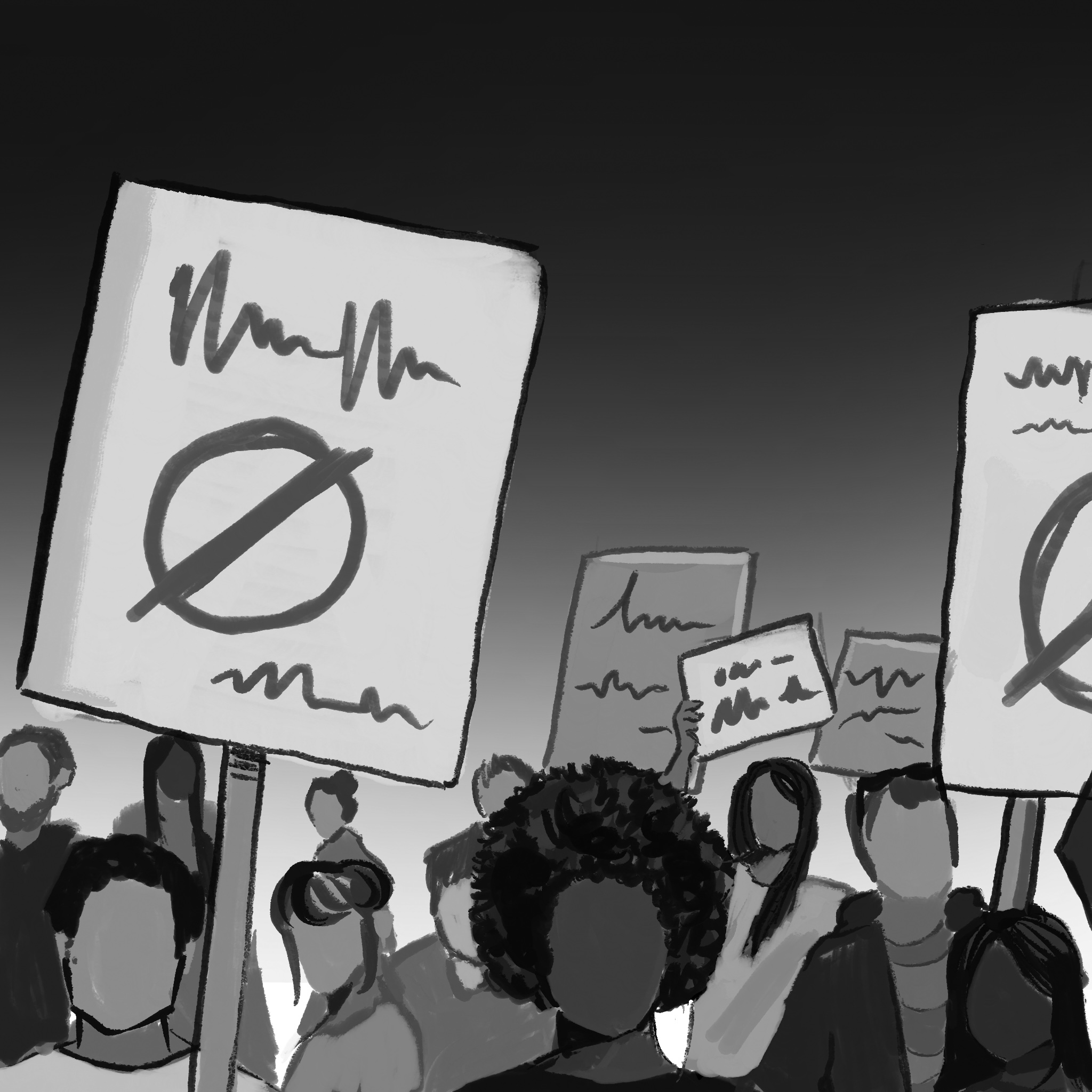
For the protest, we arrived at Monument Square to a majority-white crowd. Upon our arrival, we overhear someone say, “The people masking are sus as hell,” while my friend and I are masked. This shows that the people protesting aren’t taking their health and others’ seriously. In addition, the signs many protestors brought were disadvantageous. Through the many signs that highlighted the brutality of ICE and America, there were other signs, such as “Defund ICE” and “Make America America Again.” The former is a liberal co-opting of the more radical goal of abolishing ICE (deeming it as reformable), while the latter treats ICE as distinct from America. However, ICE is neither reformable nor distinct from the history of this country. ICE is a very American entity (one of the most, to me) that only breeds further violence against Black and brown people. A genocidal system that is separating families and killing people in peaceful resistance cannot be reformed. A solution to the violence that does not eliminate an entity that parallels the slave patrol and upholds the settler colonialism that is at the heart of America is frankly insufficient. ICE is a state creation that reaffirms white supremacy through labeling people of color as un-American and subjecting them to the worst dehumanization in detention centers.
Furthermore, during the very peaceful and unintimidating march, we noticed a white man raising his American flag high in the air. As a person who wanted to use this as an opportunity to educate, I approached the man and gently asked him to put the flag down, as it has no place in the resistance toward ICE. I further talked with him to discuss how ICE is, in fact, American. However, all I was met with was hostility and a lack of respect. This entire interaction left me isolated in a place where I was supposed to find community.
At this point, I realized that the white working class lacks the radical imagination for change, and they are still subscribed to the America that the slaveholding Founding Fathers promised them. Historically, the white working class’s belief in the American project has led to the creation of the modern police state, the Ku Klux Klan and, more recently, ICE. This belief in America is what put us here in the first place. Through the signs of many of the protestors calling for the defunding of ICE instead of its abolition, the “Make America America Again” sign and the presence of the American flag, it’s clear that the crowd’s whiteness is getting in the way of the anti-ICE struggle. Even in this protest, it’s still very clear that America as an entity is still being reaffirmed. To struggle against ICE is to struggle against the American empire as a whole, and this understanding is needed for effective struggle against ICE.
To say more explicitly, the white working class has never felt the need to imagine a world without and beyond America. This is because whiteness is synonymous with citizenship, so in their minds, why imagine beyond a nation that does not need to be fixed? Black and brown people’s existence in America has been marked by their second-class citizenship status. Whether through slavery, Jim Crow, Indigenous genocide, police brutality, ICE, etc., America has shown that it does not value Black and brown bodies. On the other hand, white people have never had to face this type of oppression (and in fact, actively benefit from it). So why would they imagine a world where they do not face any type of oppression if that’s been their reality since 1776?
We are at a point where we do not need poorly executed protests that ultimately do not challenge the status quo (and in some cases reaffirm it). We need actual politically grounded action. So the question remains: What is to be done? Why not look further to the Black radical tradition?
In 1979, Audre Lorde, a well-distinguished poet and intersectional feminist, wrote in an essay, “The master’s tools will never dismantle the master’s house.” To liberate ourselves from ICE, we must look beyond the American political system. ICE is a bipartisan project funded by every president since George W. Bush. Electoralism has failed in the abolishing of ICE, as it’s not in the interests of the ruling class. To dismantle ICE, we first need to stop believing in the lie of America. Gil-Scott Heron, a renowned spoken word poet, once said in a song, “The revolution will not be televised,” ultimately pointing out how revolutionary struggle starts internally. We have to be willing to believe that a world without ICE, prisons, capitalism, etc. exists. We have to put an end to American hegemonic thinking if we are serious about combating ICE.
Most importantly, the Black radical tradition emphasizes radical care and empathy. The Black Panther Party’s praxis was providing meals and healthcare clinics to the community. The Civil Rights Movement is filled with many examples of radical care. During the Montgomery bus boycott, Black Americans who had cars organized a carpooling system for those who had no other alternative to get to work. The Black radical tradition emphasized taking care of the needs of others. This even extends beyond the Black community when you consider that Black radicals found themselves in solidarity with other struggles. This can be seen in the many Black radicals supporting the self-determination and complete liberation of the Palestinian people or Latin America’s struggle against U.S. imperialism. Radical empathy is crucial in the anti-ICE struggle. To protect the most vulnerable against ICE, we have to first do the relational work. By doing this, we humanize the people that ICE seeks to dehumanize, and we best understand what communities need. Then, we can best work to provide for those needs. Let Fred Hampton’s words remind us of the importance of solidarity: “We say you don’t fight racism with racism. We’re going to fight racism with solidarity.”
The current movement against ICE sits in the legacy and tradition of decolonial movements. When discussing what is to be done at this current moment, the Black radical tradition offers two actions: imagine and empathize. Fanon asserted all those decades ago that we must recognize our mission and either fulfill or betray it. This is the current crossroads we are at now. We must put an end to the virus known as ICE by any means necessary.
Jaeleen Baffour is a member of the Class of 2028.
Comments
Before submitting a comment, please review our comment policy. Some key points from the policy:
- No hate speech, profanity, disrespectful or threatening comments.
- No personal attacks on reporters.
- Comments must be under 200 words.
- You are strongly encouraged to use a real name or identifier ("Class of '92").
- Any comments made with an email address that does not belong to you will get removed.
The sentence structures exhibited are middle school age at best. The thought processes are sadly evident of an elementary level comprehension of the world. How does someone who writes this get into Bowdoin?