
Fires, frats and freedom of choice: February in the archives
February 20, 2026
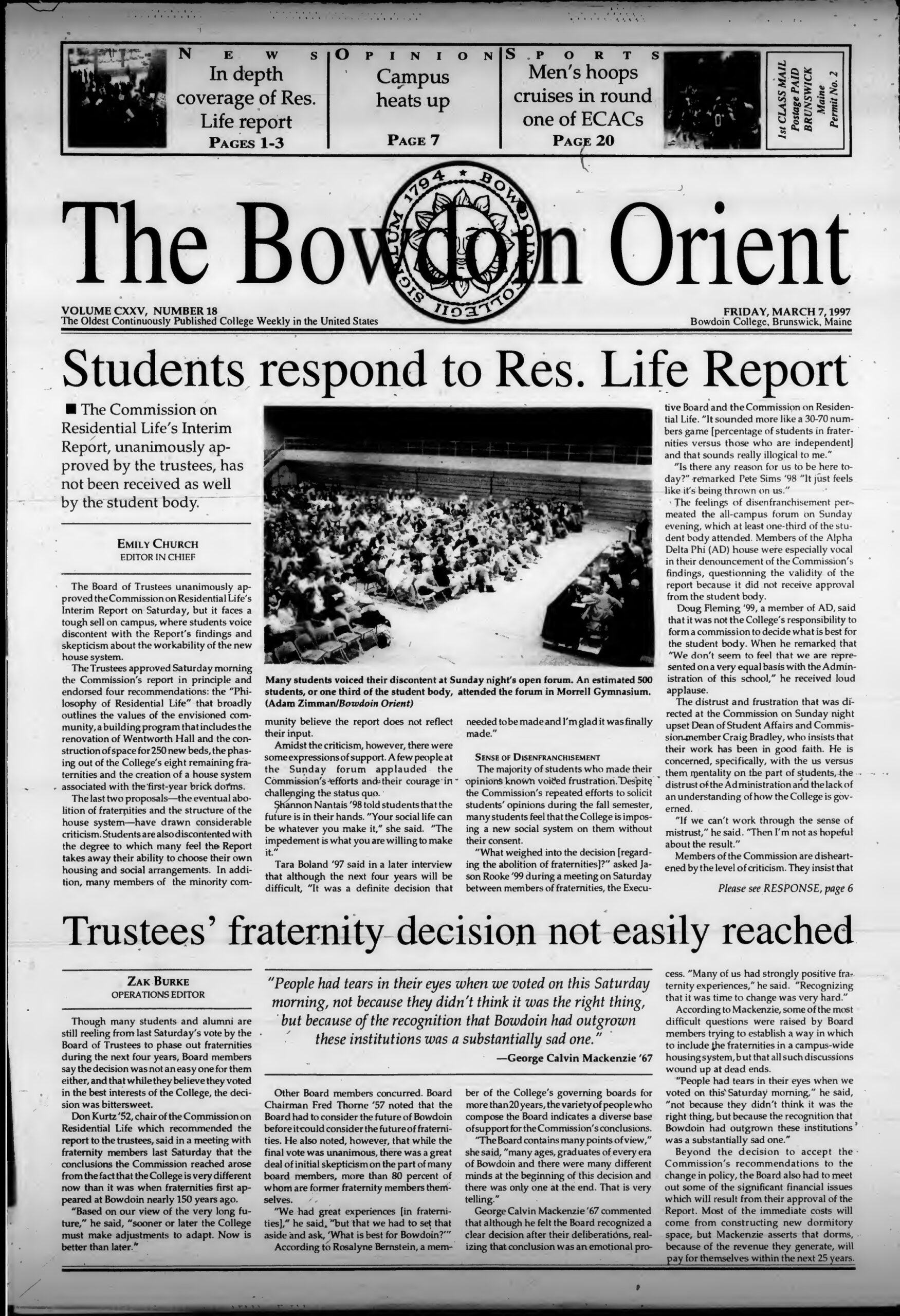 Courtesy of the George J. Mitchell Department of Special Collections
Since 1871, The Bowdoin Orient has been a staple at the College, covering and chronicling events on and around campus. From April 1899 onward, our coverage has been weekly. Looking back at Orient issues from the month of February, we have compiled a few noteworthy moments in Bowdoin’s past.
February 28 and 29, 1997: Board of Trustees votes to end fraternities
Presented with an interim report from the Commission on Residential Life with recommendations on student housing and fraternity life, the Board of Trustees made the pivotal decision to phase out the eight remaining fraternities on campus and adopt the College House system.
The Orient reported in the following week’s issue that student reception to the decision was mixed.
“Despite the Commission’s repeated efforts to solicit students’ opinions during the fall semester, many students feel that the College is imposing a new social system on them without their consent,” the article states.
The College’s choice to end fraternity life provoked “feelings of disenfranchisement” in the student body, and many were critical of “the perceived lack of choice in the new system,” in which students living in the first-year bricks would be randomly assigned to a College House they would be affiliated with for the next four years.
Students from underrepresented backgrounds also expressed discontent with the report’s approval, feeling that their concerns about diversity, inclusion and support in residential life were not adequately addressed.
Then-President Robert Edwards said he was continuing to meet with students to hear their concerns and was working to address them outside residential life through targeted programs and increased financial aid.
Students also voiced concerns that the end of fraternities would end the tradition of the houses altogether.
“We are very conscious of preserving the history of the places,” Chair of the Commission on Residential Life Donald R. Kurtz ’52 said. “We have no intention of changing or rewriting Bowdoin’s history. We want alumni and students to be able to come back to those places and be proud.”
February 1, 2004: Students erect “towering inferno” in honor of Patriots win in Super Bowl XXXVIII
The Carolina Panthers faced the New England Patriots in Super Bowl XXXVIII. With this momentous second Super Bowl victory for the Patriots—the first occurring two years prior—many students held celebrations. The largest of these celebrations took place on the Brunswick Apartments quad in the form of a large fire.
The fire was between apartment buildings I and J and encircled by a group of around 100 students. In the issue published the week of the fire, the Orient quoted the reactions of some Bruns Apartment residents.
“Right after the Pats won we heard people yelling on the quad. We went out to join the celebration and were blown away by the towering inferno,” Chris Donnelly ’05 said.
The fire was reported to Safety and Security at 10:31 p.m., after which Brunswick Fire Department (BFD) volunteer firefighters were dispatched to the scene. Around an hour after the fire was extinguished, another smaller fire was erected. This fire was put out without the help of the BFD.
Drew Russo ’06 was quoted regarding the good nature of the fire and its surrounding celebration.
“It was pretty cool,” Russo said. “It was good, clean fun; there were a lot of passionate sports fans out there. There were people singing ‘We Didn’t Start the Fire’ and chanting and celebrating.”
February 12, 2010: Gender neutral doubles approved
After a long student-led campaign, the College adopted a new policy allowing mixed-gender, one-bedroom doubles in upperclass housing for the following academic year. This change built off the previous policy allowing mixed-gender suites.
Students fought for the change on the basis of providing more agency in their housing decisions and ensuring that students of all sexual and gender identities felt comfortable in their living spaces.
Previously, students were only able to live in “gender-blind” doubles if they met with the director of residential life to “[explain] their situation.”
The article noted that “preliminary student reaction appeared to range from neutrality to full support,” while the College maintained that it would continue to dissuade students in romantic relationships from living together.
The decision marked an important change for students’ agency, especially for queer students on campus.
February 6, 2025: Students for Justice in Palestine form an encampment in Smith Union
Last year, Bowdoin Students for Justice in Palestine (SJP) formed an encampment in Smith Union. The encampment, which was the first college encampment during President Donald Trump’s second term, lasted four days and ended with the protesters coming to an agreement with College administrators.
The encampment came almost a year after students voted on the Bowdoin Solidarity Referendum, a referendum demanding the College halt its investments in defense focused funds and take an institutional stand opposing the scholasticide in Gaza.
The referendum received a supermajority, with 66.84 percent of students voting in favor of it. Despite the supermajority, the College did not adopt its demands.
During the length of the encampment, many students gathered outside to chant their support.
“To our beautiful bears who are encamping inside the Union, we send you our love, we will not leave you,” students chanted.
Comments
Before submitting a comment, please review our comment policy. Some key points from the policy: