
Former NFL lineman Urschel talks algorithms
January 30, 2026
 Andrew Shi
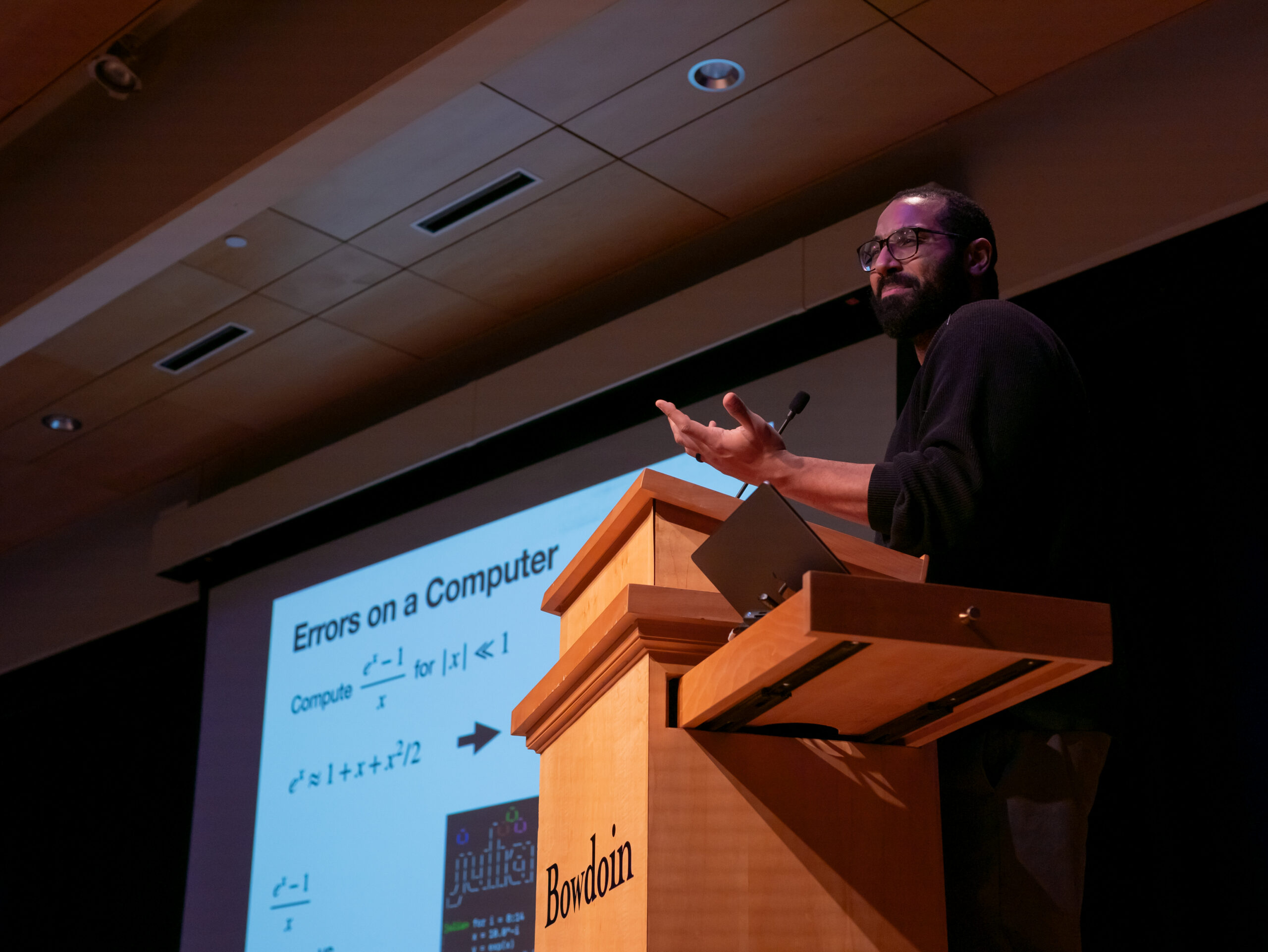
On Tuesday night, former Baltimore Ravens lineman John Urschel delivered a lecture on Gaussian elimination, a system of solving linear equations, in Kresge Auditorium. Urschel, who is now a math professor at the Massachusetts Institute of Technology, played in the NFL for three years before deciding to pursue a PhD. The lecture focused on performing this process with a computer and began with the perceived difficulty of this task.
“Computers, as you know, are just a bunch of zeros and ones. You look at your laptop, [and] this is some finite thing with only so much size,” Urschel said. “That means when we store numbers, we have to be efficient about it, and we have to really think when [we] put a number into Python or MATLAB or Julia or your favorite programming language, ‘What is your computer actually doing?’”
He explained the difficulty of storing long numbers, such as pi or precise decimals, in a limited binary space.
“If you take the number pi, note that this does not have a terminating decimal expansion,” Urschel said. “We can’t store this number perfectly on a computer, so that means … inherently error is going to creep in just by writing this number down.”
These errors extended to attempts to compute numbers, where equivalent equations would provide different answers when programmed in Urschel’s programming language of choice, Julia. An equation divided by x provided increasingly wrong answers, but an equation divided by log of e to the x—equivalent to x—provided the correct answer.
“This is just one example of the way that coding something to be accurate on a computer versus doing math on a blackboard can look very different. When we do even basic operations [with a programming language], error accumulates. These errors can become quite large,” Urschel said.
Urschel involved the crowd in his explanation of linear systems. He used an example problem of finding the ages of two children, before introducing a more complex problem featuring three equations focusing on how much grain different variants of rice yield. For Urschel, the rice problem had particular relevance.
“This math problem was created about 2,200 years ago, possibly older. This problem appeared in the eighth chapter of the ‘Nine Chapters on the Mathematical Art,’ dated about 200 BCE. [The book] record[ed] techniques that appeared from the previous [Chinese] dynasty,” Urschel said. “The technique I showed you is very similar to the elimination method that you may have learned in high school or college.”
This method of solving equations became a challenge for early scientists such as Manhattan Project participants John von Neumann and Robert Oppenheimer.
“Von Neumann wanted to build a computer that did something that had never really been done before. The idea is that the computer actually stores the program in it, and he asked Oppenheimer to build this at the Institute for Advanced Study,” Urschel said. “There were a number of technical reports and papers by fairly famous mathematicians questioning whether or not this computer can actually perform computations stably and consistently.”
Urschel explained how, while modern computers can solve the problems that von Neumann and Oppenheimer were curious about, difficulties remain.
“But now suppose on your computer you’re using half precision, and so you can only store a number using 16 bits. And the problem is, what was negative 4,095, because it has to be rounded because there’s not enough space on the computer, becomes negative 4,096. This feels like some really small change [but] it should make a big difference,” Urschel said.
Nathan Hale ’29 appreciated the perspective that Urschel’s lecture offered.
“I didn’t know much about linear algebra coming into this, especially modeling within coding,” Hale said. “I think it’s very interesting how we’ve been tackling the same issue for over 80 years, and we still see it today, and how we code in different languages.”
Comments
Before submitting a comment, please review our comment policy. Some key points from the policy: