
Argentine artist featured in BCMA exhibit
January 30, 2026
 Abigail Hebert
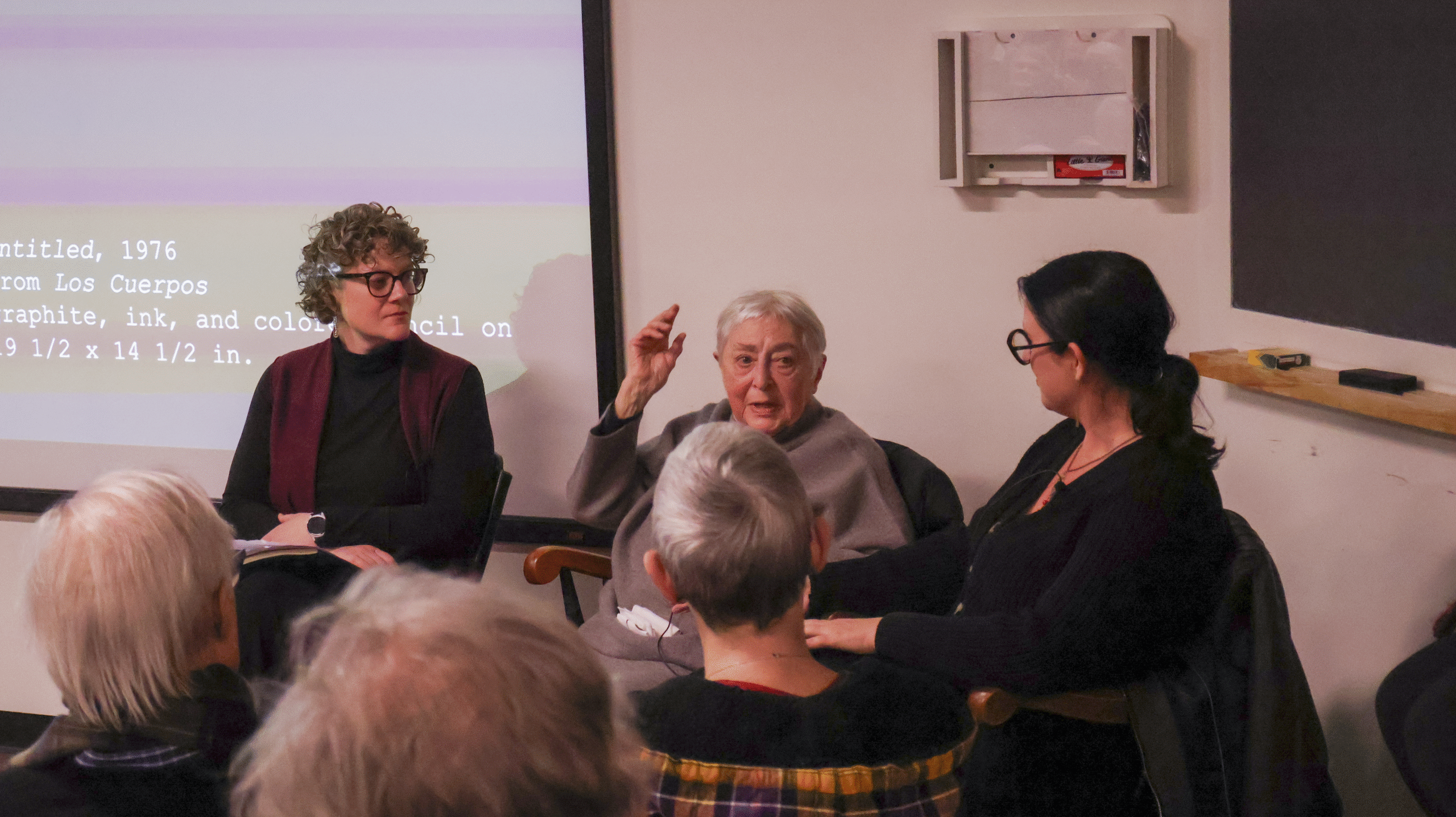
On Thursday evening, students and community members gathered in the Visual Arts Center to celebrate the opening of the Bowdoin College Museum of Art’s (BCMA) exhibition “Drawing Myself Free,” featuring work by artist Josefina Auslender and curated by Cassandra “Casey” Mesick Braun. The BCMA is the second institution to acquire Auslender’s work after the Portland Museum of Art featured some of her pieces from the series “Stendhal” in the 2007 exhibition “Graphite.”
Auslender was born in 1934 in Buenos Aires, Argentina. Though she was interested in art at a young age, Auslender did not formally study art until enrolling at the Perugino School of Art as well as the National School of Fine Arts Prilidiano Pueyrredón in Buenos Aires. She took a hiatus after graduating in 1956 to focus on raising her two sons, Marcelo and Ariel.
Eventually, Auslender found her way back into the art world, studying ceramics under Carlos Bartolini. Despite acclaim for her work, Auslender lacked a love for ceramics and began working with sculpture before finding her true artistic love: drawing.
Auslender’s drawings began as graphite on paper. Set against solid black backgrounds, Auslender drew sharp geometric shapes. Creating the background’s black color was a thorough process, requiring rigorous layering over time.
“It’s like Leonardo with the Mona Lisa,” Auslender said. “He never finished the Mona Lisa…. We are so attracted to her because of the layers…. It was always a little bit and a little bit. The same is with the black.… Some are five layers. It took me almost a month to finish a background.”
“La Ciudad” was Auslender’s first series to experiment with color. She also experimented with shapes in the series “The Magic Space,” which transformed geometric forms into a cityscape. Inspired by traffic lights and the views of the city in the rain, Auslender felt inspired to incorporate these images into her work using colored pencils. The use of color was amplified in her work after Auslender emigrated to Portland in the late 1980s.
“I arrived in the United States, and everything was pink,” Auslender said. “The women were using lots of pink. There were pink cars. There was a house … [that] was completely pink.”
Camilo Rodriguez ’28, a student curator at the BCMA, was tasked with looking at “La Ciudad” and “Los Cuerpos,” two series Auslender created before immigrating to the United States. He was particularly inspired by how Auslender’s journey impacted her work.
“Seeing how her view of Buenos Aires is and her relationship to Buenos Aires [was] changing during that pivotal time in her life was really exciting because I was able to track how her artistic progression occurred and how both works represent Buenos Aires in one way or another, [as well as] how she was relating to the city as an artist, both in her practice and in the way she was depicting the space around her and the space within her,” Rodriguez said.
Rodriguez was also interested in Auslender’s artistic journey after settling in the United States.
“A lot of artists, when they have to endure a transition, are adopting ideas from the places they’re arriving to into their work. The way she has melded her own experiences and her own practice with what she’s seeing in the United States is really interesting,” Rodriguez said.
Braun mentioned her favorite series titled “Voyage.” Braun noted that these pieces illustrate Auslender’s creativity.
“I thought, ‘Wouldn’t it be nice to make a series that is called Voyage? But voyage to the past,’” Auslender said.
Although Auslender spent the majority of her career using graphite and occasionally colored pencils, she has adapted to a new mode in recent years.
“I have issues in my right hand and problems with the right side of my back…. Ink is easier,” Auslender said.
However, this is not the first time Auslender has experimented with ink. Braun pointed out that Auslender briefly used Micron pens in 1974. Auslender never showed the original ink-work in Argentina because of a negative comment her friend made about the mode. Still, Auslender eventually felt the need to try a new form.
“I needed to change…. Sometimes, I go back to [my old work] 20 years later because they are mine. I love them…. But it’s fairly the same. It’s completely different, but in reality, it’s always the same,” Auslender said. “I am an artist. I am a narcissist.”
As a whole, the exhibition depicts the transformation of Auslender’s on-paper creations throughout her adult life. Auslender’s art will be displayed until May 31, 2026.
Comments
Before submitting a comment, please review our comment policy. Some key points from the policy: