
Ken Stern offers up hope for inclusive campus discourse
November 7, 2025
 Abigail Hebert
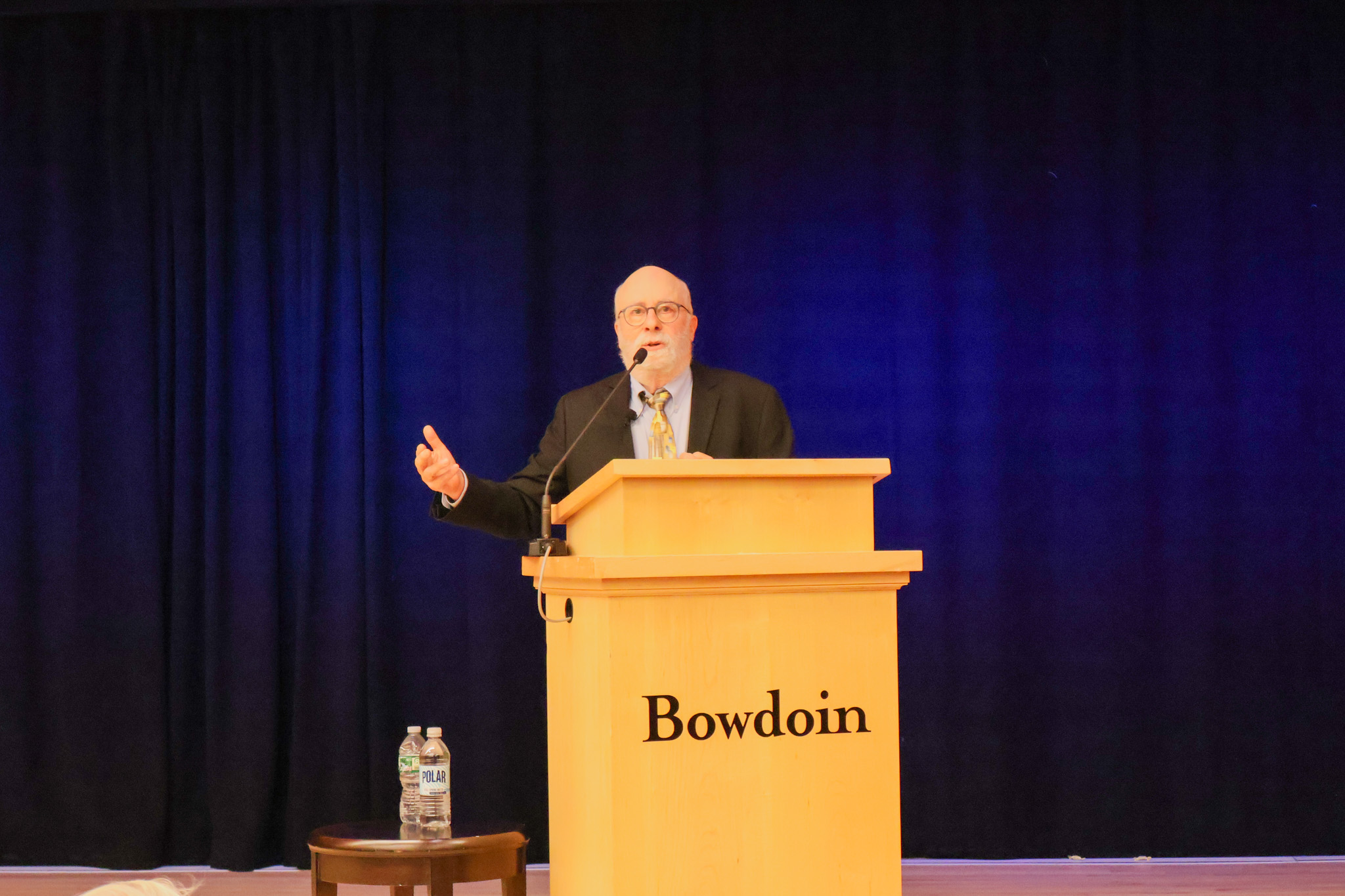
On Tuesday afternoon, author and director of the Bard Center for the Study of Hate Ken Stern delivered a talk titled “Hate, Memory, Binary Thinking and the Future of Democracy” in Kresge Auditorium. The talk was the fourth in the Viewpoint Exchange series.
Stern began by defining what studying hate meant to him.
“[Hate studies] is born of the observation that no matter where, no matter when, no matter what political system or economic system or major religion, we’ve always divided [people] into ‘who’s us’ and ‘who’s them,’ and that can lead to hate, demonization and dehumanization,” he said.
Stern connected the development of hate with human evolution and the survival need of determining ingroups and outgroups.
“[The] brain was developed at a time when spiders and snakes were very dangerous. It also developed at a time when we had to make quick decisions about ‘who’s us’ and ‘who’s them.’ That group over the hill might be a danger to us,” Stern said.
Accusations of antisemitism directed towards pro-Palestinian organizations have been frequent over the past several years. Stern explained how, in some cases, accusations of hate speech and discrimination have been weaponized to damage these organizations.
“The Zionist Organization of America said,… ‘We have this new power. Let’s go after speech on campus.’ And they started filing all these cases, some of which had correct [complaints] like … actual harassment. But they started filing complaints, about what a professor was teaching, what texts they were assigning in the classroom, what speakers were coming to a campus, what films were being shown,” Stern said. “All the cases lost, but they started saying, ‘At least it has a positive effect. It’s making pro-Palestinian organizers and administrators have to work more.’”
To Stern, both the political right and left fall victim to looking at the world through a narrow, binary lens.
“Does it fit inside a definition or not? [This] denies us an important tool to combat hate and understanding things like antisemitism, which, to me, requires using a wider lens,” Stern said. “Political leaders are vilifying anyone [and] that’s priming the pump for antisemitism.”
Concerned by repressive trends in today’s political climate, Stern harkened back to parallels with other points in American history when speech was threatened.
“You look at the Palmer Raids, you look at the McCarthy era. Those were not good times for Jews or anybody else, and we’re seeing an assault on those values today, on due process and free speech,” Stern said. “Remember the Tufts student who was whisked off a street for co-authoring an op-ed in a student paper supporting boycott, divestment and sanctions?… You have people like Secretary [of State Marco] Rubio and others saying things like [these individuals] … are dangers to the U.S. foreign policy and our national security.”
Stern continually reiterated the importance of understanding multiple viewpoints when engaging in dialogue and not immediately jumping to reflexively-held opinions.
“For Jews seeing what happened on October 7, it brought up for people [the] memories of family stories of the Holocaust and pogroms. And for Palestinians, memories of the Nakba,” Stern said. “The brightest people I know acknowledge they may be wrong. Reject anything that your antenna tells you is groupthink or [a] simplistic formula. If you feel comfort in reducing complicated issues to binaries, alarm bells should [be] going off.”
In a closing lesson for students, Stern urged students to remain empathetic, even during difficult conversations.
“There’s nothing more important you can do in situations like this than call out the transgressions of people on your side of a political debate who are demonizing and dehumanizing another human being,” Stern said. “I suggest you engage people and seek them out, people that you disagree with. You’ll learn more from people you disagree with. You might even change minds and certainly sharpen your own.”
Attendee Brendan McLoughlin ’29 appreciated the perspective that Stern offered.
“I liked what [Stern] had to say about the need to understand where people’s thought processes come from and also understand antisemitism and how one form of hatred ties into many others,” McLoughlin said. “I also liked how he brought up the importance of student groups [and] activism.”
Comments
Before submitting a comment, please review our comment policy. Some key points from the policy:
- No hate speech, profanity, disrespectful or threatening comments.
- No personal attacks on reporters.
- Comments must be under 200 words.
- You are strongly encouraged to use a real name or identifier ("Class of '92").
- Any comments made with an email address that does not belong to you will get removed.
Fan-friggin-tastic article. Sensational work yet again Mr. Duffy!