
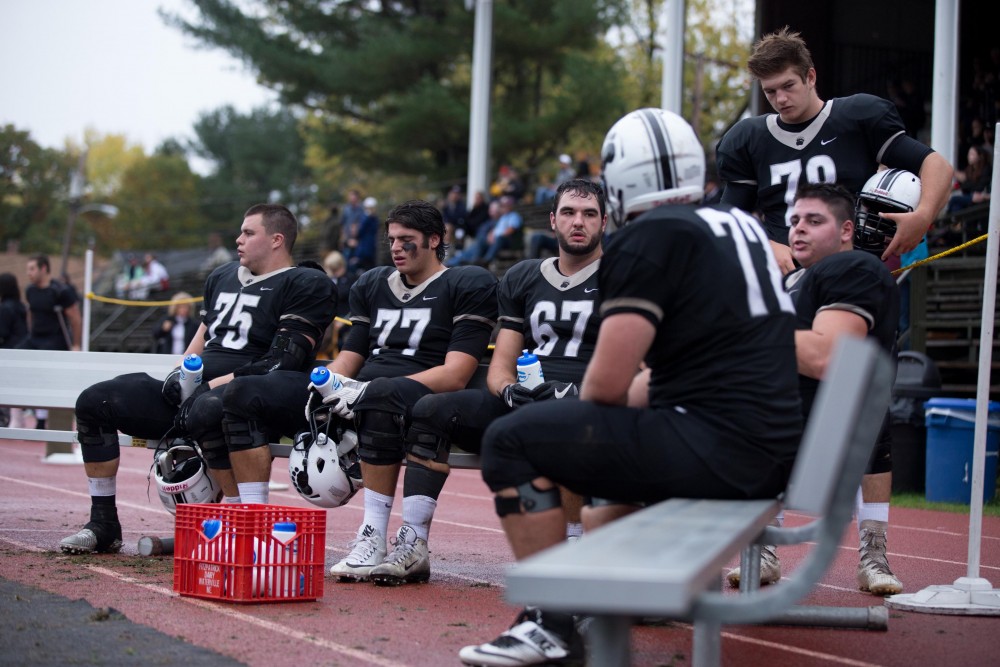
The Bowdoin football team has never had any periods of sustained success. Since 1990, the team has had just two seasons with five or more wins. The team has not had back-to-back seasons over .500 since 1979-80. In 125 years of football, the team has gone 394-516-44—equating to a .436% winning percentage.
Many players point to confidence as the key to turning around the program.
“It’s really a sense of belief, and that comes with a few years of success,” captain Nadim Elhage ’16 said.
Past players, present players, coaches and administrators all believe that, even more than recruiting or coaching, a winning tradition is the most important factor for achieving success.
“Winning and losing are habitual,” Football Head Coach J.B. Wells said.
The difficult part is breaking the cycle. Trinity was often mentioned as an example of a team accustomed to winning. Players can sense the gap in attitudes between programs like Bowdoin’s and Trinity’s on the field.
“The biggest difference is that [teams like Trinity] they expect to win … year after year,” Elhage said.
The top teams in the NESCAC really do win every year. Since 1990, Trinity has had only one losing season. They have also had seven undefeated seasons in that span. Another NESCAC powerhouse, Amherst, had a 21-game winning streak spanning four seasons before they lost to Middlebury this fall.
Recruiting plays a crucial role in determining a football program’s success. The official description of NESCAC recruiting was detailed in a 2005 New York Times article, as well as 2014 articles by both the Orient and the Bates Student.
In football, recruiting essentially entails trying to acquire the biggest, fastest, quickest players, who have the best instincts for the game and the best character off the field, who also won’t fail in the classroom. More than in most sports, size is crucial.
“One of the biggest things you notice when playing against the top teams, is that you see the guys are bigger, like the Trinity offensive line, their boundary side tackle is like 6-4, 320 lbs and a lot of times you would think they’re more athletic,” said Elhage. “I think that has to do with the academic caliber at Bowdoin. Not to make an excuse, but we’re not letting in a lot of the students that a lot of the other schools are letting in.”
The size differences of players—drastic at times—marks the most visible, calculable difference between top NESCAC teams and the less successful teams in the league. In football, size might not be everything, but uneven matchups on the line are tough to overcome.
“The offensive line is the only place where size matters a ton,” said Wells. “They’ve got to sit back and anchor their feet. Offensive linemen are either like sledgehammers or railroad spikes. If you have to get off the ball and hit somebody, you’re like the hammer. But you also have to put your foot in the ground and sit down against somebody running into you, you gotta be able to absorb that. That’s where size matters most.”
For deans and athletic directors around the NESCAC, recruiting is a touchy subject. In a 2014 Bates article on the subject, the Bates Dean of Admissions declined to comment on recruiting, saying that it was against league policy to discuss the process. Ashmead White Director of Athletics Tim Ryan does not think there are any recruiting differences between NESCAC schools.
“Every institution has essentially the same process,” said Ryan. “There are parameters across the conference that are the same in terms of the overall number of support opportunities … Different schools can allocate those resources as they’d would like across their own individual programs, but there are guidelines in place to ensure the system is consistent across the whole conference.”
NESCAC guidelines allocate two recruiting spots to each team at a school, with the exception of football, which receives 14. However, each college is allowed to decide how these spots and the associated resources are actually spread amongst their individual programs.
Once each team uses up its recruiting spots, the team largely relies on admissions to accept students who play each sport at a high level. Wells suggests that cooperation, as opposed to working outside the system, is the key to acquiring recruits that might be considered borderline applicants by the admissions office.
“I think a lot of people point fingers at the admissions office and they say, ‘they’re too stringent, they’re not giving you the players you need.’ You hear that a lot, they’re not ‘giving you the players.’ Well, it’s not admissions’ responsibility to give us anything really. It’s the responsibility for the offices to work together,” he said.
Wells also noted differences in recruiting at Bowdoin compared to when he was the Head Coach of the Endicott football team.
“The average student at Endicott was probably going to visit three, four, five, times before making a decision,” he said. “Here they might be able to visit one time. So, one of the biggest differences between recruiting at Bowdoin and Endicott is the limited face-to-face contact, the limited times that each recruit gets to visit campus at Bowdoin.”
Ryan does not believe schools lower admission standards for football players in a significant way.
“There may be slight variations, but no institution is going to have members of an athletic program who are considerably outside the range of the rest of the student body,” he said.
This provides an explanation for why Trinity would be able to out-recruit a school like Bowdoin: they have lower academic averages in the admissions process, and therefore have a greater pool of student-athletes to choose from.
Schools like Wesleyan and Tufts are simply bigger. Tufts has 5,000 undergraduates, and Wesleyan has 3,000, so they have a greater pool of admitted students who want to play football, outside of standard recruits. So they have the potential to receive more walk-ons.
Removing Trinity, Tufts and Wesleyan, what explains Amherst’s success? If Amherst and Bowdoin are assumed to be on the same academic level, why are they able to stock their team with more, and bigger, bodies?
“That’s the million-dollar question. If you figure that out, call me. That’s the code [we’re] trying to crack,” Wells said.
An important difference between the schools, in Wells’ view, is consistency in staff. Having the same coaches, year after year, delivering the same message to the players, is important.
“If you don’t have a lot of turnover on your staff, that allows you to improve more effectively, communicate more effectively, teach more effectively,” Wells said. “If you have good coaches that are good recruiters, over a long period of time that helps your team.”
Wells also pointed to communication between offices as a key to success.
“With football, you really have to be vertically aligned. From your players, to your coaches, to your athletic director, to your admissions office, to your president, you all have to be on the same page,” Wells said.
At the end of the day, however, games are played on the field, not at desks. Bowdoin players and administrators have emphasized that, record aside, the team is moving in the right direction.
“There’s never a time when we’re playing a team, and what we’re doing is just completely wrong. For example, Coach Bloom has been great at dissecting opposing offenses … really any time there have been big plays against our defense it’s kids not executing. When we’re doing what we’re supposed to against the best teams in the league, they’re not able to do anything,” Elhage said.
In building a successful football program, the margin of error is incredibly small and a host of factors puts Bowdoin at a disadvantage. Bowdoin does not operate with the same set of rules as Trinity or Amherst. When compared to other Maine schools, Bowdoin actually performs quite well. Bowdoin has traditionally been the best DIII football program in the state and has won the most Colby-Bates-Bowdoin championships, with 20.