
Spring Concert rewind through the archives
April 3, 2026
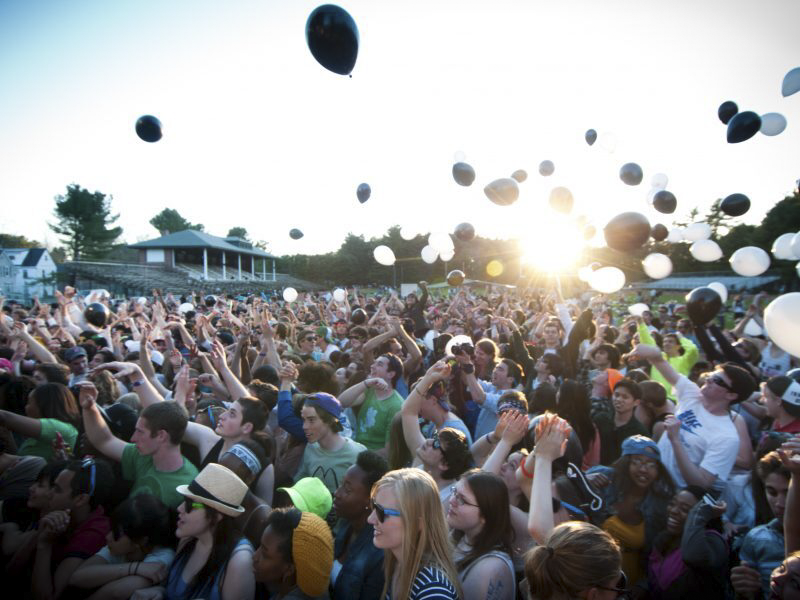 Courtesy of Bowdoin Communications
On Friday, the campus will welcome performances from electropop duo MGNA Crrrta and indie band Peach Pit for the annual Spring Concert, now held separately from Ivies Weekend.
Ivy Day, Bowdoin’s annual spring tradition, dates back to 1865, when the Class of 1866 first stood in front of the Chapel to speak to a crowd, sing, celebrate and plant an ivy tree.
This tradition has transformed over the past 160 years, expanding into a full weekend of events. Live music has been central since 1912, when students first danced until daylight at the Ivy Ball.
As the ages passed, so did the tastes of Bowdoin, and each generation has had its chance to shape the concert lineup to best suit the melodies of the moment. Here, we look back at some memorable acts that have made the journey up north to Brunswick.
Duke Ellington: 1928 and 1932
Duke Ellington first came to Bowdoin during Ivies in 1928 with his orchestra, the Washingtonians, to play a house dance. He was on the rise and had just secured a spot in Harlem’s famed whites-only Cotton Club. The nightly radio broadcasts carried Ellington’s music throughout households, finally reaching the student dorms in Maine.
Bowdoin brought him back four years later, where, at this point, Ellington had left the Cotton Club and taken his band to the road. In 1932, the same year he returned to campus, he released “It Don’t Mean a Thing (If It Ain’t Got That Swing),” which would become an anthem of the Swing Era.
“No such weird combinations, such unique and effective cross rhythms and counter melodies with strange and broken tempos are attempted by anybody but Ellington,” an April 13, 1932, Orient article reads.
Students highly anticipated the second concert at the Ivy Ball, and with record attendance expected, one dollar would be charged for admission.
Louis Armstrong: 1936
In 1936, “The King of the Trumpet” Louis Armstrong came to campus. At the time, Armstrong was already widely considered a defining figure in jazz, having recorded his hugely popular “Swing That Music” days before coming to Bowdoin.
“His phenomenal popularity was and is based not only on his masterful trumpet playing but also his unique style of singing,” a May 20, 1936, Orient article reads. “He can hardly be called a legitimate singer, but his ‘rough’ voice and hot style has clicked with the public.”
Armstrong’s stop at Bowdoin was one of only four during his trip to New England. His band included three other highly anticipated feature performers: Luis Russell on piano and Sonny Woods and Bobby Caster on vocals.
“The selection of Louis Armstrong as the gym dance band has met with wide approval,” the 1936 article read. “All indications are for one of the most successful parties in many years.”
Armstrong was scheduled to return to Bowdoin for Ivies in 1967 but was unable to perform due to poor health.
Miles Davis: 1963
In 1963, Bowdoin welcomed the Miles Davis Sextet for a concert at the height of his career. Students anticipated the trumpeter’s unique style and his cohesive integration of the world-class members of his band.
“They have more sheer class as a unit than any small group has produced in years, with the single exception of the modern jazz quartet,” student Ralph Gleason said in an April 19, 1963 Orient article.
Another student expressed underlying concerns about how Bowdoin’s overwhelmingly white student body might shape Davis’s reception at his show.
“Miles is guilty of a certain amount of Crow Jim, part of which is the feeling that most whites are really incapable of understanding his music,” Jim Riley said in a 1963 Orient opinion piece. “What if Miles gets an unfriendly reception? It would be foolish to deny the possibility of this happening, and if it does happen, then the students are only depriving themselves of a great listening experience.”
Simon and Garfunkel: 1967
In the mid-1960s, the concert began to evolve away from the formal Ivy Ball. Simon and Garfunkel were invited to perform in the new Sargent Gymnasium. The duo rose to fame in 1965 with “The Sound of Silence.”
“These two new entertainers have popularized a new wave of urban folk expression in song,” an October 14, 1966, Orient article reads.
Not all were thrilled about the change in style for musical acts, such as Peter H. Vanderwaart, who wrote a letter to the editor.
“[Students] have been too afraid of their own intellectuality to choose performers of jazz, or other significant music,” Vanderwaart wrote. “When it happened that Simon and Garfunkel were invited here, I thought the unhappy plague was at last over, but I see now that they were only here as representatives of Folk-Rock, loved more for Rock than for Folk.”
The duo broke up in 1970 after releasing their final album, “Bridge over Troubled Water.” Bowdoin caught them just in time.
Mac Miller: 2011
By 2011, the concert had moved to an outdoor production on Whittier Field, following years of shifting locations across campus. The E-Board had surveyed the student body to gauge artist interest in an effort to cover a range of musical tastes.
Philadelphia rock band Dr. Dog opened the set. Mac Miller followed, and at 19, he was still signed to independent label Rostrum Records. Riding the momentum of his 2010 mixtape “K.I.D.S.” and on the way to releasing “Blue Slide Park” in 2011, he was on the rise yet not big enough to headline the show—an honor that went to R&B star Janelle Monae.
“[Miller] is getting a lot of press now for being one of the best up-and-coming artists this year,” David Gruber said in a February 25, 2011, Orient article.
Evan Gershkovich ’14 explained the set was far from uneventful.
“[Miller was] that absolutely lame guy, pulling his shirt up and telling, not asking, all the girls in the crowd to do the same (with less eloquent phrasing, mind you). How the much-too-PC student culture didn’t erupt at his comment, I still don’t know,” Gershkovich wrote.
Comments
Before submitting a comment, please review our comment policy. Some key points from the policy: