
How the introspection of music works within shared spaces
April 3, 2026
 Lauren Russler
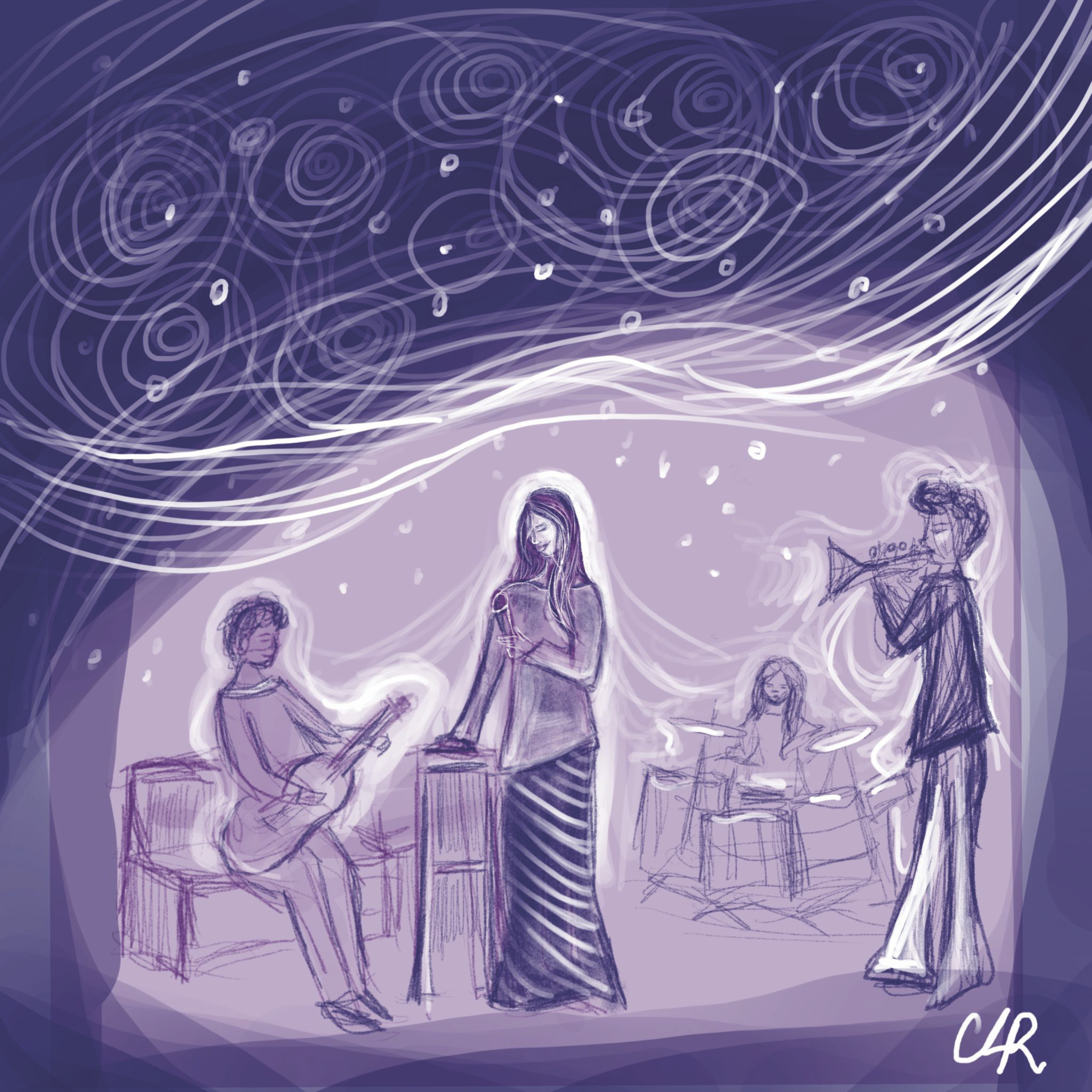
Last Friday, 11 special musical groups competed in the treacherous Battle of the Bands, held in Jack Magee’s Pub. In its lengthiness, the event successfully staged a diverse array of genres and talent. Between funk improvisation, intense percussion and pure screaming, sound consumed students and, in return, students consumed sound. Of the various artists who took the stage, I had a bit of a conversation with a member from my own band (yay Josh Klein), Karma Samtani ’27, to reflect on the value of bands, concerts and collaborative music projects.
To begin, we went over a few details, reviewing thoughts on the Battle.
“I really enjoyed playing.… It was fun getting to spend more time with my bandmates in practice, and I always enjoy working hard on something that I can eventually put out into the world,” Karma said.
In line with this logic, Karma’s favorite song covered by Josh Klein was one of our more involved, rehearsed pieces: Tanya Tucker’s “Delta Dawn.” The song, which features all of our band members on vocals, allowed us to experiment with a larger dimension of harmony and groupwork. While working on “Delta Dawn,” we found ourselves in the middle of a tedious, but ultimately rewarding, task. Karma referred to the Battle as a “culmination of a process that took a lot of work but was … enjoyable nonetheless.”
I asked how playing music individually compares to playing with others.
“Playing music on my own is really awesome because I get to move at the speed of my own ideas. But playing with others is an unparalleled experience because I get to hear my friends do things I don’t know how to do,” Karma said.
He included that encounters with his friends’ distinct styles or abilities provide “an awesome way to unlock a lot more sonic possibilities.” Zooming out even more, I find this perspective cool not just on the inter-band level but also in relation to the larger collective of the Battle. Considering the range of noise shared on Friday night, there’s certainly a lot of opportunity for exploration and emulation in the Bowdoin music community.
In the vein of evolving as an artist, crucial to Karma’s experience as a member of Josh Klein and the larger music scene at Bowdoin has been his development on stage performing.
“Being observed on stage definitely makes the experience feel more real, and whereas my bandmates have seen me on good and bad days, I feel the pressure of making a good first and potentially last impression for people who won’t see us play again,” Karma said
Nevertheless, Karma told me that he has been able to work through this obstacle by practicing and playing live shows. While the tension of potential disappointment remains, Karma added that the sentiment is alleviated by the trust and kindness of the audience members and his bandmates.
Regarding the emotional work of group music, it is evident how transformative performance, especially with a band, can feel. Drawing on Karma’s mention of the “understanding and trust” he has received from other members of Josh Klein, I think an emphasis should be placed on how bands are microcosms of communally-informed identity formation. In an artistically experimental setting (i.e. band practice or performance), individuals collaborate to produce their own original sound, established through the synthesis of their unique qualities. Consequently, the music created in communicative environments where band members feel supported has a more authentic quality.
On a like-minded but more vague note, I asked Karma how performance of music could be thought of as a tool.
“Josh Klein really took life during one of the most difficult periods of my time at Bowdoin, and being a part of the band was an incredibly rewarding highlight for me and gave me a sense of community and purpose,” Karma said.
In cultivating a space intent on workshopping and improving abilities on multiple levels, singular and plural, I imagine most band members find synonymous meaning in their groups.
“It’s been awesome to connect with other people on campus through music. I’m very lucky to have had this community and opportunity,” Karma said.
Karma Samtami ’27 is a member of the Bowdoin Orient.
Comments
Before submitting a comment, please review our comment policy. Some key points from the policy: