
Students envision Maine’s energy future at Common Good Energy Challenge
February 27, 2026
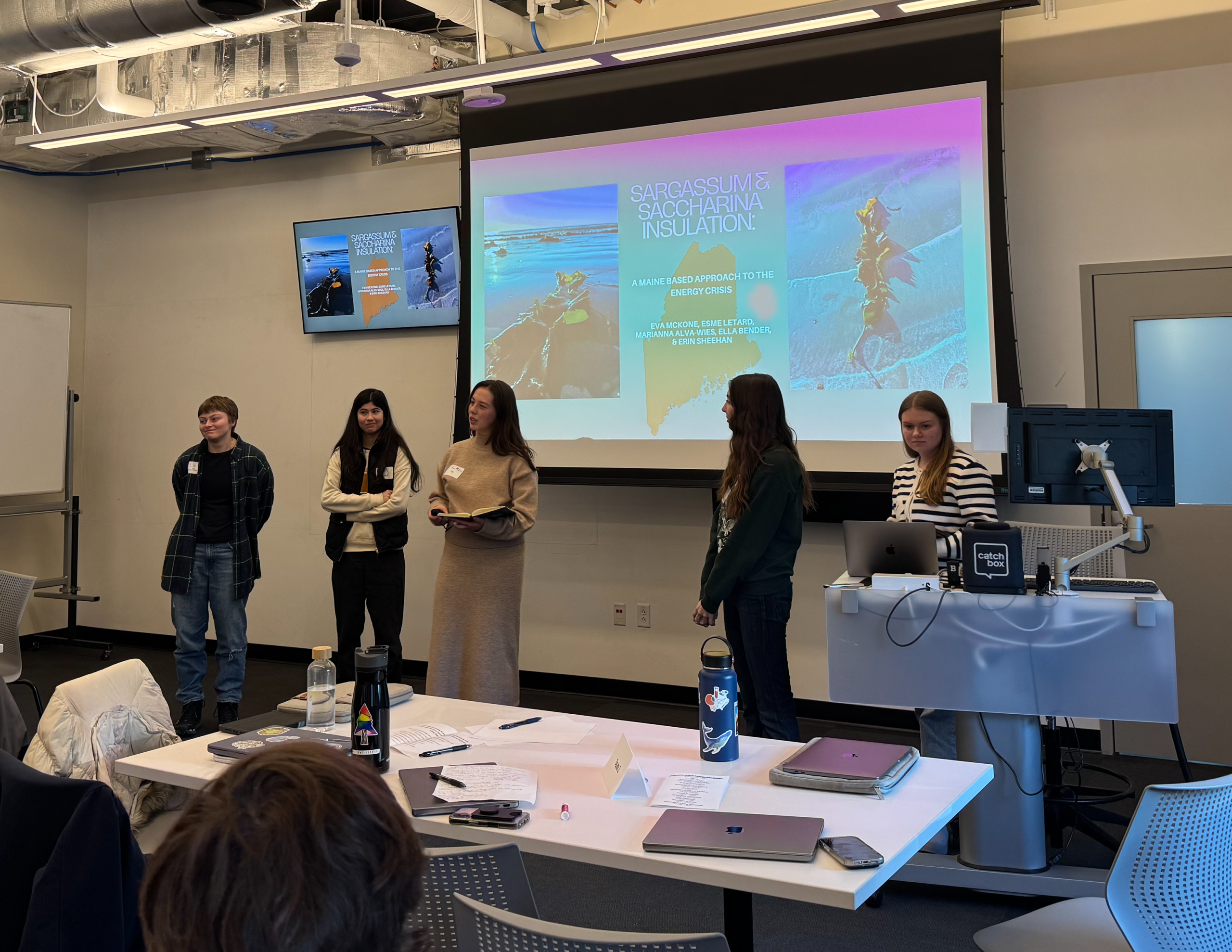 Courtesy of Eden Zumbrun
Last Saturday, students gathered in the Roux Center for the Environment for the Common Good Energy Challenge, a daylong event that prompted participants to develop small-scale energy solutions through interdisciplinary collaboration and competition.
Eden Zumbrun ’26, an environmental studies and government coordinate major, began planning the event in the fall. For Zumbrun, the challenge was a way to apply her coursework interactively, translating classroom lectures into a hands-on event.
She also wanted an opportunity for students to appeal to future employers and scholarship opportunities by showcasing their problem-solving skills.
The challenge was sponsored by the Departments of Environmental Studies, Government and Legal Studies, Digital and Computational Studies, Earth and Oceanographic Science, Computer Science and Economics, along with the Bowdoin Sustainability Office and Career Exploration and Development.
The various departments encouraged interdisciplinary partnerships, inviting students to register as academically diverse teams of five.
“We stressed interdisciplinary the whole time, and that’s why the sign-up sheet told students to try to register with friends who are different majors,” Zumbrun explained. “It’s nice to hear what friends are learning in their classes, and when you apply it all together, it’s really interesting.”
Seven teams participated, each tasked with proposing a small-scale energy solution that could be implemented in Maine without requiring federal funding.
Before the competition began, three guest speakers provided professional insight into energy innovation.
Acting Commissioner for the Maine Department of Energy Resources Dan Burgess outlined current trends in energy use and planning across Maine, while Climate and Energy Policy Advisor for Maine’s branch of the Nature Conservancy Karen Blakelock explained the components of a sustainable and realistic energy solution.
Professor of Economics Erik Nelson rounded out the presentations by introducing students to the economic and technical dimensions of clean energy innovations.
Teams spent the remainder of the day researching, debating and refining their solutions into actionable plans.
Zumbrun first conceived of the energy challenge after attending a pitch competition at Northeastern University’s Portland-based Roux Institute during her sophomore year. Designed by graduate students, the program emphasized sustainability and entrepreneurship.
Inspired by this experience, Zumbrun envisioned a refined version that retained the event’s environmental problem-solving focus while expanding participation beyond STEM students and appealing to a younger demographic.
Zumbrun explained that Bowdoin’s environmental studies coordinate major is uniquely interdisciplinary, involving courses from the humanities, social sciences and hard sciences. She wanted Bowdoin’s event to reflect this diversity of thought, recognizing that energy solutions aren’t devised by scientists and policymakers alone.
“When you’re trying to approach a complex problem like climate change or an energy challenge, it’s very helpful to have people from different backgrounds,” Zumbrun said. “While obviously people will think about the environment and policy, you also want people from an economic and math background that will think about the financial feasibility.”
Participants presented to a judging panel of Blakelock, Nelson and Fred Horch, co-founder of Spark Applied Efficiency. Judges awarded prizes to the top three teams.
The first-place team, composed of Liam Mattox ’29, Annie Moore ’26, Graham Reynolds ’29, Adam Rublin ’29 and Ethan Stolper ’29 impressed the judges with their creative suggestion for energy storage.
Their proposal included a state government program to subsidize the purchase of household batteries. By selling excess renewable energy back to the grid, both the state-funded program and homeowners would recover their initial losses. Homeowners would continue to own, use and profit from the battery once it was paid off.
“We used Excel to model the math behind our proposal, and the judges complimented the fact that we discussed the math in our presentation,” Rublin wrote in an email to the Orient. “But we weren’t fully math-focused; we also covered the environmental justice behind our proposal and a publicity campaign.”
While financial logistics shaped the winning team’s response, other teams approached the problem from equally creative angles, influenced by solar power, state legislation and community-owned resources.
Biology students on the third-place team recommended using Maine’s abundance of seagrass and kelp as alternative insulation, mitigating energy use by reducing heat loss. The group modeled a current rebate system and offered pragmatic financial incentives.
“It was really exciting to see all the ranges of solutions, which is what I was personally hoping to see come out of the event,” Zumbrun said.
Rublin emphasized the positive collaborative experience he got from the challenge.
“I learned so much about the specific energy challenges facing Maine and New England,” Rublin wrote. “I really enjoyed working as a team and coming up with ideas together. We did a great job of building on each other’s ideas and honing our policy proposal throughout the day.”
Comments
Before submitting a comment, please review our comment policy. Some key points from the policy: