
Panel speakers and discussion mark fourth year of Russia’s full-scale invasion of Ukrainian territory
February 27, 2026
 Andrew Shi
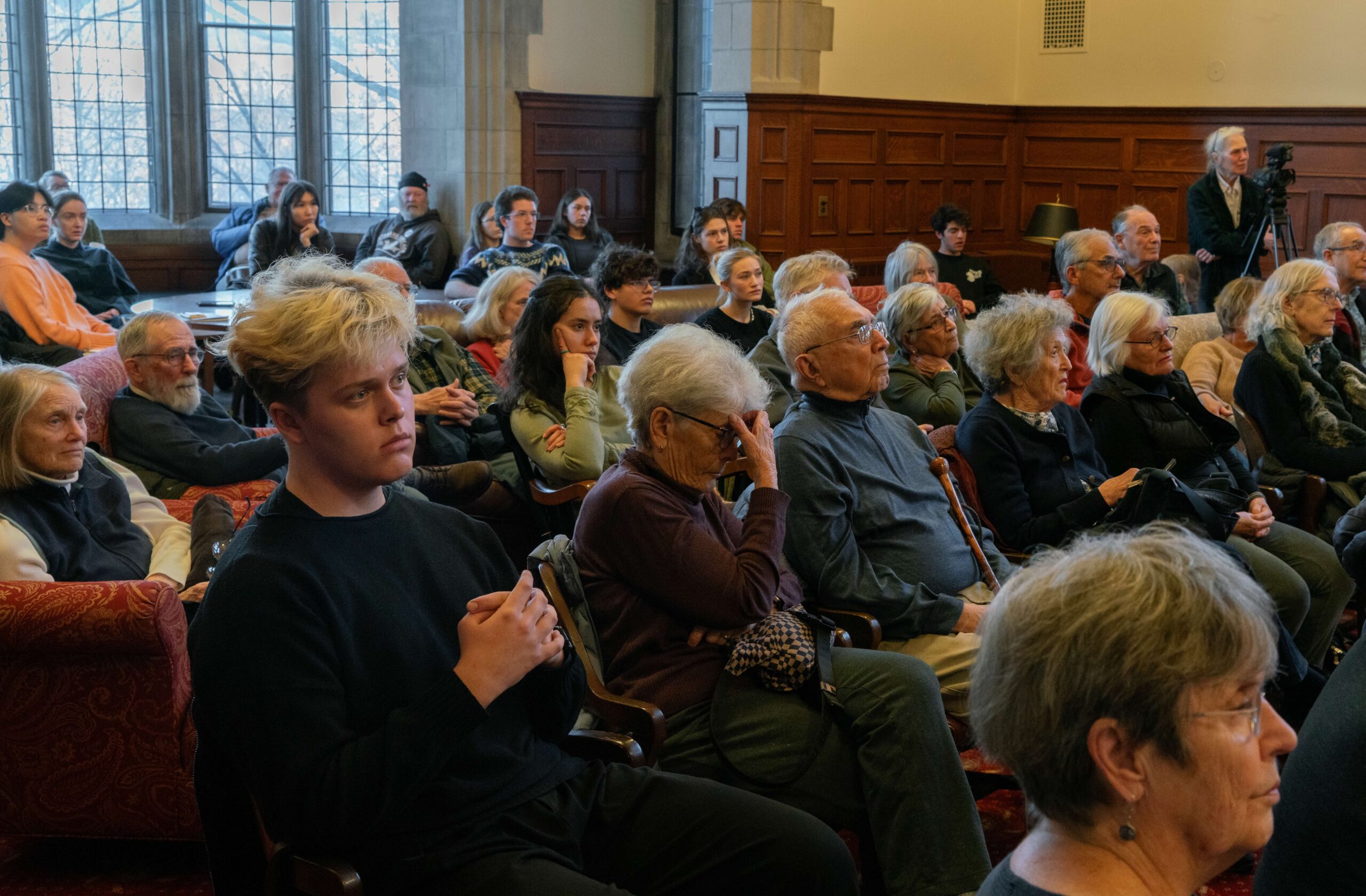
On Tuesday afternoon, members of the College community gathered in Hubbard Hall for a panel and discussion to mark the four-year anniversary of Russia’s full-scale invasion of Ukraine. The event was sponsored by the Russian, East European and Eurasian Studies and Government and Legal Studies departments, as well as representatives from student group Bowdoin for Ukraine (BfU).
The program opened with recorded remarks from Oleksandra Matviichuk, director of the Center for Civil Liberties, a Ukrainian nonprofit human rights organization and a 2022 Nobel Peace Prize recipient.
Speaking from more than 4,000 miles away, Matviichuck framed the ongoing war as a broader political and moral struggle.
“This is not just a war between two states.… This is a war between two systems: authoritarianism and democracy. With this war, [President of Russia Vladimir] Putin attempts to convince the entire world that democracy, rule of law [and] human rights are fake values because they couldn’t protect anyone during the war,” Matviichuck said.
Matviichuck also emphasized the role of civic action.
“I know, from my own experience, [that] when you can’t rely on the international system of peace and security, you can still rely on people,” Matviichuck said. “We get used to thinking through the categories of states and interstate organizations, but ordinary people have much [greater] power than they can’t even imagine. Ordinary people can change history.”
The organizers also played recorded remarks from Colonel Volodymyr Polevyi of the Armed Forces of Ukraine. Polevyi rejected the idea that Ukraine has an infantry shortage and the claim that its citizens are unwilling to fight.
“Ukraine has [a] higher percentage of people ready to defend the country with violence in their hands than any other democracies in the world,” Polevyi said.
Polevyi warned that reductions in support for Ukraine from countries such as the U.S. can have tangible consequences on the battlefield.
“The [U.S.] plays the following cards—reduces support and arm supplies, lowers the flow of intelligence information—and Ukraine loses more infantry,” Polevyi said. “Nobody wants to fight with bayonets and shovels. Then you accuse us of our people being tired. It is disgusting.”
Following these recorded messages, Brian Milakovsky, a researcher and expert on economic recovery in Ukraine, joined BfU student organizer Volodymyr Zadorojny ’27 to discuss the war’s political and economic implications and pathways to the conflict’s end.
Milakovsky explained that U.S support is necessary for an end to the war, but that recent policy has been divided. He said President Joe Biden strongly supported Ukraine and provided military aid, but did not pair this with a diplomatic strategy aimed at securing specific concessions from Russia. In contrast, he said President Donald Trump has moved to establish diplomatic channels with Moscow but has not matched that engagement with sufficient military force to strengthen Ukraine’s negotiating position.
“[The two administrations] have never been fused together to operate as one cohesive cause,” Milakovsky said.
Milakovsky said that wartime pressures have reshaped civic life in Ukraine.
“This war is horrifically costly in lives, treasure and the future of Ukraine. What they’re enduring is not sustainable. It cannot go on,” Milakovsky said. “Political life in the country is distorted when you’re at war. Ukrainians would like to have elections. They genuinely would. Right now, they cannot. Their political life is suspended in a country that is enormously proud of its democracy.”
Milakovsky addressed proposals to end the war through territorial concessions, noting that such plans often assume Russia would halt its aggression when sufficient demands are met.
“If you listen to what the Russians say amongst themselves in their own media universe and political universe…, it becomes very difficult or impossible to trust Russia to actually stop where it says it will,” Milakovsky said.
Looking to the future, Milakovsky noted that the main pressure points on Russia are continued military aid for Ukraine, tighter economic coercion through tariffs and a stricter enforcement of Russia’s international oil shadow fleet.
“Russia doesn’t lose its desire to subjugate Ukraine,” Milakovsky said. “But it is forced to temper it by pressure.”
Milakovsky called to the audience to look inwards.
“What we all need to appreciate is how tiny the fraction of human sacrifice would be for us to achieve that compared to what is being borne on the shoulders every day of the Ukrainian people,” Milakovsky said.
Milakovsky’s parents, Roy and Lisa Miller, attended the event along with his wife, Anna Kharitonova. After the panel, the family reflected on the personal toll of the war, recalling how Milakovsky and Kharitonova fled Ukraine four years ago as the invasion escalated.
“The apartment that they lived in [in southern Donetsk] is gone. [Kharitonova’s] parents’ apartment is gone,” Lisa Miller said. “They’ll never be able to go back.”
Attendee Bettina Holden ’27 reflected on the event’s turnout.
“The amount of people who came to show up and support was truly beautiful,” Holden said. “You feel so removed and yet people still want to show up at a local level to somehow persuade upper levels of government to do something.”
Comments
Before submitting a comment, please review our comment policy. Some key points from the policy: