
Radon talks risks of deep sea mining
February 20, 2026
 Addison Moore
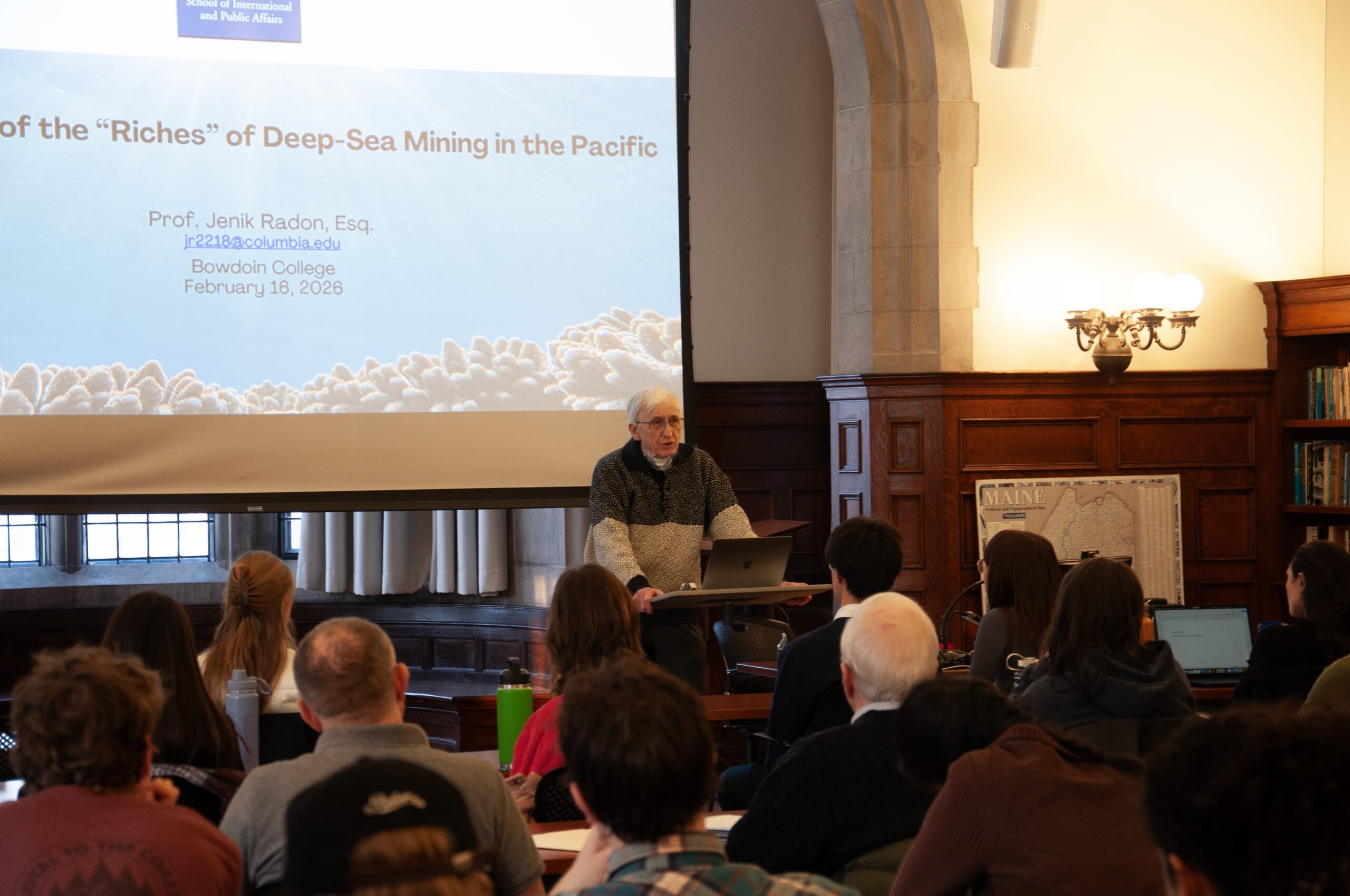
On Monday afternoon, Jenik Radon, an adjunct professor of international and public affairs at Columbia University, delivered a talk in Hubbard Hall titled “Sirens Singing of the ‘Riches’ of Deep Sea Mining in the Pacific.” The talk discussed the risks of deep sea mineral mining and the commercial pressures that drive the industry despite the lack of data regarding its ecological impacts.
Radon began by establishing the risk of mining mineral-rich deposits thousands of meters below the ocean’s surface. These nodules contain nickel, cobalt and copper, minerals critical to renewable energy technologies and battery production. Proponents of deep sea mining believe it can accelerate humanity’s adoption of green energy production while reducing environmental pollution from land-based mining. According to Radon, this overlooks many potential issues.
“Look at that percentage of how much of the deep ocean is explored—basically nothing, that’s what,” Radon said. “We know more about space than we do about the deep ocean. That should say something.”
Not having a full understanding of potentially harmful actions goes against what Radon defined as the “precautionary principle,” which argues that policy should take preventative action against scientifically uncertain but potentially severe environmental damage. Radon believes this is especially pertinent to deep sea mining, as its effects are not necessarily limited to just the mining area.
“We can cause damage to the plants in the sea,” Radon said. “[We’ve] got something in the oceans. It’s called currents. So we can take the damage from one [site of] pollution and send it, as they’ve already discovered, hundreds of miles underneath the sea further.”
The concern, as Radon sees it, is that deep sea mining companies are advancing commercial interests faster than science can keep up.
“Companies and some governments are saying we need to go to the deep sea. Why? This is a great excuse that the corporations are using. ‘The land is so screwed up; we can do it safer by going into the sea. There’ll be less pollution. There’ll be less environmental problems. So therefore we should do it because it’s less dangerous, less harmful by going into the sea,’” Radon said. “Besides, how many of you guys are going to dive down to see what’s at the bottom of the sea that’s been ruined?”
Radon further described how much of the regulatory debate centers on how the International Seabed Authority (ISA), which governs underwater mining, lacks a universal code.
“[The ISA] has been delaying. But I think they’ve been delaying for a very good reason. We don’t have the answers. We don’t have the knowledge,” Radon said. “But there [are] major geopolitical pressures, and they control the international area…. Every country can do what it wants.”
The Trump administration has signaled support for domestic deep sea mining and has not ratified the United Nations Convention on the Law of the Sea. Radon said that this only complicates matters. The Metals Company, a Canadian deep sea mining company, recently established a U.S. subsidiary, and appears poised to take advantage of this legal gray zone.
Radon closed by emphasizing that deep sea mining will prove to be a test for how societies balance environmental harm and economic gain.
“We have to speak to everybody, the communities, the children. Everyone needs to be part of it. You can’t just speak to each other,” Radon said. “We can’t just do reports. We have to use various means…. You need different mediums, different things to get the same message out.”
Attendee Charlie Anderson ’29 was surprised by how underresearched the impacts of deep sea mining are.
“The biggest thing that I took away was how little we actually know about the effects of deep sea mining,” Anderson said. “One of the themes [Radon] harped on was the importance of the precautionary principle, as in we shouldn’t embark on deep sea mining before we know more about how it will impact things like fish populations.”
Comments
Before submitting a comment, please review our comment policy. Some key points from the policy: