
La Mudanza: On Bad Bunny and moving away
February 13, 2026
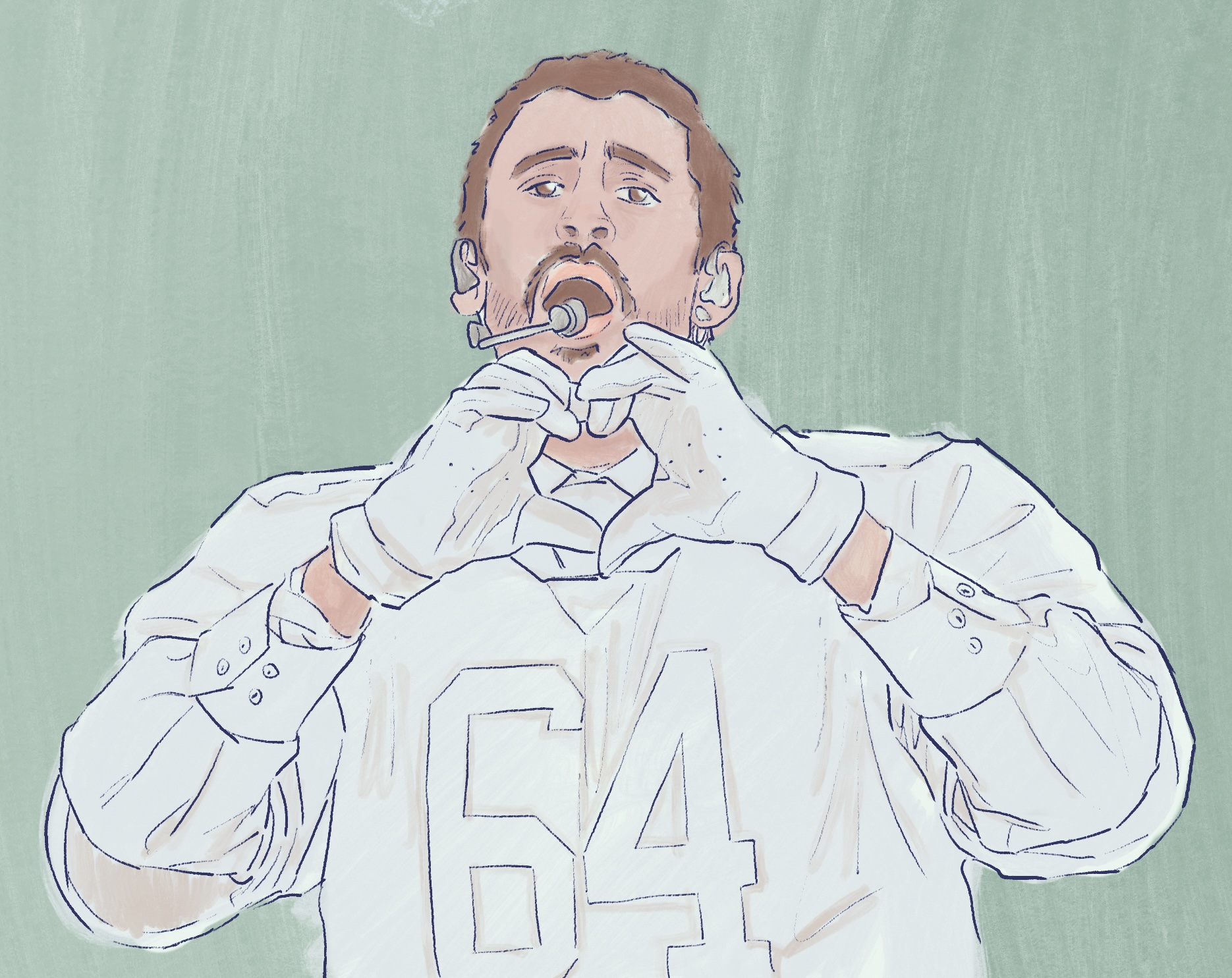 Charlotte Ng
We sat on the floor sandwiched between the TV and a dilapidated pile of furniture in a Coleman basement dorm on Sunday evening, my phone lying flat between Tess Artzer ’29 and I with my liked Bad Bunny songs open on Spotify.
“I think he’s going to open with ‘La MuDANZA,'” Tess said, her finger stopped on the song mid-scroll.
“I don’t think so. That’s too political. He’s going to have to be more careful than that,” I responded.
I leaned my head back against the wooden armrest of the couch behind me. Behind that couch, someone had stacked a second couch on top of two dressers—a feat of furniture geometry designed to fit as many people as possible in front of the TV for the Super Bowl.
At some point, a voice from behind us asked, “Do you guys even care about the game?”
“Not really,” Tess said, shrugging at me with a smile.
Tess is Mexican, with family ancestry in Spain, and at Bowdoin, she is my only other close Hispanic friend, which is its own kind of adjustment. I’m Spanish and Argentinian, which is, admittedly, about the whitest combination of Hispanic you could assemble.
Back home in Miami, my relationship with Spanish was something I mostly tried to ignore—like a messy junk drawer you pretended wasn’t there and kept forcing shut. My father is Hispanic, but my mother is from New Hampshire, so Spanish was rarely spoken in our house. Coming from such a bilingual city, my inability to speak the language was one of my greatest embarrassments. Most of my practice happened in the elevator with my Venezuelan neighbors. In these instances, I could piece together semi-articulate sentences, but I could never fully explain myself.
In Miami, this didn’t matter much. Hispanic wasn’t really a category that applied to me. In a city where a huge portion of the population is some version of Latin American, the label doesn’t do much sorting work. What sorted you was which country your family was from and whether you actually spoke Spanish. By those measures, I was a white American. Spanish was the language of the radio, the grocery store, the nail salon and the WhatsApp voice notes from relatives I half understood. None of it felt like an identity I participated in. It was just the atmosphere around me.
Last semester, in my “Hispanic Culture in the U.S.” class, I heard classmates from small New England towns describe growing up as the only Hispanic kid in their school—their identity was something they had to defend constantly. For many of them, Bowdoin was a kind of arrival, a broader community with more Hispanic peers than they ever had before. They had spent years knowing exactly what they were and they came here looking for others like them.
My experience was the opposite. I arrived at Bowdoin and, for the first time, became visible as Hispanic—not through any dramatic moment—but in small, hard-to-pin-down ways: jokes about my Miami accent and over-enunciated L’s; no confused looks when I call myself Hispanic; people genuinely listening when I share my experience in Spanish class. It was a category applied that hadn’t existed for me before, and I wasn’t sure I’d earned it, and I wasn’t sure I hadn’t.
The strange part is what the new environment did to me internally. I started listening to more Spanish music, not by conscious decision, but reflexively. I began missing my high school cafeteria’s Cuban food with an intensity that felt new. The language I never learned properly started to feel less like a personal failing and more like a genuine consequence of growing up in a bilingual household.
That left me sitting on the floor of a Coleman basement dorm, studying Bad Bunny’s discography with Tess.
His lyrics range from topics like twerking in the club to political struggles in Puerto Rico—often in the same breath and without apology or explanation—and there’s something in that refusal to sort himself that I kept returning to. Miami’s infamous party culture and the current harsh political realities of being Latin American in the U.S. aren’t contradictions to try to resolve. They coexist in Miami just like they do in his music.
I grew up quiet in Miami in ways I’m less quiet here. Some of that is just college. But some of it is this: Being perceived as Hispanic here, even in small ways I can’t fully explain, made me start actually looking at the parts of myself I’d always treated as background noise. At Bowdoin, the category of my identity arrived, and with it, weirdly, something that felt like permission—not to perform anything but to stop suppressing the parts of it that had always been there.
Tess and I could feel our excitement was grating on some people in the room as we were guessing which other artists he would bring out. When the halftime show started, we defaulted to lip syncing, exchanging looks, mouthing the words we knew.
He didn’t open with “La MuDANZA,” or even perform it. Tess was wrong about that. But the title kept circling back to me: the move. The relocation. It’s a song about defending Puerto Rican identity against the forces trying to dilute it, forces similar to those reshaping Miami, a city built on Latin culture now being quietly priced out of it.
I don’t know yet what I am here, exactly, or whether that question is even the right one to ask myself. I don’t know if being Hispanic means something different in Maine than it did in Miami. I just know that I notice it now in a way I didn’t before: the category, the junk drawer I used to keep shut now spilling open, the move that made it impossible to keep pretending it wasn’t there.
Sofia Martin is a member of the Class of 2029.
Comments
Before submitting a comment, please review our comment policy. Some key points from the policy: