
Brock Clarke launches new short story collection
February 13, 2026
 Addison Moore
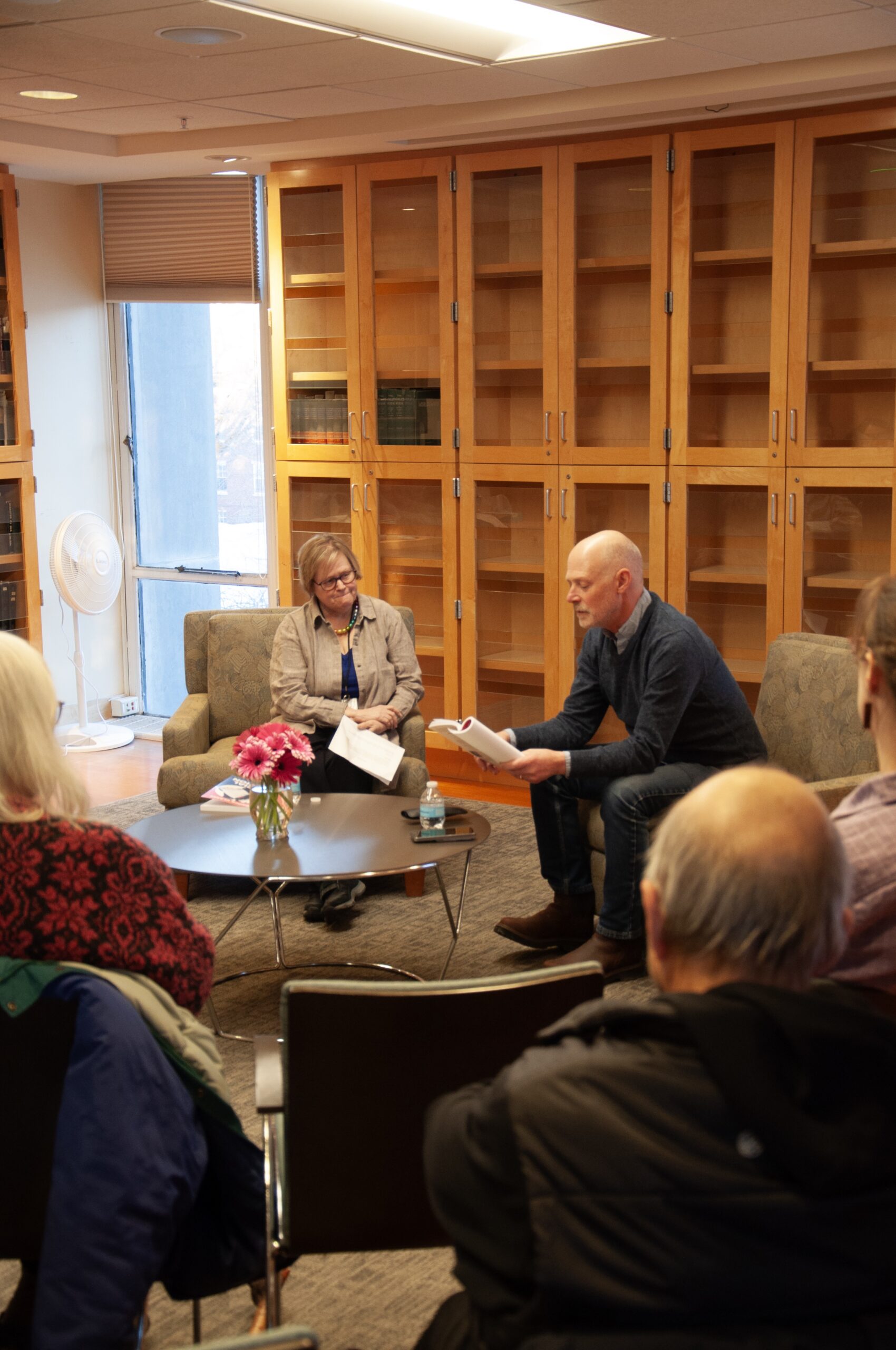
On Thursday, an audience gathered in Hawthorne-Longfellow Library to hear Professor of English Brock Clarke introduce “Special Election,” his recently published collection of short stories. In conversation with Professor of English Ann Kibbie, the two contemplated satire, chance and the unlikely humor in divine interruptions.
Clarke opened the event by reading an excerpt “The Big Book of Useless Saturdays,” one of nine short stories the collection comprises, which parallels an imaginary renowned memoir, a man watching a football game and his mother’s cancer treatment.
Kibbie read the book’s epigraph, a quote from novelist and short story writer Flannery O’Connor.
“Our plans were so beautifully laid out, ready to be carried to action, but with magnificent certainty God laid them aside and said: ‘You have forgotten—mine?’” O’Connor wrote in a reflection on divine disruption and her father’s tragic, unanticipated death.
Kibbie proposed the possibility of a continuous godlike presence in “Special Election.” Although title story protagonist Lawrence Welk engages with God and expresses disillusionment with these interactions, Clarke explained that the book is more so focused on the disruption of plans rather than a focus on God.
O’Connor’s epigraph alludes to this recurring theme of interference, in which mortality often rears its head and wreaks havoc on the characters’ best intentions.
“Special Election” does not coalesce around intentional themes, but Clarke shared that a recurring sense of style enables the stories’ convergence as a cohesive work. Clarke’s distinctive voice, which some have classified as satirical, remains the most enduring constant throughout the collection.
While Clarke admitted his work has satirical tendencies, he asserted that he often associates satire with obvious humor or his “cardinal sin,” the self-satisfied impression of being more entertaining or risky than it is.
Nevertheless, humor remains an essential component of his work.
“Whenever someone says to me they don’t have much use for humor, I think, ‘Oh, how sad for you,’” Clarke said. “Especially when it’s part of something as grave as someone you care about dying, or the end of civilization or whatever large, terrible thing is about to happen. I wouldn’t read that story or novel unless the writer were pulling something surprising and funny out of it.”
Kibbie also contemplated the concept of meanness as an extension of satire in Clarke’s work. In response, Clarke cited President Donald Trump and other political figures as examples of meanness being perceived as humorous, an idea he sought to evoke by exploiting the meanness in his male characters without being gratuitous.
Clarke argued that authors retain meaner tones in their texts as an overreaction to the premise of fiction writing as a virtue. “We Found Ourselves in Toronto,” a short story inspired by lead singer of Steppenwolf John Kay, embodied this intuitive overcompensation.
The story is a woeful tale of men aspiring to rock and roll greatness relegated to ordinary, compromised lives in Toronto. Clarke removed it from “Special Election” upon deciding that the tone felt excessively mean.
Kibbie and Clarke’s conversation eventually turned to the influence of technology, particularly phones, on storytelling.
For years, Clarke adamantly excluded phones from his writing, explaining that he found their presence “boring” for his characters. However, as he entered into the detective fiction genre, phones became more present in his work.
Crossed signals and miscommunications are entangled with technology in “Special Election,” once again thwarting Clarke’s characters.
Written predominantly during the Covid-19 pandemic, Clarke attributes the brevity of his pieces to a limited attention span in lockdown.
The condensed narratives encapsulate his writing process, which involves collecting and accumulating personal anecdotes, unconventional tidbits and friend-of-a-friend accounts. Clarke referenced a companion’s poetry, another close friend’s cancer treatment and observing the snow in a televised Cincinnati football game as intimate components of “Special Election.”
Additionally, Brunswick and Bowdoin make repeated appearances in Clarke’s work. The Baldwin Center for Teaching and Learning is an unnamed entity in one piece, while another follows a character walking through Bowdoin’s campus for 40 pages.
Clarke concluded by admiring the triumph of writing absurd stories works that revel in the unlikely and unexpected intersection of grief and humor. Clarke’s stories are a testament to authentic narratives that resist simple resolutions, ever-absurd and darkly endearing.
Comments
Before submitting a comment, please review our comment policy. Some key points from the policy: