
Finding comfort in a procedural answer
January 30, 2026
 This
piece represents the opinion of the author
.
This
piece represents the opinion of the author
.
 Eva Ahn
I haven’t called myself a “math person” since I was 12 or so, probably about when they were adding letters to math in the rural Texas curriculum. I didn’t want to dislike it; I had found a lot of love in probability, and I usually understood enough to at least be of some help to my peers if needed. But I was bored. I was “preteen-with-undiagnosed-ADHD” bored. It was concept stacked on concept stacked on concept. I came to Bowdoin with nothing more than a vague sense of annoyance around the tedium that was math and all its derivatives in the hard STEM fields. I found so much freedom in the flexibility of an essay, in compiling sources and in truly understanding that there is no singular answer to any question one could ask about our social realities. I found passion in the details and in finding the connections. But not the way math did it. That was tedious, not illuminating.
This apathy led to three years without a math class. Now, I’m a junior, and I … have not touched a calculator since making it to campus. Granted, it wasn’t intentional; medically obligated reduced course loads and last-minute language study for abroad meant I severely neglected my MCSR and INS requirements. MCSR didn’t concern me; sociology requires a statistics class, and I can easily connect that to my work. That left a concern, which I have finally begun to remedy and, for the first time in my life, I delved into physics.
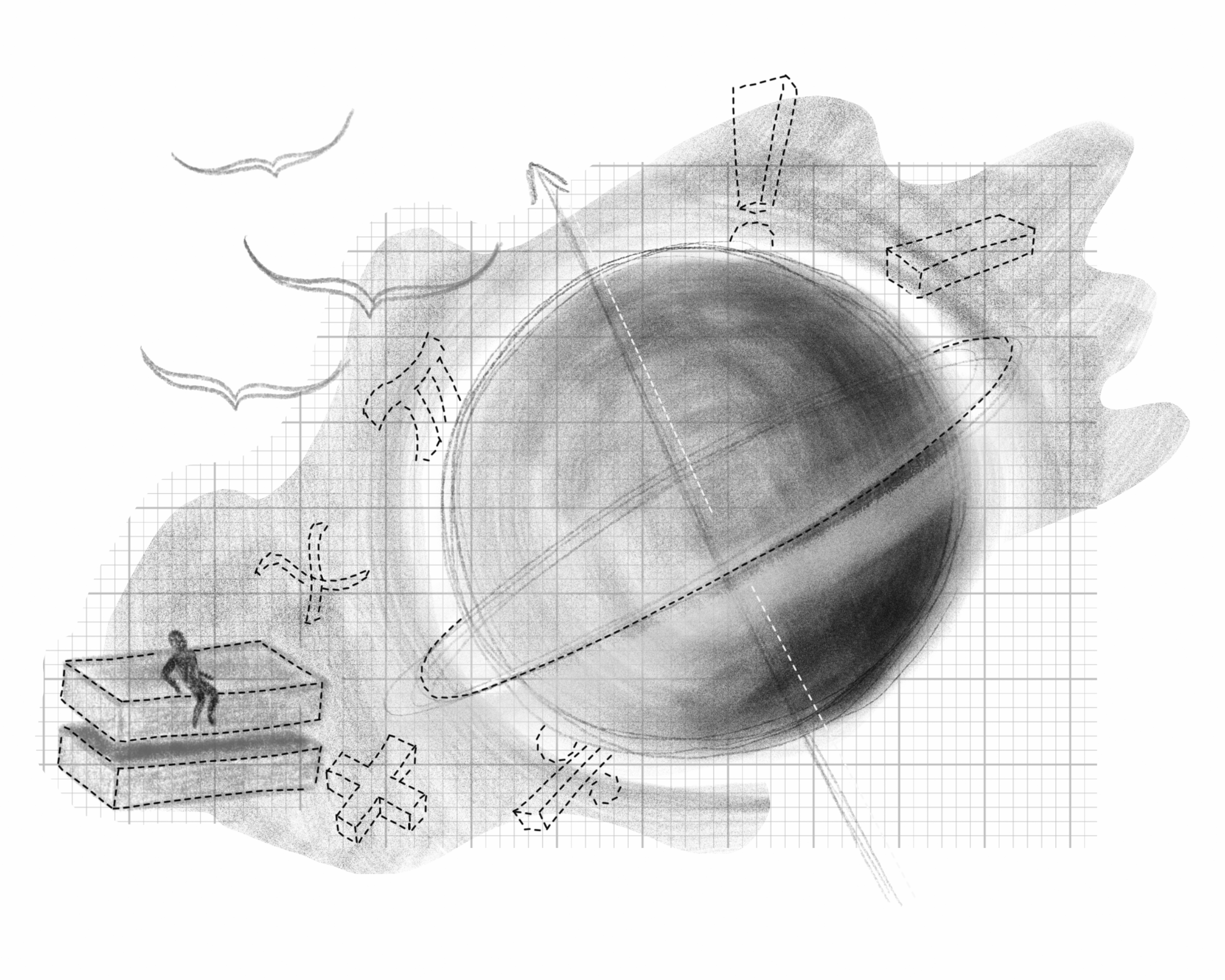
After finishing my first two problems, I was struck by how genuinely fun it was. With my notes in front of me and my iPad riddled with numbers and conversions, I didn’t feel overwhelmed or bored. I didn’t even feel apathetic, which can be one of the better feelings to have surrounding homework as a student. I found myself thinking about things I had never given a second thought to: how big the universe that cradles our planet really is and how the smallest tilt or shift would fundamentally reorganize its structure. About how impossible it is to understand how big everything else is compared to me. I think a lot during homework, but I was struck by the very nature of how I was looking at the world. Humanities and social sciences taught me to see myself as an agent of change, as a companion, as an ally. They taught me to never underestimate the power of collaboration and idealism.
But I finished two problems, and I found myself mulling over how much of a miracle our lives are. How vast the gap is between here and any chance of a theoretical “there” that orbited a sun just perfectly enough to even potentially contain life. How grand infinity really is.
Perhaps I am jumping the gun somewhat. It doesn’t escape me that I am writing this on the Friday after the first week of class. It certainly doesn’t escape me that there will inevitably be a time when the challenge of the work will keep me from really leaning into that sense of wonder and scale. But the nature of a problem set means I have time between the steps. The mulling and deep thought are the work of an essay, and the labor of a “procedure” is limited. Organizational, revisionary, but not the grunt work. The success hits when you realize you’ve finally created a piece of literature and a body of information. The dopamine is delayed.
Math is different. The work is finding the right steps of the procedure; the tedium is doing it right. The success is recurring, small successes that necessitate more to do, but don’t invalidate that one little success. Sure, it feels great to finish it up, but it’s gratifying to make progress just as procedurally as the work is organized. There’s time to pause, to appreciate.
It’s not that I plan to suddenly become a physicist. I am more than content with my double major that means I perpetually exist in Adams Hall. I find greater joy than in a project that has taken a life of its own than in creating a microcosm of a reality. But, man, it’s far more motivating to make progress on a math problem. A singular, final point encourages a moment to breathe, and a moment to wonder about the magic that happens beyond a scale we can understand.
Elias McEaneney is a member of the Class of 2027.
Comments
Before submitting a comment, please review our comment policy. Some key points from the policy: