
Hastings Initiative progresses with campus outreach and continues to allocate funds
December 5, 2025
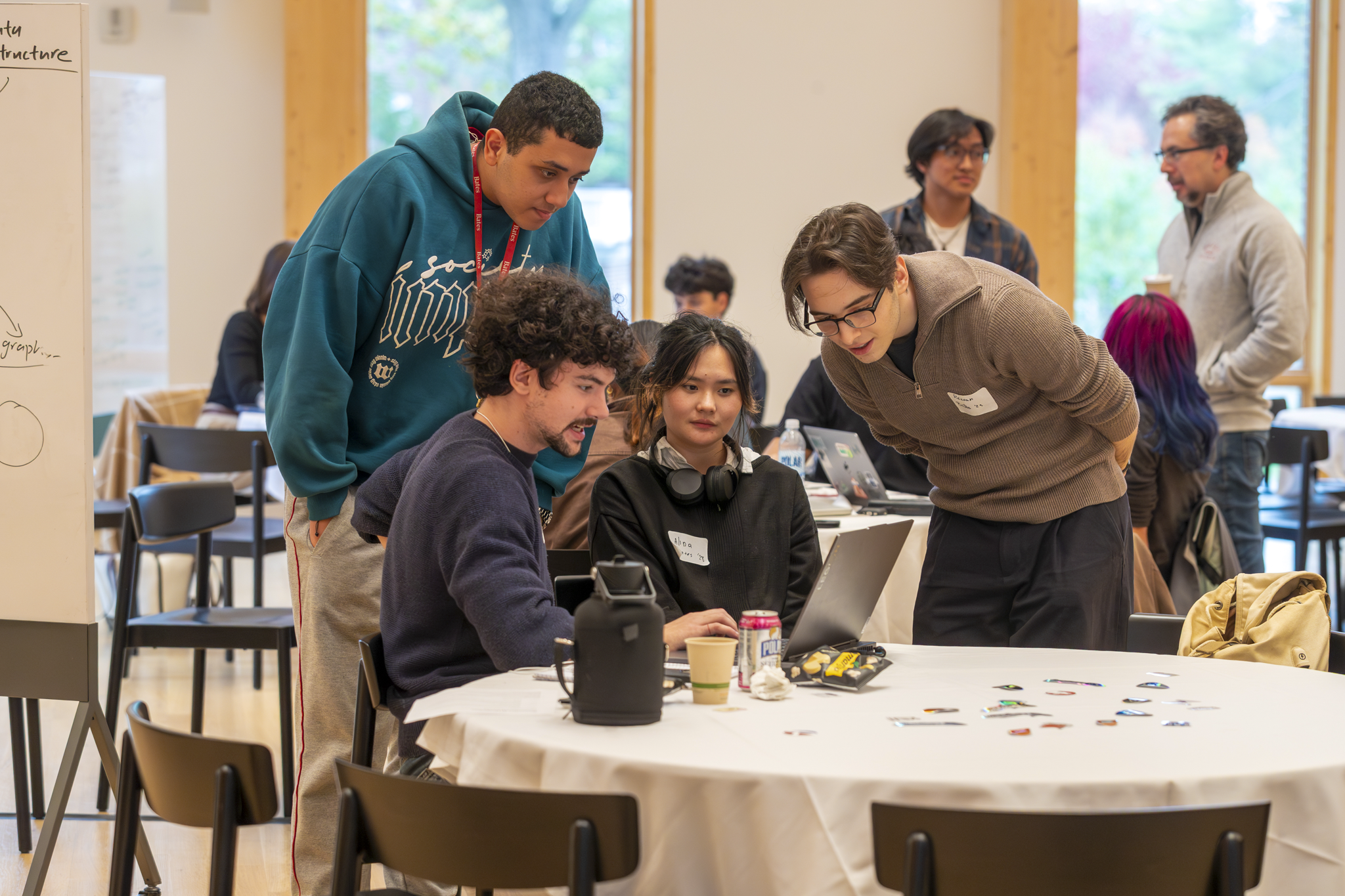 Courtesy of Bowdoin Communications
In March, the College announced a $50 million donation from Netflix co-founder Reed Hastings ’83 to establish the Hastings Initiative for AI and Humanity. Since then, an advisory committee consisting of faculty across departments has worked to guide the implementation of the initiative and reach out to students, faculty and staff across campus.
“Part of what we’re doing in the first year is figuring out what the Hastings [Initiative] will look like in the long run,” chair of the advisory committee and Professor of Digital and Computational Studies Eric Chown said. “We’re going to need to rethink education to some degree, in the face of [artificial intelligence (AI)], and so partly, it is our job to start that process and start some conversations.”
One of the most direct ways the initiative is impacting the classroom is through the creation of ten new faculty lines across disciplines, intended to navigate the intersection of AI and education. Professor of Earth and Oceanographic Sciences and member of the Curriculum and Education Policy Committee (CEP) Collin Roesler explained in an email to the Orient that in applying for new faculty lines, departments must address the Allocation of Faculty Positions (AFP) guidelines as well as specific requirements set by the Hastings Initiative. The CEP reviews the application and makes a recommendation to the Dean for Academic Affairs.
“Ultimately, the Dean for Academic Affairs makes the decision, but it is strongly driven by the recommendation of [the] CEP,” Roesler wrote.
So far, Hastings faculty lines have been allocated to three departments: anthropology, philosophy and neuroscience. Hastings AFP proposals for the remaining seven lines are due from departments by January, with the goal for the CEP to make recommendations by the end of the semester and the hiring process to begin next fall.
Professor of Anthropology and Chair of the Department of Anthropology Krista Van Vleet explained in an email to the Orient that the department’s new faculty member will engage with important questions related to emerging technology and its impact on human society.
“In the [AFP] proposal we submitted to [the] CEP, the anthropology department noted that anthropologists are uniquely situated to engage in generative conversations across the humanities, social sciences and natural sciences,” Van Vleet wrote.
Van Vleet noted that as a small department, anthropology professors teach many cross-listed courses, meaning the new faculty line will impact students across disciplines.
“We expect that the Hastings faculty will add to the intellectual and pedagogical conversations in our department, enriching how all of us think about AI—including whether and how to use AI,” she wrote.
Similarly, the philosophy department is a small department that expects its new member to teach classes attracting students from various majors.
“All of us in a college this small have to be able to teach well outside our area of research expertise, and that’s especially true in a small department,” Professor of Philosophy and Chair of the Department of Philosophy Matthew Stuart said. “So whoever ends up being hired in the Hastings position is going to have to do other things too for classes.”
Before the allocation of the first Hastings positions, the philosophy department submitted an application for a new line that was denied. Ultimately, the lines were given to departments with lower faculty-to-student ratios. Shortly after, the department was invited to resubmit the application for a Hastings faculty line instead.
“Previously, there was an invitation for departments to apply for one of ten lines that didn’t come with particular strings like [Hastings guidelines], and we made what I think was a very good case for a fifth line in philosophy,” Stuart said. “But we came near the top of the departments who had made a good case but didn’t quite make the cut, so when suddenly there was [the Hastings] opportunity, I think that was not an old memory at that point.”
The neuroscience department received both a Hastings line and one of the lines allocated in the previous cycle. Professor of Neuroscience and Biology and Director of the Neuroscience Program Manuel Diaz-Rios reflected on the overlap between the candidates for the two positions. Candidates who did not apply for the Hastings position often still used AI in their computational and analytical approaches. When interviewing, these candidates were encouraged to apply for the Hastings line as well.
“We didn’t promote [the Hastings line] in a super targeted or super specific way.… That ended up being a very big positive for us because it allowed us the flexibility of candidates being considered,” Diaz-Rios said.
Beyond contributing both AI and non-AI related courses to their respective departments, the Hastings hires will form a cohort expected to work with one another across departments to broaden campus knowledge about current and future applications of AI.
“We had a blurb that was included basically in all AI Hastings searches,” Diaz-Rios said. “It was saying ‘Hey, you’re going to be part of the cohort of researchers coming in that are going to be … our voices and maybe ears into the future about what direction AI is taking.’”
Additionally, the committee hired two postbaccalaureate fellows and two postdoctoral associates to support faculty, staff and students in exploring AI. Through their roles, they strive to help members of Bowdoin’s community navigate the increasing presence of AI on campus.
In addition, the fellows and associates work closely with faculty engaging with AI through their research. Two grants are currently available to faculty through the Hastings Initiative: the Explore AI grant (up to $1,500) and Project Seed Funding (up to $5,000). According to Chown, around 30 have been granted.
“We’ll meet and talk about what kind of technical support they need in order to move forward with their research. And from there, it might be a one-off chat, or it may be a longer term collaboration,” postdoctoral associate Adrienne Kinney said.
Senior Lecturer in Mathematics and Director of Quantitative Reasoning Eric Gaze applied for and received Project Seed Funding to support AI use among Quantitative Reasoning tutors (Q-tutors) at the Baldwin Center for Learning and Teaching (BCLT). He intended to use the funding to purchase access to an AI model for Q-tutors. However, after the College launched LibreChat, the BCLT decided to wait to spend the funds while exploring other possible ways it could utilize AI.
“We had the opportunity to do a temperature of how students coming in, looking for tutoring, were using AI,” Gaze said.
According to Gaze, some Q-tutors felt uncomfortable introducing AI to the one-to-one connections many students seek tutoring for. Additionally, few students reported using LibreChat.
“There’s been this strange sort of disconnect between offering this pretty powerful platform to use all of the best AI models available with uptake from the students,” Gaze said. “It seemed like students just didn’t want to put any time into that Canvas course to unlock [LibreChat] when they were using [ChatGPT] for free.”
To increase student engagement with the Hastings Initiative, six student ambassadors were recently hired: Andrew Mott ’26, Anastazia Stallworth ’26, Prathit Kurup ’26, Mauricio Cuba Almeida ’27, Joe Gaetano ’27 and Ana Lopes ’28. These students will receive a stipend to serve as peer educators and work with both students and faculty members on AI-related research projects.
“Hastings is not just for computer science or [digital and computational studies]; it really is for all departments and lots of different types of research,” Kurup, who, along with Mott, is a leader of the Bowdoin AI Ethics Club, said. “While some research is better suited to using AI, there are a lot of professionals on campus that are doing work that could benefit from some kind of AI tool behind them.”
The ambassadors will attend monthly meetings with the rest of the Hastings team to share student feedback and offer a range of perspectives on AI.
Another way students have become involved with the initiative is as research assistants. Josie Fischman ’28 is working on an environmental economics project with Professor of Economics Erik Nelson and collaborates with the postbaccalaureate fellows and postdoctoral associates on how to integrate AI into the project through use of a large language model (LLM).
“The goal of the project is basically to create an LLM that’s able to find and replicate the [Environmental Protection Agency (EPA)] greenhouse gas emissions data,” Fischman said.
Fischman explained that while she has felt skepticism toward AI and its impact on education, this project has helped her see its benefits as well.
“I’m still feeling very anti-AI in many ways, but I really like how this project has helped me understand more of what it is and learn about how it can be used in helpful ways,” she said.
While it is yet to be determined what this would look like, members of the advisory committee, along with the postbaccalaureate fellows and postdoctoral associates, hope for students themselves to receive Hastings funding for research.
“It seemed like many [students wanted] to have some experience with a hands-on technical project that will not only help them learn something by doing it but also be really relevant AI experience for their job going forward,” postdoctoral associate Collin Lucken said. “So that seems like a really good possibility for me, if we can get some of the Hastings money directly into the hands of students.”
Additionally, while student-led clubs do not currently have direct access to Hastings funding, Director of Student Activities Nate Hintze supports more engagement between clubs and the initiative.
“I do think that there’s a great opportunity for clubs to partner with the Hastings Initiative, to have more conversations around AI, but there aren’t presently any earmarked funds for clubs,” Hintze said.
Students can also interact with AI through other campus organizations, including the McKeen Center for the Common Good, which was one stop on a “listening tour” the advisory committee took to consider how AI could touch various corners of campus. Director of the McKeen Center for the Common Good Sarah Seames explained that the McKeen Center applied for and received funds to purchase access to Cortico, an AI tool to record and analyze conversations for key themes. Additionally, the student leaders for the Alternative Spring Break trip “AI for Indigenous Past and Futures in Hawai’i” are in conversation with the advisory committee about potential financial support.
“It’s abundantly clear that AI holds both great potential to improve lives but also the possibility to cause harm,” Seames wrote. “We see our role as providing opportunities for students to explore how this impacts communities and issues that they care about and [that] may be connected to themselves.”
Similarly, Executive Director of Career Exploration and Development Kristin Brennan expressed that the initiative is valuable in helping students understand the role AI plays in their careers.
“You don’t have to be—and shouldn’t be—an uncritical consumer and user of [generative AI] to navigate the workplace,” Brennan wrote. “You can remain a critic, and you can also know that your liberal arts skills—critical thinking, judgment, creativity—are more vital than ever and will differentiate you in the job search and in your career.”
As the committee continues to implement the initiative, Chown explained that the next steps include direct engagement with academic departments and students. He noted that there are various viewpoints on campus among both students and faculty, including those eager to embrace AI, those hoping to avoid it and those who believe it is actively harmful.
Chown expressed that he is sympathetic to all of these viewpoints and hopes the Hastings Initiative will help each group consider different perspectives and reflect on their own relationship with AI.
“I said to someone the other day, if the only thing that happens is that the next time a Bowdoin student pulls out their phone to get ChatGPT or Gemini or whatever, they just pause and they say, ‘Is this really what I want to do, is the cost of it, for me, personally, for the environment, is it balanced against what I’m going to get out of this?’ If we just get people to pause, I think that’s a real accomplishment,” Chown said.
Comments
Before submitting a comment, please review our comment policy. Some key points from the policy: