
Run like a girl
November 14, 2025
 This
piece represents the opinion of the author
.
This
piece represents the opinion of the author
.
 Kiran Elfenbein
There’s nothing quite like doing a track workout in the early morning. The smell of wet track blown over by the morning breeze. The pounding of red-dyed trainers reverberating around you. The rapid breaths of your teammates as they keep pushing to maintain pace. The bellowing of “TRACK!” and the subsequent scurry of feet to get out of lane one before the boys trample us over.
The best part of high school was my cross country and track and field team. I joined the team completely unprepared and very nervous; I cried after my first track workout because I couldn’t keep up. But the older girls continued to tell me “Good job!” as they ran past, congratulated me on my race times, cheered me on from the sidelines and said hi to me in the hallways. They accepted me.
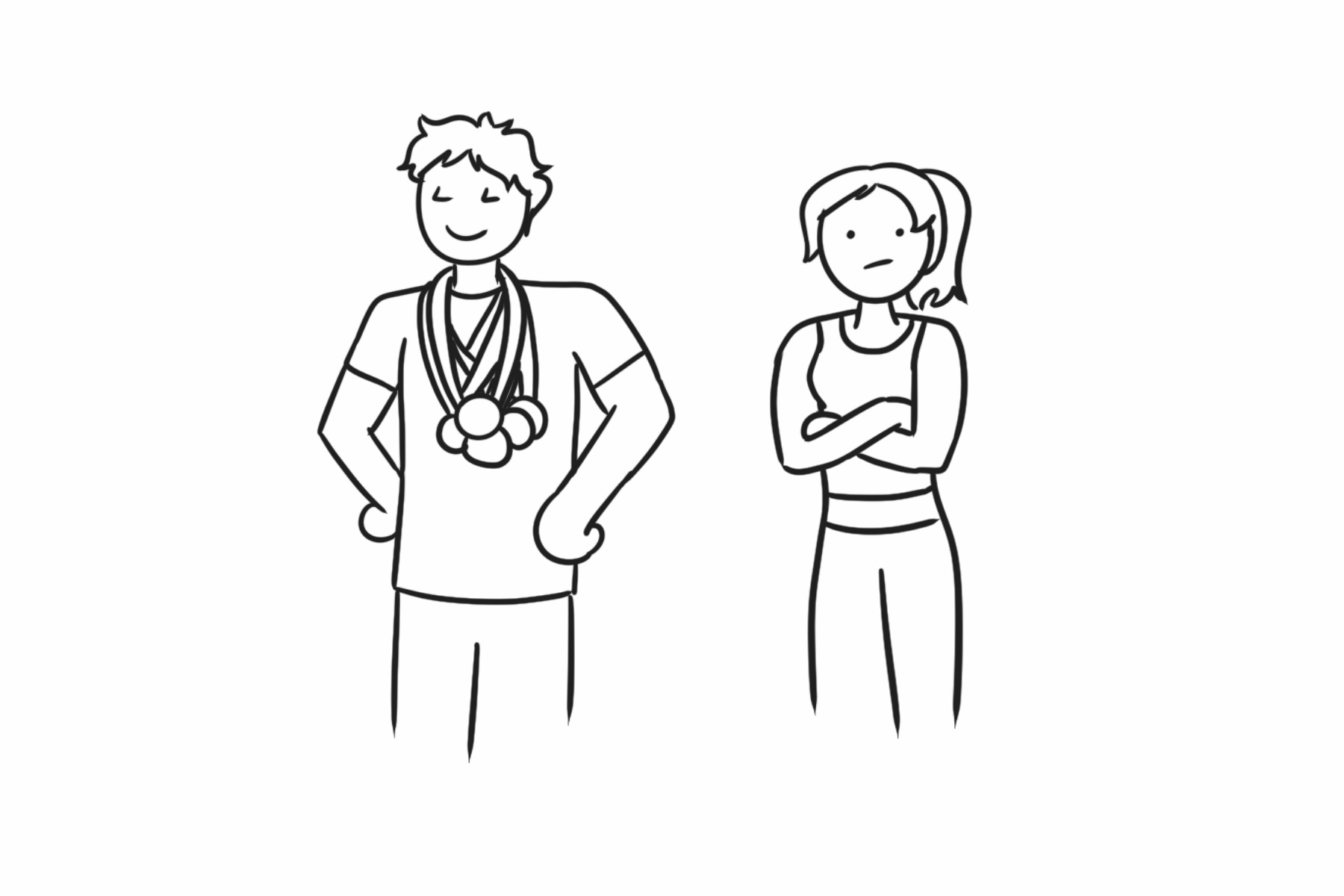
One of the unique aspects of high school running is that the girls’ and boys’ teams train together. We ran the same loops, same workouts, same courses. The only difference is us girls do a little bit less; one or two fewer miles or reps during track workouts. Our bodies just can’t handle the same type of stress.
A 2005 study explained it nicely: “Men possess greater muscular strength and a larger aerobic capacity.” Boys just get more juice out of each squeeze, to use Lauren Fleshman’s metaphor from her book “Good for a Girl.” Their bodies and hormones are designed to build muscle mass, while ours are designed to maintain it.
Day after day, I showed up to practice and built my fitness. I learned how to race for my teammates, how to push past my limits. At the end of my sophomore season of cross country, I raced my record five-kilometer race in just under 22 minutes. And then I hit a wall.
As Kate Edwards describes, teens typically hit a “performance plateau” when their bodies begin changing rapidly during puberty. Girls feel the brunt of it because we start puberty earlier. For me and a lot of my teammates, this meant that despite putting in consistent effort and training, our progress was frozen and sometimes reversed.
The system didn’t account for this: When Title IX required schools to have both male and female sports programs (and correspondingly skyrocketed female participation in athletics), it did not change that medical research is based only on men’s bodies. Programs typically default to the logic that women are basically smaller and weaker men. That was the logic behind my training, anyway.
At the time, our program was run by the boys’ track coach (technically, he was also the girls’ track coach, but he repeatedly implied to us that he was primarily the boys’ coach). We were required to do exactly the same exercises as the boys in the exact same order.
Although this expectation is often exalted as “model equality,” it ends up overlooking the obvious differences in female bodies. Consider the effects of female puberty itself: wider hips, increased body fat, breasts. While boobs and body fat add weight to lug around, our hips widening fundamentally changes how we power our stride, especially if the hip flexors remain neglected.
In sum, while the boys on the team benefited from constant increases of volume and difficulty as their bodies matured, my body began to break down. It felt like no matter how hard I pushed, how exhausted I became, I just couldn’t get any better. I’d have panic attacks frequently, breathless after falling behind during strides.
Considering all of this, it’s no wonder teen girls are twice as likely to drop out of sports by age 14. We lack adequate role models and funding for our teams. We’re often embarrassed by our bodies and feel like we’re not fit enough to participate in a sport—they don’t warn you about how many mental stresses you’re fighting during puberty.
They don’t warn you about a lot, actually. Women often lose their periods while undergoing intense training, which can negatively impact our overall health. Having menstrual cramps can make it difficult to start or maintain workouts. Adolescent female athletes are at the highest risk for developing eating disorders—roughly 20 percent compared to the national average of one to five percent—which can lead to unhealthy weight fluctuations and more menstruation-related health risks. Without the right support system, it can get overwhelming and exhausting very quickly.
By my senior year, both our girls’s head and assistant coaches were female, and the team culture grew stronger in ways I hadn’t anticipated. Having female coaches gave us vital role models. Instead of trying to explain why our bodies weren’t working with us, we were intrinsically seen and understood because our coaches had those very same bodies.
This past season, the program I graduated out of has grown wildly successful. The coaches have begun designing workouts specifically for the girls’ team, and there is a deeper culture of understanding and connection. I owe a lot of my confidence and grit to the team and the girls who are racing without me.
It’s my greatest hope that many more girls will join the program and discover their love of running shielded from the brunt of misogyny.
Bella Gulati is a member of the Class of 2029.
Comments
Before submitting a comment, please review our comment policy. Some key points from the policy: