
Film screening explores the untold history of Black Africans in Renaissance Europe
October 24, 2025
 Abigail Hebert
On Monday evening, Afro-Italian filmmaker Fred Kuwornu stood before a Bowdoin audience with a simple message: Diversity in Europe today has deeper roots than most people realize.
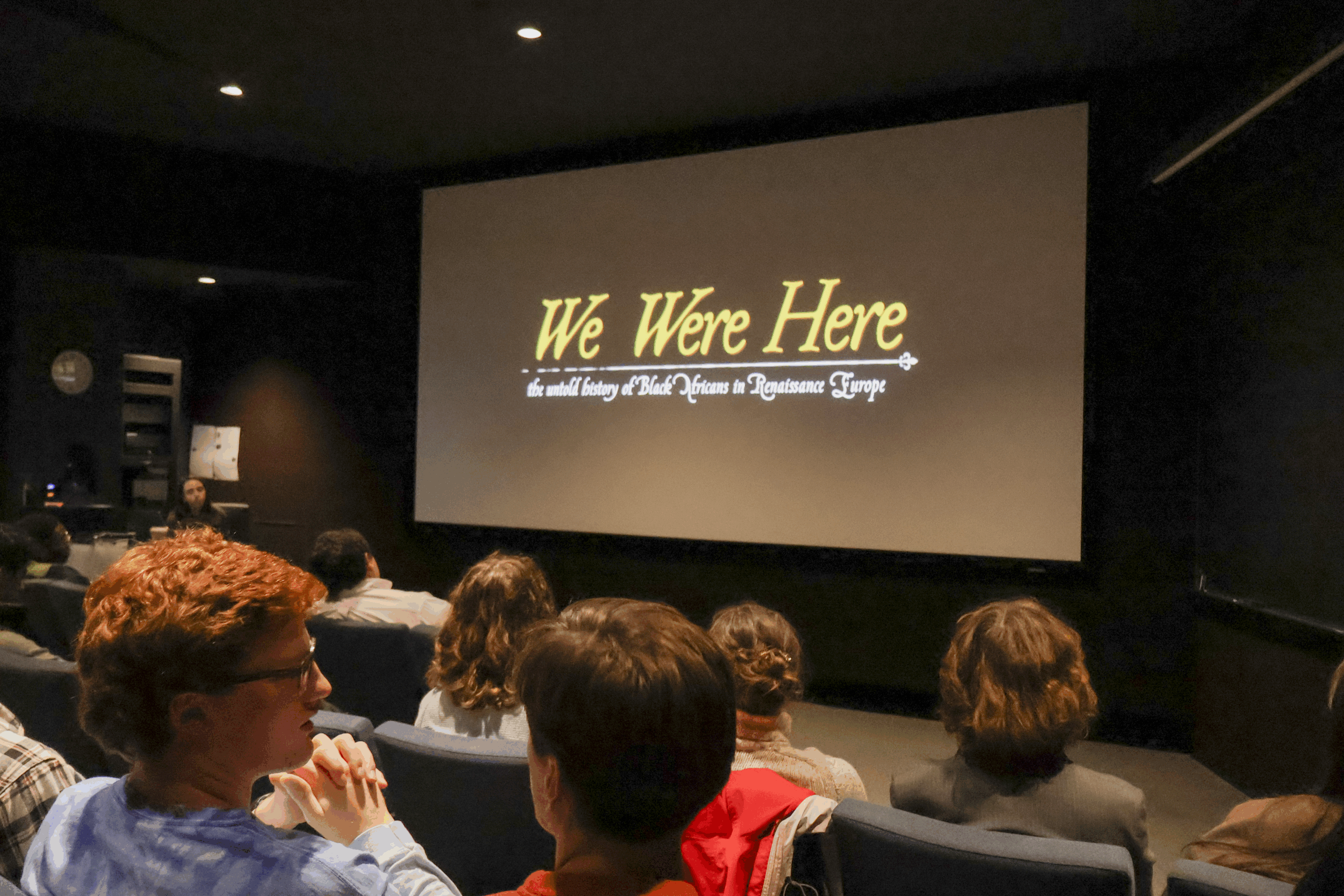
His documentary, “We Were Here: The Untold History of Black Africans in Renaissance Europe,” screened in Mills Hall and was followed by a conversation that traced connections between 15th-century paintings and contemporary debates about migration and identity.
The documentary confronts widespread assumptions about migration and diversity in Europe. Kuwornu challenged Bowdoin audiences to reconsider their existing understanding of European history.
Visiting Professor of Art History Caitlin DiMartino helped organize the event.
“Many people think about migration as a new phenomenon, but [Kuwornu’s] film is showing that Europe was a much more ethnically and culturally diverse place far earlier in time,” DiMartino said.
The film addresses not only the historical presence of Black people in Renaissance Europe but also contemporary issues of immigration and identity in Europe.
“Many people have this idea, in particular in Italy or Spain now, that Africans came only in the last 20 years or with the colonies, maybe in the 18th century, when this presence is more ancient,” Kuwornu said.
In cities like Lisbon, Seville and Amsterdam, up to 30 to 40 percent of total residents were of African descent during the Renaissance, according to the film.
Kuwornu’s journey to creating the film began during the Covid-19 pandemic. Originally planning a contemporary project about Afro-Europeans, he shifted his focus to the Renaissance era for both practical and strategic reasons.
“Renaissance is a beautiful word, especially for art and art history. It’s really well known everywhere outside Europe,” Kuwornu said. “Matching Renaissance art and history with African presence was the most valuable way to highlight the story of Africans in Europe.”
The film’s distinctive visual approach includes a motif of frames that emphasizes how societies construct historical narratives.
“This film, like every artwork or every book, is always constantly framing,” Kuwornu said. “We decide consciously or unconsciously what is important in the story. When you apply this to society and history, you understand how society can really limit the real story or what really happened.”
What began as a low-budget educational project transformed into an internationally renowned film when Kuwornu received an unexpected Instagram message from the newly appointed curator of the Venice Biennale’s artistic division, Adriano Pedrosa, who invited the documentary to premiere at the prestigious 2024 exhibition. The exposure allowed Kuwornu to secure additional funding and elevate the production quality, adding reenactments and animation.
A striking element of the film is its use of reenactments featuring current members of the African migrant community living in Bologna. Kuwornu collaborated with a Bologna-based non-governmental organization that supports migrants through theater and art workshops.
“I wanted to include some [people of] African descent in the process of making the film,” Kuwornu said. “I grew up without really seeing a lot of audiovisual work that massively portrayed Africans in Renaissance times, so it was important to have much more characters to bring into this visual representation.”
DiMartino chose to bring this film to the College because the screening aligns with her research on the relationship between gender, race and religious material in Renaissance art.
“There have been a lot of exhibitions at museums and publications for a scholarly audience about the African presence in medieval and early modern Europe, but not anything of this nature, where it’s a documentary film geared towards students and the general public,” DiMartino said.
Following the Bowdoin screening, Kuwornu will continue his New England tour with stops at schools across the region, including Boston College, Boston University and Fairfield University. The film is also being screened at universities and cultural institutions internationally.
DiMartino hopes the film will help Bowdoin students and community members approach history, art and politics from a new perspective.
“Something that I have really appreciated about this broader work is this way of thinking about how the past comes down to us and continues to affect the present, and I think that’s something we see so much in this film. Thinking about how to understand the past allows us to work differently in the present,” DiMartino said.
Depending on his audience, Kuwornu has different hopes. For European viewers, that means recognizing that African presence predates modern immigration debates. For his global audience, it means understanding how societies choose which stories to tell and which to ignore.
“The concept of frame and reframe, inclusion and exclusion—there are many things that are created by society, but there are also many things that exist because there is a lack of understanding and consciousness,” Kuwornu said. “This is one of the most important messages of the film.”
Comments
Before submitting a comment, please review our comment policy. Some key points from the policy: