
Campbell Strauss and Mikesell release jazz album, “Give Way”
October 24, 2025
 Bergen Pickett
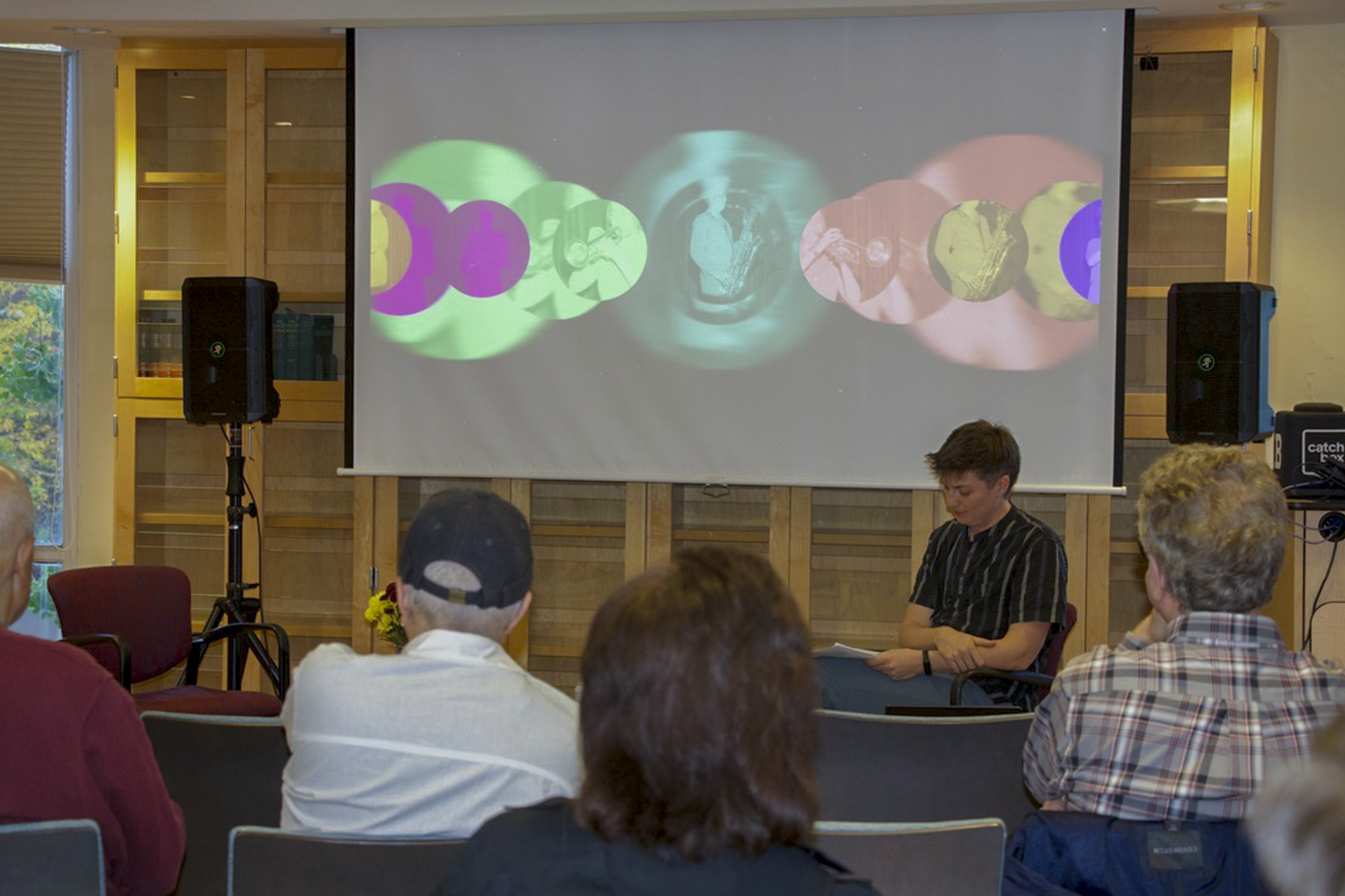
Perhaps fittingly for an album that distinguishes itself through its defiance of convention, “Give Way,” a musical release by Director of Jazz Ensembles Kate Campbell Strauss, was given the musical equivalent of a “book launch” this Thursday. Campbell Strauss presented their album to the Bowdoin community at the Hawthorne-Longfellow Library, where “Give Way” will be joining fellow faculty publications in the library’s collection.
Campbell Strauss’s collaborator on the album, trumpeter and composer Emily Mikesell, was also present for the event over Zoom—circumstances that recalled the album’s unusual origins.
“Give Way” began in September 2020 as a class project between Campbell Strauss and Mikesell at University of New Orleans. Unable to create music in person due to the Covid-19 quarantine, the pair implemented a creative tactic to simulate the experience of live improvisation.
One musician would initiate the song with a brief clip—perhaps a trumpet sequence from Mikesell, or a saxophone riff from Campbell Strauss—which they would record and email to their partner. The recipient would play back the clip, then respond spontaneously with their own additions, introducing new layers to the song or extending the clip by exploring a new direction for the piece. The emerging creation would continue to pass back and forth over email, accumulating depth and complexity until it matured into a finished product.
The back and forth between the artists would seemingly cause a disruption to the flow of creativity, but Mikesell described how they took it in stride.
“We knew what the rules were and how we fit into that,” Mikesell said.
The clear structure removed the need for the constant feedback and coordination typical of a live jazz ensemble, enabling the pair to try out new ideas.
“It took out any negotiating…. It was very freeing, actually,” Mikesell said.
Campbell Strauss emphasized the unexpected value of the isolated, non-communicative environment created by collaboration over email.
Another liberating aspect of the project was the unorthodox makeup of the band. The musicians’ roots in jazz and big band didn’t impose many expectations on the two-person ensemble, and the duo avoided choosing a particular artist or style to explicitly emulate. Because they weren’t shoehorned into any of the roles generally associated with their instruments, Campbell Strauss and Mikesell were free to explore their own unique sound.
Campbell Strauss and Mikesell always used the first ideas that came to mind, and over several years of mixing and post-production, they never edited anything out, only cleaned up background noise and smoothed over the syncopation between the layers of recordings. The result was an album with more polish than a live performance but just as much raw authenticity.
When the duo presented the project to their classmates, they were moved by the positive feedback they received, but their peers weren’t the only ones who recognized that Campbell Strauss and Mikesell had created something special. In addition to being selected for DownBeat magazine, “Give Way” was on the ballot for the Grammys.
Although “Give Way” was composed nearly five years ago, the creators attest that it has particular relevance to today’s artistic landscape.
“In this moment, people are looking for connection, looking for meaning,” said Mikesell.
For Campbell Strauss and Mikesell, “Give Way” is a testament that technology need not always be a barrier to developing human connection through art and can, in fact, be an opportunity to facilitate new types of human bonds.
Comments
Before submitting a comment, please review our comment policy. Some key points from the policy: