
Medieval art exhibition opens at BCMA, displays objects from the Wyvern Collection
September 5, 2025
 Isa Cruz, The Bowdoin Orient
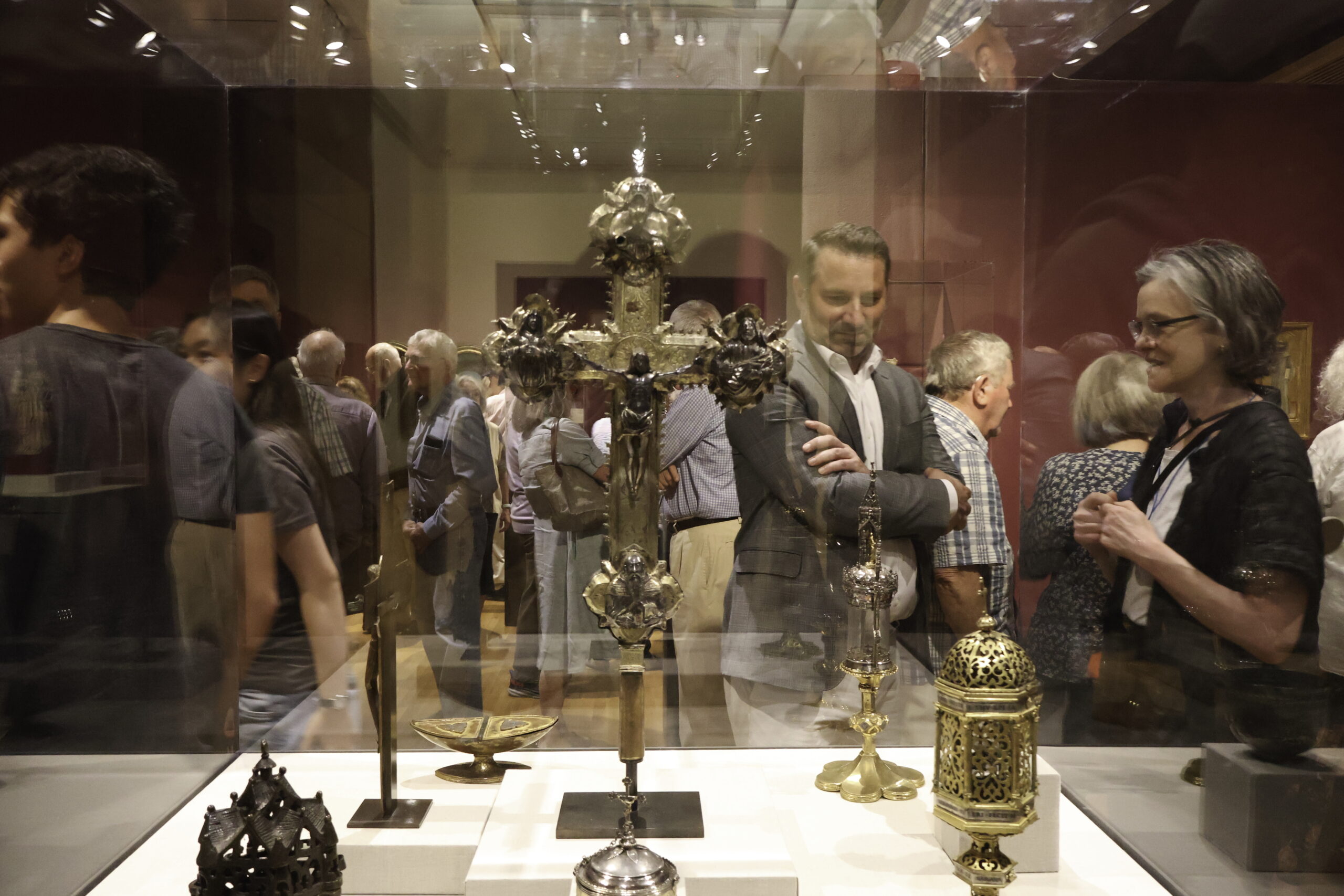
On Thursday, a crowd of art enthusiasts gathered at the Bowdoin College Museum of Art (BCMA) to celebrate the opening of the museum’s newest exhibition: “Medieval Art from the Wyvern Collection: Global Networks and Creative Connections.”
The event included an opening tour followed by a reception on the museum steps celebrating the show, which will be open for the next three years.
Curated by Professor of Art History Stephen Perkinson, the exhibition brings together loaned works from the Wyvern Collection, a private collection of medieval and Renaissance works, with a series of objects from the College’s collections.
Perkinson’s scholarship focuses on medieval and early Renaissance art and manuscripts in Northern Europe, and his expertise is apparent in the exhibition’s curation.
“I love the ways [medieval] material embodies human creativity in often really difficult situations, using techniques that are honed over the course of generations passed down to produce things none of us today could,” Perkinson said. “I’m astounded by the virtuosity of these things that are at once simpler than our computer technologies but also incredibly sophisticated and complex.”
The show intends to display medieval works through a global and diverse perspective.
“The exhibition addresses a fascinating period of history during which cultural, religious and economic networks link back parts of the world. We are so grateful to temporarily steward this loan of objects, which will help the BCMA tell diverse stories and enliven our understanding of the so-called Middle Ages,” BCMA curator Casey Braun said as she introduced the show.
Perkinson echoed these ideas as he emphasized the theme of interconnectedness in medieval scholarship.
“Fundamentally, people have come to realize that over the course of centuries, scholars in Europe and North America came up with this way of partitioning history into time periods… [This exhibit asks], ‘What would happen if we thought about the world differently?’” he said. “What happens when we say, ‘I’m not going to worry about if this is a Gothic piece or a Romanesque piece or a Renaissance piece. What happens when I bring them together in conversation?’”
Perkinson emphasized that the exhibition brought together collaborators from across the College and will host visits from courses across multiple disciplines. The curatorial work included the contributions of two student interns over two summers, Marianna Zingone ’26 and Cam Meyer ’28.
Meyer found her passion for art history through one of Perkinson’s courses.
“My first art history class was [with] Perkinson, it was one of the random courses that I got assigned as a first year, and I ended up really, really liking it. From that point, [I wondered] what would be a good experience to have that could make me see what it’d be like outside of college,” Meyer said.
Through conversations with Perkinson, Meyer applied for a medieval curatorial position for this past summer. After securing the job, Meyer spent the summer engaging with Wyvern and BCMA objects.
“I spent a lot of time going through Bowdoin’s own collections of art, which was really cool to see. I was [also] able to go down to museum storage … [to pull out and determine if] a piece [was] … worth including or not. There were a couple pieces from the museum’s collection that I really advocated for, which [were] just really interesting to see,” she said.
Meyer also echoed Perkinson’s goal to display a more global image of medieval-period art of the medieval world.
Out of all the objects on display, honorary degree recipient and head of the Wyvern Institute Sir Paul Ruddock and BCMA Co-Director Anne Goodyear spotlighted the same work: a diptych which brings together two panels from the 16th century, one from Ethiopia and another from the island of Crete in Greece.
“It’s an artwork that was made in a different cultural context and created by makers in two different places, and yet these two beautiful objects are the same scale, and they were joined together…, [a piece] that combines cultures across states and time, [which is] something incredibly poetic, incredibly thought-provoking and incredibly beautiful,” Goodyear said.
For the next three years, museum visitors will have the opportunity to find their own favorite works and make meaning of the diverse set of objects for themselves. Perkinson hopes that all audiences can connect with the exhibition.
“There’s something really profound about encountering objects from a pretty distant past and recognizing that the stories you may have been told about the past might be told differently, that you might question them,” Perkinson said.
Comments
Before submitting a comment, please review our comment policy. Some key points from the policy: