
From forgotten to flourishing: Inside the revival of Bowdoin Fencing
April 3, 2026
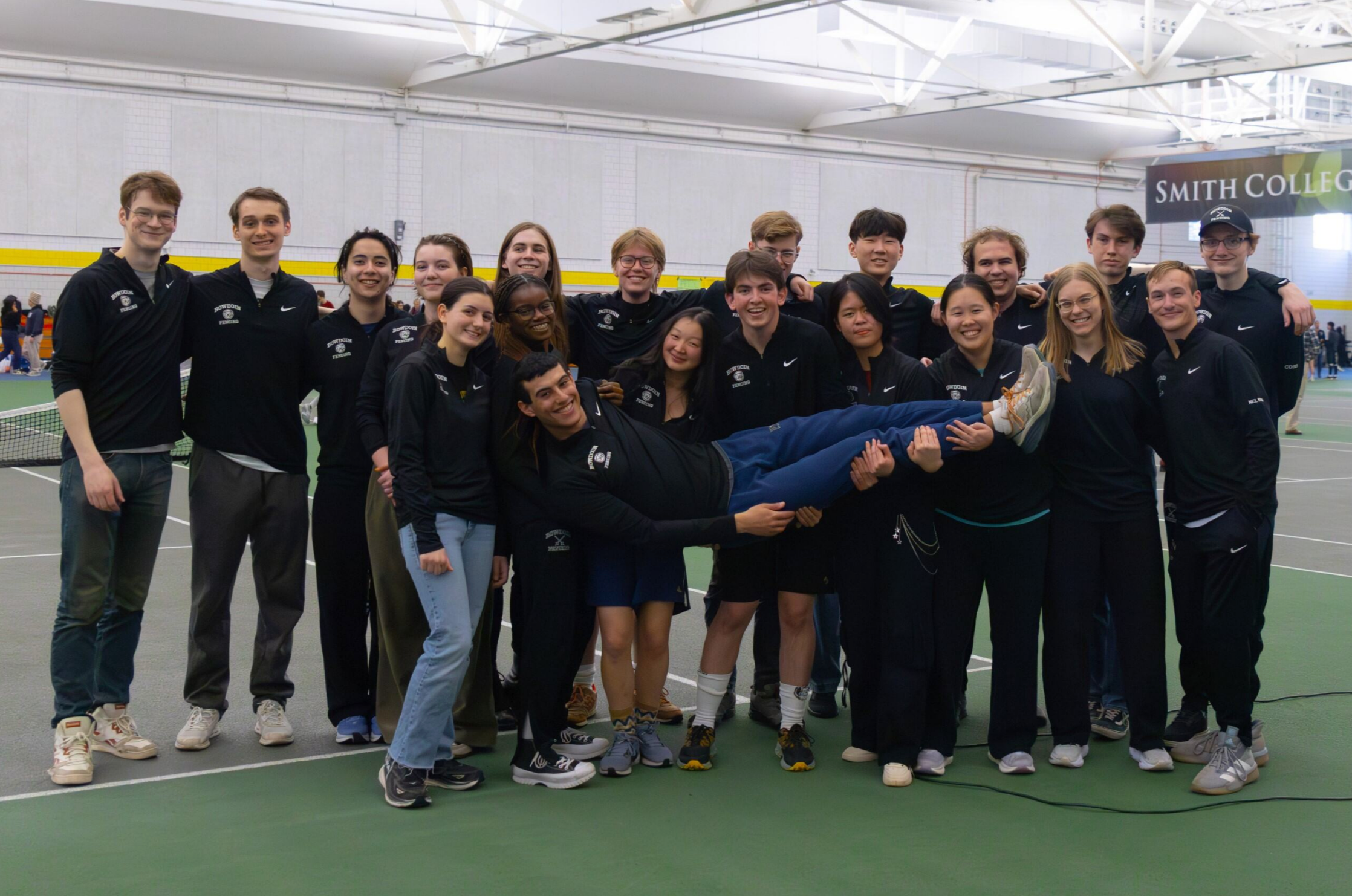 Courtesy of Elizabeth Lee
When the Bowdoin Fencing Club attended arguably the most important tournament of their season in 2023, the New England Intercollegiate Fencing Conference (NEIFC) Fall Invitational (or better known by its participants as “The Big One”), they were met with excitement as tournament officials remarked that they had not seen Bowdoin at an NEIFC tournament in over a decade. For a sport that is uniquely well-suited to the club model—structured, beginner friendly and deeply communal—fencing had long been absent from Bowdoin’s athletic landscape. That was, until captains Carlos Ruiz ’26 and Hunter Hong ’26 developed the club into what it is today: a welcoming space where students can try something entirely new while finding a genuine sense of belonging.
Walking into Tuesday practice in Sargent Gymnasium, I was immediately met with greetings and questions about my spring break. This was not because the club is unprecedentedly friendly, although it is, but because I’ve been a regular member of the fencing club since the beginning of my first year. I had debated writing this article as I wasn’t sure if my perspective as a current member of this club would be helpful, considering that this column is designed not only to introduce students to Bowdoin clubs, but also to outline the daunting experience of trying a club for the first time midsemester. But I know fencing, and even more importantly, I know about exclusion and searching for community and what safe and unsafe spaces look like. That is why I can confidently say that I am lucky enough to have joined this community.
I started fencing when I was 11 and quit when I was 14, disillusioned by a hypercompetitive culture shaped in part by the pressures of college recruiting. At my old club, parents of seven-year-olds openly discussed how fencing would one day help their children gain admission to elite universities. I had only attended Bowdoin Fencing Club’s interest meeting (fencing on the Art Museum’s steps, pretty cool) because of a both nostalgic and masochistic urge. Immediately, I realized that Bowdoin Fencing was different compared to my first fencing club. Most members of the club had never fenced before coming to Bowdoin. There was no expectation of prior experience, no pressure to attend every practice and no sense of hierarchy between beginners and more experienced fencers. Instead, there was an emphasis on learning, improvement and, most importantly, enjoyment.
The club practices three times a week—Tuesday, Thursday and Saturday evenings, often preceded by a group dinner. Each session lasts about two hours and follows a consistent structure: a warm-up, followed by drills focused on footwork and bladework, and ending with sparring. The rhythm of practice offers a welcome break from academic stress as a space dedicated to movement, strategy and connection with others.
Beyond practice, the team regularly travels to both individual and team tournaments. Having attended more than ten competitions with the club, I can confidently say that the experience is unlike anything else. There is a unique energy in fencing alongside teammates who cheer you on from the sidelines, celebrating each touch and offering encouragement after every bout. In a sport that could easily feel individualistic, Bowdoin Fencing has cultivated a strong sense of collective support.
There is also something undeniably compelling about fencing itself. It is fast-paced, strategic and, quite simply, cool. It is also a sport that becomes far less accessible after college, making opportunities like this all the more valuable. For many students, the club offers a rare chance to engage with something entirely new in a low-pressure environment.
On that Tuesday practice, arriving slightly late, I paused for a moment before joining in. In one corner, Hong patiently guided a newcomer through the fundamentals of stance and movement. Across the room, the rest of the team moved through warm-ups together, laughing and encouraging one another. It was a snapshot of how far the club has come—from near nonexistence to a thriving community where dozens of students gather each week to learn, compete and “stab or be stabbed.”
Looking ahead, Ruiz hopes that the club’s defining qualities will endure beyond his time at Bowdoin.
“I really just hope that it continues to be that opening and welcoming community for people who maybe don’t have another club sport, or they don’t want to keep playing the same sport they did in high school,” he said. “It gives them the opportunity to be active, be healthy and make friends—to find a community of people they enjoy spending time with. As long as it continues to do that, it will continue to thrive.”
In many ways, Bowdoin Fencing’s revival is not just about the return of a sport, but the creation of a space—one where curiosity is encouraged, effort is celebrated and community comes first.
Comments
Before submitting a comment, please review our comment policy. Some key points from the policy: